The Best Pitcher in Little League may be a Girl

July 27, 2010 by  
Filed under baseball, the latest

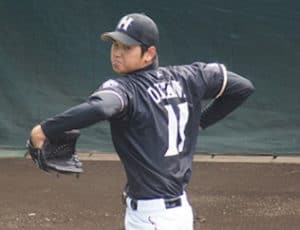
In 60 innings of pitching for her Little League baseball team in Plant City, Florida, Chelsea Baker has struck out 127 batters.  With a lively fastball and a knuckler taught to her by knuckleball legend Joe Neikro, Chelsea has led her team with a record of 12 & 0 in her pitching starts this season.  In addition to her dominating pitching skills, she can hit.  Last year her batting average was .604.

Often encouraged to play softball, especially by opposing team’s parents, Chelsea’s first love is baseball.  Her teams have won multiple city championships over the past couple of years along with two District Championships.  Chelsea hopes to one day play professional baseball.

ENJOY THIS ESPN VIDEO

25 Youth Baseball Practice Plans — Be ready for every practice in 5 minutes and get the most from your team! With complete plans for each practice, you’ll be ready to go, and can relax and enjoy the season. Go to www.coachingwhiz.com

Wiffle Ball: The Backyard Pastime

July 13, 2010 by  
Filed under baseball, the latest

Summertime is Wiffle Ball season.  With its distinctive plastic ball, featuring 8 holes on one side, and its thin yellow bat; Wiffle Ball is a summer tradition in many neighborhoods.

The bat and ball’s construction seem to make it a perfect fit in backyard fields for several reasons.  It takes a well-hit ball to make it out of your yard, house windows are less likely to break, there are fewer injuries than with traditional baseball, and its hard for bigger players to overpower smaller players with power.

Wiffle Ball BatWiffle Ball was invented in 1953 in Fairfield, Connecticut.  When 12-year-old David A. Mullany and a friend were playing baseball with a plastic golf ball and a broom handle, his dad, David N. Mullany, had an idea after watching his son try to throw a curve ball with the plastic golf ball.  Reasoning that everyone would like to throw a curve ball that really curved, he had the idea to make a plastic ball that would easily curve.  Using plastic ball from a friend’s factory, he started making prototypes of balls with unequal weight on their sides.  He cut out holes on one side of the balls, and learned that in addition to the number of holes, the shape of the holes was important as well.  The ball that curved the best had 8 oval shaped holes on the top half and the bottom was solid.

A former college and semi-pro pitcher, Mullany sat down to write rules for his new game.  He needed a name for the game.  When he asked his son what they call the game they played in the backyard, his son replied, “Wiffle.  When you miss it, it’s a wiff.”  So, “Wiffle Ball” it was.

Taking a second mortgage on his house, Mullany went about marketing the new game.  It quickly caught on.  In the 1960s, it was hard to find a house that didn’t own a Wiffle Ball and bat.  Wiffle Ball’s popularity is apparently here to stay.  Today, there are Wiffle Ball leagues, tournaments and national championships.

The Mullany’s, 3rd generation owners, still run the company.  Stephen A. Mullany, a V.P. with the company and grandson of the founder, notes, “You get people who played as kids, and then play with their kids, and then will play with their grandchildren.  You can play right across the board.  You don’t have to be Nolan Ryan.”

Wiffle Ball is available at Sports Authority, Kmart, Toys R Us and at mom-and-pop sporting goods and toy retailers across the country.  You can read more about the product at their website:  www.wiffle.com.

One Wiffle Ball pitcher you don’t want to face

25 Youth Baseball Practice Plans — Be ready for every practice in 5 minutes and get the most from your team! With complete plans for each practice, you’ll be ready to go, and can relax and enjoy the season. Go to www.coachingwhiz.com

“Who’s on First” — Abbott and Costello

June 30, 2010 by  
Filed under baseball, the latest

Comments Off

Abbott and Costello were an American comedy duo who performed on radio, TV and in films predominantly during the 1940s and 1950s. William “Bud” Abbot and Lou Costello are now featured in the Baseball Hall of Fame for their rendition of one of the most famous comedy bits: “Who’s on First.”

Abbot & Costello’s “Who’s on First?” routine from the 1945 movie “The Naughty Nineties

There are many versions of “Who’s on First,” as the comedians sometimes shortened the act to fill various time requests.  Here’s the written transcript to one performance.

——————–

Abbott: Well, Costello, I’m going to New York with you. Bucky Harris the Yankee’s manager gave me a job as coach for as long as you’re on the team.

Costello: Look Abbott, if you’re the coach, you must know all the players.

Abbott: I certainly do.

Costello: Well you know I’ve never met the guys. So you’ll have to tell me their names, and then I’ll know who’s playing on the team.

Abbott: Oh, I’ll tell you their names, but you know it seems to me they give these ball players now-a-days very peculiar names.

Costello: You mean funny names?

Abbott: Strange names, pet names…like Dizzy Dean…

Costello: His brother Daffy

Abbott: Daffy Dean…

Costello: And their French cousin.

Abbott: French?

Costello: Goofe’

Abbott: Goofe’ Dean. Well, let’s see, we have on the bags, Who’s on first, What’s on second, I Don’t Know is on third…

Costello: That’s what I want to find out.

Abbott: I say Who’s on first, What’s on second, I Don’t Know’s on third.

Costello: Are you the manager?

Abbott: Yes.

Costello: You gonna be the coach too?

Abbott: Yes.

Costello: And you don’t know the fellows’ names.

Abbott: Well I should.

Costello: Well then who’s on first?

Abbott: Yes.

Costello: I mean the fellow’s name.

Abbott: Who.

Costello: The guy on first.

Abbott: Who.

Costello: The first baseman.

Abbott: Who.

Costello: The guy playing…

Abbott: Who is on first!

Costello: I’m asking you who’s on first.

Abbott: That’s the man’s name.

Costello: That’s who’s name?

Abbott: Yes.

Costello: Well go ahead and tell me.

Abbott: That’s it.

Costello: That’s who?

Abbott: Yes. PAUSE

Costello: Look, you gotta first baseman?

Abbott: Certainly.

Costello: Who’s playing first?

Abbott: That’s right.

Costello: When you pay off the first baseman every month, who gets the money?

Abbott: Every dollar of it.

Costello: All I’m trying to find out is the fellow’s name on first base.

Abbott: Who.

Costello: The guy that gets…

Abbott: That’s it.

Costello: Who gets the money…

Abbott: He does, every dollar of it. Sometimes his wife comes down and collects it.

Costello: Who’s wife?

Abbott: Yes. PAUSE

Abbott: What’s wrong with that?

Costello: I wanna know is when you sign up the first baseman, how does he sign his name?

Abbott: Who.

Costello: The guy.

Abbott: Who.

Costello: How does he sign…

Abbott: That’s how he signs it.

Costello: Who?

Abbott: Yes. PAUSE

Costello: All I’m trying to find out is what’s the guys name on first base.

Abbott: No. What is on second base.

Costello: I’m not asking you who’s on second.

Abbott: Who’s on first.

Costello: One base at a time!

Abbott: Well, don’t change the players around.

Costello: I’m not changing nobody!

Abbott: Take it easy, buddy.

Costello: I’m only asking you, who’s the guy on first base?

Abbott: That’s right.

Costello: OK.

Abbott: Alright. PAUSE

Costello: What’s the guy’s name on first base?

Abbott: No. What is on second.

Costello: I’m not asking you who’s on second.

Abbott: Who’s on first.

Costello: I don’t know.

Abbott: He’s on third, we’re not talking about him.

Costello: Now how did I get on third base?

Abbott: Why you mentioned his name.

Costello: If I mentioned the third baseman’s name, who did I say is playing third?

Abbott: No. Who’s playing first.

Costello: What’s on base?

Abbott: What’s on second.

Costello: I don’t know.

Abbott: He’s on third.

Costello: There I go, back on third again! PAUSE

Costello: Would you just stay on third base and don’t go off it.

Abbott: Alright, what do you want to know?

Costello: Now who’s playing third base?

Abbott: Why do you insist on putting Who on third base?

Costello: What am I putting on third.

Abbott: No. What is on second.

Costello: You don’t want who on second?

Abbott: Who is on first.

Costello: I don’t know. Together: Third base! PAUSE

Costello: Look, you gotta outfield?

Abbott: Sure.

Costello: The left fielder’s name?

Abbott: Why.

Costello: I just thought I’d ask you.

Abbott: Well, I just thought I’d tell ya.

Costello: Then tell me who’s playing left field.

Abbott: Who’s playing first.

Costello: I’m not…stay out of the infield!!! I want to know what’s the guy’s name in left field?

Abbott: No, What is on second.

Costello: I’m not asking you who’s on second.

Abbott: Who’s on first!

Costello: I don’t know. Together: Third base! PAUSE

Costello: The left fielder’s name?

Abbott: Why.

Costello: Because!

Abbott: Oh, he’s center field. PAUSE

Costello: Look, You gotta pitcher on this team?

Abbott: Sure.

Costello: The pitcher’s name?

Abbott: Tomorrow.

Costello: You don’t want to tell me today?

Abbott: I’m telling you now.

Costello: Then go ahead.

Abbott: Tomorrow!

Costello: What time?

Abbott: What time what?

Costello: What time tomorrow are you gonna tell me who’s pitching?

Abbott: Now listen. Who is not pitching.

Costello: I’ll break you’re arm if you say who’s on first!!! I want to know what’s the pitcher’s name?

Abbott: What’s on second.

Costello: I don’t know. Together: Third base! PAUSE

Costello: Gotta a catcher?

Abbott: Certainly.

Costello: The catcher’s name?

Abbott: Today.

Costello: Today, and tomorrow’s pitching.

Abbott: Now you’ve got it.

Costello: All we got is a couple of days on the team. PAUSE

Costello: You know I’m a catcher too.

Abbott: So they tell me.

Costello: I get behind the plate to do some fancy catching, Tomorrow’s pitching on my team and a heavy hitter gets up. Now the heavy hitter bunts the ball. When he bunts the ball, me, being a good catcher, I’m gonna throw the guy out at first. So I pick up the ball and throw it to who?

Abbott: Now that’s the first thing you’ve said right.

Costello: I don’t even know what I’m talking about! PAUSE

Abbott: That’s all you have to do.

Costello: Is to throw the ball to first base.

Abbott: Yes!

Costello: Now who’s got it?

Abbott: Naturally. PAUSE

Costello: Look, if I throw the ball to first base, somebody’s gotta get it. Now who has it?

Abbott: Naturally.

Costello: Who?

Abbott: Naturally.

Costello: Naturally?

Abbott: Naturally.

Costello: So I pick up the ball and I throw it to Naturally.

Abbott: No you don’t you throw the ball to Who.

Costello: Naturally.

Abbott: That’s different.

Costello: That’s what I said.

Abbott: you’re not saying it…

Costello: I throw the ball to Naturally.

Abbott: You throw it to Who.

Costello: Naturally.

Abbott: That’s it.

Costello: That’s what I said!

Abbott: You ask me.

Costello: I throw the ball to who?

Abbott: Naturally.

Costello: Now you ask me.

Abbott: You throw the ball to Who?

Costello: Naturally.

Abbott: That’s it.

Costello: Same as you! Same as YOU!!! I throw the ball to who. Whoever it is drops the ball and the guy runs to second. Who picks up the ball and throws it to What. What throws it to I Don’t Know. I Don’t Know throws it back to Tomorrow, Triple play. Another guy gets up and hits a long fly ball to Because. Why? I don’t know! He’s on third and I don’t give a darn!

Abbott: What?

Costello: I said I don’t give a darn!

Abbott: Oh, that’s our shortstop.

Costello: (makes screaming sound)

###

25 Youth Baseball Practice Plans — Be ready for every practice in 5 minutes and get the most from your team! With complete plans for each practice, you’ll be ready to go, and can relax and enjoy the season. Go to www.coachingwhiz.com

BOOK EXCERPT: Willie Mays: The Life, The Legend by James S. Hirsch

May 5, 2010 by  
Filed under baseball, the latest

Comments Off

Considered by many baseball experts to be the best all-around player of all time, Mays was selected for the Baseball Hall of Fame in his first year of eligibility.  He appeared in the All-Star game 24 times and won 2 MVP awards.  Sports Feel Good Stories is proud to present a book excerpt from Willie Mays: The Life, The Legend by James S. Hirsch, authorized by Willie Mays.

—————————————

Prologue

On May 24, 1951, a young center fielder who had dazzled crowds in
the minor leagues left Sioux City, Iowa, traveling light: a change
of clothes and some toiletries, his glove, his spikes, and his two favorite
thirty-four-ounce Adirondack bats. The twenty-year-old Alabaman was
driven to the airport in Omaha, Nebraska, where he bought a ticket from
United Airlines for an all-night journey, landing in New York early the following
day. He had been there once before, three years earlier, to play in
the Polo Grounds with the Birmingham Black Barons. On that team the
veterans had protected him, instructing the youngster on how to dress,
act, and play ball; on how to represent his team, his city, and his race. But
now, on a sunny morning at La Guardia Airport, Willie Mays slid into the
back seat of a taxi and pressed his face against the window, alone. He had
never seen so many people walk so fast in his life.

Mays was driven to the midtown offices of his employer, the New York
Giants, and promptly escorted inside. At 5-foot-11 and 160 pounds, he
did not yet have the sculpted body that would later evoke comparisons
to Michelangelo’s finest work. He was taut and fluid, but not physically
imposing. Only his rippling forearms and massive hands, each one large
enough to grip four baseballs, hinted at his crushing strength.
Mays entered the office of Horace C. Stoneham, the Giants’ shy but personable
owner, who was rarely seen in the clubhouse or interviewed by
reporters. He had thinning hair, a ruddy complexion, and thick-framed
glasses, and while his counterpart at the Brooklyn Dodgers—Walter
O’Malley—had the aura of a corporate chieftain, Stoneham more closely
resembled a rumpled bank manager who preferred the intimacy of his
office to the bustle of the lobby. Alcohol was his most notorious vice, but
undue loyalty wasn’t far behind. He liked to hire family members and fellow
Irishmen and hated to trade or cut Giants who had lost their usefulness.

Willie Mays:  The Life, The LegendBut give him his due: he cared deeply about his players, about their finances, their family, and their well-being, and he would help them as he would his own children. He also needed good players, and he never needed one more than he needed Willie Mays.

The Giants were a family business, and Stoneham was only thirty-twowhen he inherited the team after his father’s death in 1936. At the time, the Giants were the National League’s preeminent franchise, having won eleven pennants and four World Series since the turn of the century. They captured consecutive pennants in Horace’s first two years at the helm—clubs essentially assembled by his father—but the team grew stale, fan interest declined, and championships became a memory.

In 1951, after a dismal start, the Giants risked, not just a losing season, but irrelevance or even ruin. The franchise had lost money in each of the last three years and had been eclipsed by New York’s other baseball teams.  Their blood rival, the Brooklyn Dodgers, had won three pennants in the last decade, with Ebbets Field featuring social history as well as fierce competition.

Since 1947, the Dodgers had been led by Jackie Robinson, whose
breaking of the color barrier, combined with electrifying play, made for riveting
theater. Yankee Stadium, meanwhile, was its own showcase of dominance
and glamour: five World Series championships in the past decade,
one deity in center field. Joe DiMaggio would turn thirty-seven in 1951, his
final season, after which the landscape would be ready for a new hero. But
the Yankees had already found their next wunderkind in the zinc mines
of Oklahoma. The rookie Mickey Mantle—his brawn and speed exhaustively
chronicled in spring training, his alliterative name tripping off the
tongues of wide-eyed reporters, his blond crew cut and blue eyes capturing
the hearts of young fans—was poised to be Gotham’s next baseball god.

Who needed the Giants?

“Glad you could make it so soon,” Stoneham told Mays as the rookie
entered his office. “But they aren’t glad where you came from.”
Mays, confused, said nothing.

“The Minneapolis fans,” Stoneham said. “They’re upset.” Mays had
begun the season with the Minneapolis Millers, a Giants’ farm club. In
thirty-five games, he had hit .477; one searing drive, in Milwaukee, punctured
a hole in the fence. Stoneham told Mays that the Giants were putting
an ad in a Minneapolis newspaper to apologize for taking the local team’s
prodigy. “We’re going to tell them,” Stoneham said, “that you’re the answer
to what the Giants have got to have.”

Mays remained silent.

“It’s unusual, I know,” Stoneham said, “but—is something the matter?”
Mays finally found his voice, high-pitched and earnest: “Mr. Stoneham,
I know it’s unusual, but what if—”

“What if what?”

“What if I don’t make it?”

Stoneham pointed to a folder on his desk, stuffed with papers. Mays
saw his name on the cover.

“You think we just picked your name out of a hat?” Stoneham demanded.
“You think we brought you up because somebody saw your name in a
headline one day in Louisville or Columbus or Milwaukee or Kansas City?
You think nobody’s been watching you? You think managers haven’t been
up nights doing progress reports, that our own scouts haven’t checked you
out time and again? You think all of this is something somebody dreamed
up in the middle of the night two days ago?”

Mays stood there, unsettled by the barrage.

The owner pushed a buzzer beneath his desk and spoke into the intercom:
“Ask Frank to come in here.” He looked at Mays. “Got luggage?”
“No, sir. It’s still back in Minneapolis. They’re sending it on.”
Stoneham nodded and pushed the buzzer again. “Ask Brannick to save
out seventy, eighty dollars,” he said, referring to the team’s dapper traveling
secretary, Eddie Brannick. Then to Mays: “Buy yourself a couple
things—underwear, shirts, socks—until your stuff gets here.”
The door opened, and Frank Forbes, a black fight promoter hired by the
Giants to be Mays’s chaperone, walked through. “Here he is,” Stoneham
said. “Take him with you.” He extended his hand. “Good luck, Willie.”

“Thank you, Mr. Stoneham. I hope I can get into a few games, get a few
chances to help. I hope you won’t be sorry.”

“I won’t be sorry.” Stoneham turned away, then suddenly turned back.
“Get in a few games? Get a few chances to help? Don’t you know you’re
starting tonight?”

Mays’s mouth went dry. “Starting? Where?”
Stoneham glared at him, then laughed. “Center field!” he barked.

“Where else?” He looked at Forbes. “Get him out of here, Frank.”

The Giants were already in Philadelphia, where they would begin a
three-game series that night at Shibe Park. Forbes and Mays hustled to
Pennsylvania Station, boarded a train, and sat in a Pullman parlor car.
Mays had seen the opulent coaches in the movies, the ubiquitous Negro
porter fawning over white passengers. But now Mays was the passenger,
and the swivel armchairs were layered with meaning. His father, Willie
Howard Mays, Sr., had been a Pullman porter, making beds in the sleeping
cars chugging out of Birmingham. The train’s quiet rhythm lulled the
white passengers to sleep, and the elder Mays, wearing a white jacket,
would listen to the sound of the whistle at night, signaling which engineer
was driving the train. “He’d lay his hand on that rope,” he said, “and it was
like an autograph.”

Now his son sat in a Pullman car, heading south on an eighty-five-mile
trip that the young man could not have envisioned even a month earlier,
with the clicking of the wheels saying to Willie: You’re a Giant. You’re a
Giant. You’re a Giant. You’re a Giant. . . .

Willie Mays began his major league career poorly—he went 1-for-26—
but he slowly found his way. He blasted home runs over the lights at the
Polo Grounds, chased down fly balls in the cavernous outfield, unleashed
deadly throws to the plate, and ran the bases with daring glee. But what
mesmerized his teammates, what captivated the crowds, was his incandescent
personality, bringing, his manager said, “a contagious happiness that
gets everybody on the club” and moving Branch Rickey to observe that
the rookie’s greatest attribute “was the frivolity in his bloodstream [that]
doubled his strength with laughter.”

Newspapers promptly hailed the “Negro slugger” as “the Amazing
Mays” and “the Wondrous Willie,” a unique blend of speed and power
who performed with childlike exuberance. But the most prescient account
appeared on June 24 in the New York Post—one month after his debut—
which chronicled a stunning baserunning feat as “part of the legend” of
this new marvel.

Long before his Rookie of the Year Award, long before his two Most
Valuable Player awards and his one batting title and his 12 Gold Gloves,
long before his 24 All-Star Games and his 3,283 hits and his 660 home
runs, and long before “the Catch,” Willie Mays was a legend. And by the
time he retired, he was an American icon whose athletic brilliance and stylistic
bravado contributed to the assimilation of blacks during the turbulent
civil rights era, a distinctive figure of ambition, sacrifice, and triumph
who became a lasting cultural touchstone for a nation in search of heroes.
Mays represented the quintessential American dream. He was the poor
Depression-era black kid from the segregated South who overcame insuperable
odds to reach the pinnacle of society, and he succeeded by hewing
to the country’s most cherished values—hard work, clean living, and perseverance.

He also benefited from great timing. Had he been born fifteen
or even ten years earlier, he would have played most if not all of his career
in the Negro Leagues, probably remembered, along with Josh Gibson,
Oscar Charleston, and Cool Papa Bell, as a mythic but ill-defined figure
who was victimized by America’s racial hypocrisy. Had he been born ten
years later, he would never have been part of perhaps the most celebrated
era in sports history—New York in the 1950s—when baseball dominated
the sports culture, integrated teams stole the march on civil rights, ballparks
sponsored miracles, and legends were born.

Mays was the youngest black player to reach the major leagues, and
his ascension in 1951 coincided with other powerful social and economic
forces. Television, for one, was emerging as a transformative medium in
sports. Fans across the country could now watch baseball in real time,
the grainy black-and-white images turning an anonymous player into a
national hero (Bobby Thomson, following his “Shot Heard ’Round the
World,” being the most conspicuous example). Several decades would pass
before baseball highlights became daily fare, but television still contributed
to Mays’s popularity by broadening access to his spellbinding performances:
the spinning catches followed by laser throws; the churning legs
rounding second base, his feet barely brushing the dirt, his cap sailing off
like a flimsy derby in a windstorm; the giddy smile that bespoke his love
for the game. Mays was a completely new archetype, the first five-tool
player before anyone else had even opened the shed.* But he always saw
himself as an entertainer first, and television gave him a national stage.

Mays was an unlikely celebrity, but he flourished in an increasingly
intense media culture. He appeared on television variety shows, talk
shows, sitcoms, and in documentaries—timid, to be sure, but also handsome,
respectful, and self-deprecating. Magazines splashed him on their
covers while recording artists celebrated him in song, screenwriters
immortalized him in films, and cartoonists grandly etched him in print.
He was the game’s first true international star, playing before huge crowds
from Mexico to Venezuela to Japan in winter league games or exhibitions.
He was a worthy antidote to Ralph Ellison’s lament that the Negro was the
“Invisible Man.”

Mays’s star power made him the most luminous prize in baseball’s great
migration westward in 1958, when the Giants and Dodgers moved to California.
This shift symbolized the broader demographic tilt of the country
and turned the national pastime into a transcontinental enterprise. Mays
benefited from baseball’s entrance into new markets and new stadiums
with new corporate sponsors, all of which helped make him the highest
paid player in the league, topping the magical $100,000 figure in 1963. He
left the game ten years later, just as the system that had restricted players
from the open market was about to collapse. A new era of baseball was
about to begin.

Mays’s career exquisitely overlapped one of the great social movements
in American history—the modern civil rights era. One of the most recognized
and admired black people of that period, Mays led by example, yet
his role in the movement became the most controversial part of his leg-

* A five-tool player can hit for average, hit for power, run, catch, and throw.

acy. In some quarters, he was scorned as a “do-nothing Negro” or an Uncle
Tom for refusing to actively support civil rights or even to speak out when
he himself was victimized or his hometown of Birmingham was terrorized.

But Mays countered racial discrimination on his own terms in ways
that he understood—as a role model who never drank or smoked, who
avoided scandal, and who gave his time and money to children’s causes;
as a player who excelled through discipline, preparation, and sacrifice;
and as a man who brought Americans together through the force of his
personality and his passion for the game. Mays knew his influence, particularly
on the bigots. “I changed the hatred to laughter,” he said. “That’s
what I think.”

Mays also had his disappointments. His first marriage ended badly, with
a painful public divorce and an adopted son with whom he is no longer
close. (His second marriage, however, to a beautiful, educated professional
has been a source of love and strength for more than thirty-five
years.) Financial troubles, caused mostly by overspending, dogged him
through his playing days. Bad financial advice cost him as well. He was
one of the most durable players in history, but the pressures took an enormous
toll, physically and emotionally, causing several hospitalizations
during his career. At times gruff and impatient, Mays was not the easiest to
approach, and his desire for privacy contributed to flare-ups with reporters,
some of whom attacked him in print. The give-and-take of friendships
was not his strength. His distrust of others, born of betrayals and affronts,
ran deep, and strangers with uncertain motives needed to tread lightly
when they entered his space.

Who is Willie Mays? It’s a fair question. He has a small circle of loyal
friends who love him unconditionally, but even they rarely see his wounds.
To his fans, he has long been an enigma who spoons out just enough biographical
morsels to nourish their curiosity but not satisfy their appetite.

The pity is that the most appealing parts of Willie Mays have nothing
to do with baseball.

But baseball is his rightful legacy, and now, almost sixty years after he
nervously asked Horace Stoneham if he was good enough, his accomplishments
loom larger than ever. Baseball has never been more popular,
but the steroid era—an endless train of congressional hearings, legal
maneuverings, and hollow pledges of reform—has tainted records, vindicated
cynics, and placed the biggest names under suspicion.

No one ever doubted Willie Mays. He not only played the game as well
as anyone who’s ever taken the field but he also played it the right way. He is now revered for capturing the joy and innocence of a bygone era, a transcendent
figure who is compared to the most important men in American
history. In the presidential campaign of 2008, Barack Obama emphasized
his biracial appeal by pairing John F. Kennedy with Martin Luther King,
Jr.; Abraham Lincoln with Willie Mays.

Heady company indeed, though maybe not a stretch for a man who
seemed to embody the impossible. “The first thing to establish about Willie
Mays,” Jim Murray once wrote, “is that there really is one.”

###

Excerpted from Willie Mays: The Life, The Legend by James S. Hirsch, Authorized by Willie Mays. Copyright © 2010 by James S. Hirsch. Excerpted with permission by Scribner, a Division of Simon & Schuster, Inc.

—————————————

Willie Mays:  The Life, The Legend available at Amazon.com

25 Youth Baseball Practice Plans — Be ready for every practice in 5 minutes and get the most from your team! With complete plans for each practice, you’ll be ready to go, and can relax and enjoy the season. Go to www.coachingwhiz.com

Brian Kownacki and the Fordham Flip

April 23, 2010 by  
Filed under baseball, the latest

Despite Fordham University’s baseball team record of 13 & 23, their shortstop Brian Kownacki is an Internet sensation.  Trying to make it home from first base on a single and a bobbled ball in the outfield, Kownacki scored by performing a front flip over Iona’s catcher and landing on home plate!  The YouTube clip has been viewed by more than one million people and ESPN rated it the top play of the day.

Prior to his magical leap, the game had been an odd one for Kownacki.  He entered the game in the 5th inning and was hit by a pitch on the wrist.  In the 8th inning where he made the leap, he batted twice as Fordham batted around the order and was hit by pitches in both instances.  Given the lumps he had already taken in the game, it’s no surprise that Kownacki wanted to avoid contact with the Iona catcher.

ENJOY THIS VIDEO

Baseball’s Back!

April 14, 2010 by  
Filed under baseball, the latest

Comments Off

Home opener, first pitch, first hit, first home run and first hot dog!  With baseball season just getting underway, there are all kinds of firsts.  No more so than at a new park like the Twins’ Target Field.  When the Twins took on the Red Sox at the home opener at Target Field on Monday, balls were retrieved for the first pitch, the first hit and the first home run.

Here’s a video clip of an interview with a fan who caught the first home run at Target Field off Jason Kubel’s bat

In Chicago, when Bill Murray was unable to be in attendance to throw out the first pitch, the Cubs ended up asking a random family of 4 to carry out the ceremonious task.  Read the Sluga’s family story of a memorable home opener at the DailyHerald.

« Previous PageNext Page »