
Who doesn’t love a good college football or NFL game? We spend Saturdays glued to the television watching College Football. Sundays, Mondays, and Thursdays are devoted to a heavy dose of NFL games. We think about football pretty much 24-7.
The Story Behind College Football and the NFL
When you’re thinking about the game, it’s natural to wonder about the history of football. Football’s closest predecessor, Rugby, became popular in England in the mid-1800s. It’s believed that American, Australian, and Canadian Football all evolved from Rugby. So, read on to find the story behind football.

How College Football Started
Using rules loosely based on soccer and rugby, the first American College Football game was played in 1869 with a match between Rutgers and Princeton. Some rule changes were initiated in the 1880s by a notable College player named Walter Camp. These new rules truly changed the game of American Football we are familiar with today’s football field dimensions.
Camp is considered the father of modern-day football. While the forward pass had been attempted as early as 1876, the play wasn’t legalized until 1906. It was then that the first legal forward pass was thrown.
The first College Football fields were called Gridirons because of the line pattern drawn on the field. From the start of College Football, the game was played in two 45-minute halves. Initially, the only way to score was to bat or kick the ball into your opponent’s goal. This received one point, so early College Football game scores looked more like baseball game scores. Initially, gridirons were 140 yards long and 70 yards wide.
Standardization of Football Rules
In 1873, three colleges, including Rutgers, Princeton, and Yale, met to create a standardized set of rules for playing College Football. Harvard decided not to attend the rules meeting because they disagreed with the changes. So, they continued playing by their own rules.
The term “touchdown” originates from a rugby rule where a player touches the ball down past the goal line. This allowed the team to kick a goal. At this point, there were no end zones. If the team missed, the touchdown was not awarded.
In 1876, Harvard, Yale, Princeton, and Columbia adopted a new set of rules that more closely resembled the game that is played today. Yale held off on participating in the new Intercollegiate Football Association until 1879.
They objected to the number of players the new rules allowed on a team. By 1980, teams could field 11 players and have 25 players total on the sidelines. Early rules required teams to advance the ball five yards in three downs to earn a first down.
You might like Four-Time Cancer Survivor Plays First D1 Football Game.
College Early Scoring Rules
The points were substantially different from today’s game, with four points for a touchdown, two points for points after a touchdown, two points for safety, and five points for field goals. In 1981, the gridiron was reduced to 120 yards long (including end zones) by 53 ½ yards wide. At this time, there were just two officials to judge a game.
As it was known in Rugby, during the late 1880s blocking or “interference” was legalized. Team members could now block for the player running with the ball. Interference or blocking remains illegal in the Rugby rules.
Blocking led to the creation of unique formations, such as the flying V, where players would interlock their arms and travel down the field as a single unit, mowing over their opponents. As you’ll find out below, this style of blocking had a dramatic impact on the game.
See How Long Is A Football Game?
Finalized Scoring System for College Football
By 1912, the scoring points were finalized with 6 points for a touchdown, and a kicking point after conversion was worth 1 point. A running or passing conversion was worth 2 points, and safety was also worth 2 points. The roughing the passer penalty was initiated in 1914, and by 1918, receivers were allowed to catch the ball anywhere on the field. Previously, “catching zones” limited the areas where receivers could catch the ball.
Establishment of College Football Conferences
College Football continued to grow, and different sections of the country were organized into conferences, including the American Athletic Conference, Atlantic Coast, Big 12, Big Ten (now with 14 teams), Conference USA, Independents (FBS), Mid-American, Mountain West, Pac 12, Southeastern, Sun Belt, and more.
Conference play would eventually lead to the creation of Bowl Games that pitted Division winners against each other. While Soccer is called football everywhere except in the United States, and it is the most popular sport in the world, American football (the kind we watch on Saturdays and Sundays) is the most popular sport in the United States.
The Year College Football Almost Died
As the popularity of College Football grew, so did the violence of the sport. The newly legalized blocking styles meant that teams would meet in violent crashes that often cause life-altering injuries or even death. In 1905, 19 players (23 by some accounts) were killed playing College Football, and President Theodore Roosevelt threatened to eliminate the game unless some changes were made.
In December of that year, 62 colleges met to determine how the rules had to change to make the game safer. This meeting led to the creation of the National Collegiate Athletic Association (NCAA) and the institution of the forward pass in 1906.
Interlocking arm blocking was prohibited, the number of players required on the line of scrimmage was changed to seven, and a neutral zone was established between the two teams at the time of the snap. These changes led to a dramatic reduction in injuries and deaths, and the College Football game survived.
Protective Equipment Through the Years
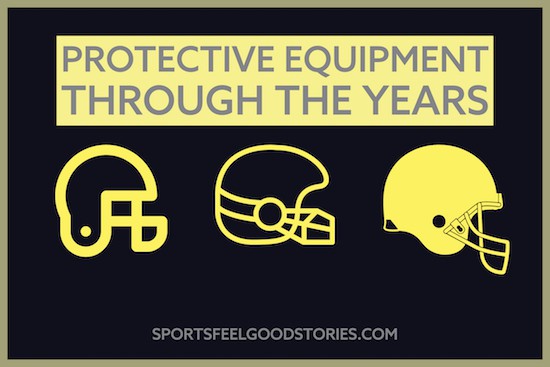
While the changes to the rules of football helped reduce the number of injuries and fatalities in the game. The addition of protective equipment also lowered injuries and helped keep players safe. Until 1893, there were no helmets. This was the source of some of the most serious injuries. It is said that the first use of helmets was in the 1893 Army-Navy game. But the helmet wasn’t a rules requirement until 1939.
The helmet slowly evolved from a crude leather “hat” that barely covered the entire head to a padded, more substantial model. The plastic helmet didn’t emerge until the 1940s, when the sporting goods company Riddell patented the design. This innovation led to the introduction of different-colored helmets and the ability to feature a team’s logo on the helmet. The helmets continue to evolve with advancements in padding and other concussion-reducing measures.
Introduction of the Face Mask
Before introducing the helmet, a nose guard or nose armor was patented in 1892 to protect the nose and teeth. Not everyone wore or even favored the new advancement, but it did protect players from the most common injury of the day, broken noses. These nose guards could be worn with or without a helmet.
This facial protection led to the development of the face mask, which began to be mass-produced on helmets in 1953. It started with a single bar across the front of the helmet and grew into the grid-like face masks we see today. As the popularity of face masks grew, the necessity of creating a penalty for grabbing them became apparent.
A Princeton student is credited with creating shoulder pads in the late 1800s. The pads were made of leather and wool and were sewn directly into a player’s uniform instead of being worn separately. Today, the pads we know worn under the uniform were designed in the early 1900s and are still made from leather with padding. Mass-produced plastic shoulder pads emerged in the 1960s.
Padding in the pants dates back to the late 1880s. Sewn directly into the pants to protect the thighs or shins, these pads have remained relatively unchanged, except that they are now made from plastic, a development that dates back to the early days of football.
How Professional Football Got Started
The beginnings of professional football date back to November 12, 1892. A gentleman named William “Pudge” Hefflefinger was given a $500 contract to play for the Allegheny Athletic Association against the Pittsburgh Athletic Club. Thus, Professional Football was born.
The game standard at the time was not to pay players, but instead to have them “volunteer” their time to play the game. However, there were no specific rules regarding payment for playing. A cash receipt from the Allegheny Athletic Association clearly shows a payment of $500 to Pudge Hefflefinger. This receipt is on display on the Professional Football Hall of Fame website. It is considered the “birth certificate” of Professional Football.
See our NFL Practice Squad Breakdown feature.
Player Compensation for Pro Football
During these early years of Professional Football, athletic clubs and Associations found clever and unique ways to compensate their players. In some cases, a team would find a job for a player. The job would have flexible hours, allowing the player to be paid for his “job” but still have amateur status when playing football.
Other times, a team would award trophies or watches to players for playing a game. The player could then pawn these prizes and keep the money. The Amateur Athletic Union attempted to regulate these practices, but every time they changed the rules, the teams found ways to circumvent them.
The 1892 game was a hallmark because it was the first time a player was openly paid by a team (Allegheny Athletic Association), and it was proof of payment. But the Pittsburgh Athletic Club was squeaky clean, either.
William Kirchner: Player and Coach
Their best player, a man named William Kirchner, was considered a professional coach because his pay increased during football season. But his workload went down at his real “job.” With pay for play out in the open, players began getting season-long contracts in 1893 and received bonuses for playing for City and Club Teams.
Also, in the 1892 game, with extensive betting and before allowing his team to take the field, the Pittsburgh Athletic coach demanded that the game be played as an exhibition with no betting. Allegheny agreed, and the game was played. Touchdowns were worth only 4 points in those days, and Allegheny won the game 4 to 0 after a touchdown from Heffelfinger.
However, some teams continued to pay “double expenses” to compensate players while still allowing them to be classified as amateurs. Something had to change. In 1897, the Latrobe Athletic Association became the first team to employ only professional, paid football players for its entire season. It would be 23 years before a viable professional football league is formed.
Pro Football Scoring Changes
In 1898, the touchdown was changed to 5 points. In 1902, the very first attempt to form a professional football league was made. The league was called the National Football League but only lasted two years. In 1904, the field goal was reduced from 5 to 4 points, and in 1909, it was again decreased to 3 points. To make the game more exciting, a touchdown was increased to 6 points in 1912.
By 1920, Professional Football needed to make some changes because it was plagued by players jumping from team to team, teams using college players who were still in school, and rising salaries. A league was formed, including the Cleveland Indians, Canton Bulldogs, Dayton Triangles, and Akron Pros. The league was named the American Professional Football Conference.
The NFL is Formed
In 1922, the league changed its name from the American Professional Football Conference to the National Football League. The Chicago Staleys became the Chicago Bears, and the league had grown to 18 teams. In 1927, to increase the league’s popularity, the number of teams was reduced from 22 to 12 and then to 10 in 1928. By 1932, the struggling NFL had dropped to just 8 Teams.
In 1933, the NFL was reorganized into two divisions with the idea of a season-long championship between the winners of each division. Rules were added to differentiate the game from college. Up until 1933, the NFL had followed college rules. In addition, three new franchises were added to the league: the Pittsburgh Pirates, the Philadelphia Eagles, and the Cincinnati Reds.
In 1936, the first organized draft of college players was held. And in 1939, the first NFL game was broadcast on television. The game that was televised was the second “Pro Bowl” game. The New York Giants (NFL Champs) are playing a team of professional all-stars.
A Series of Firsts in the 1940s
1940 – First National Network Radio Broadcast of the NFL Championship Game
1941 – The NFL installed its first Commissioner
1944 – The first time coaching from the bench is legalized
1946 – The first African Americans are signed to play in the NFL
1947 – The NFL adds a fifth official for the first time.
1948 – The first emblems are painted on the sides of helmets
1949 – For the very first time, the NFL had two 1,000-yard rushers in the same season
TV and the NFL
In 1950, the Los Angeles Rams became the first professional team to have all of their games televised. In 1951, the NFL Championship game was televised coast to coast for the first time. Joe Perry became the first running back to record 1,000-yard seasons in consecutive years.
To end the decade, in 1959, Lamar Hunt, a Dallas area businessman and oil tycoon, announced his intention to form a new professional football league. He named it the American Football League (AFL).
The 1960s were an exciting time for a change in the NFL. An agreement was reached regarding the two leagues—the NFL and AFL — to coexist. In 1961, the first professional player deliberately moved from one league to the other.
Both leagues agreed in 1962 that the grabbing of a face mask would be illegal. Lamar Hunt owned an AFL franchise in Dallas called the Dallas Texans, but by the end of the 1962 season, he decided to move the team from Dallas to Kansas City, forming the Kansas City Chiefs.
NFL and AFL Merge
In 1966, the two leagues mutually decided to merge and keep the name NFL, but have two divisions, the National Football Conference and the American Football Conference. The first NFC–AFC world championship was held in 1967, with the Green Bay Packers defeating the Kansas City Chiefs 35-10. The AFC got revenge in 1969 when the heavily favored Baltimore Colts lost to the AFL’s “Broadway” Joe Namath and the New York Jets by a score of 16 to 7.
To start the decade in 1970, the Super Bowl Trophy was renamed the Vince Lombardi Trophy. Player safety became the thrust for rules changes in the 1970s with a growing concern over injuries. The first NFC–AFC Pro Bowl was played in 1971, and in 1973, the Miami Dolphins became the first professional football team to post a perfect season at 17- 0.
NFL Players’ Strike
The 1980s and 1990s were two decades of tremendous growth in television viewership in the NFL. The Super Bowl becomes the most-watched live sporting event year in and year out. The first NFL television contract with a Cable network was signed in the 1980s. In 1982, the NFL suffered through a players’ strike. The Players Association strike lasted for 67 days and shortened the season from 16 games to 8.
NFL Europe
In 1991, the NFL launched the World League of American Football, later called the NFL Europe League and NFL Europe. The new league never quite caught on, losing money every season and operating from 1991 until 2007.
Youth Football Arm of the NFL: USA Football
The year 2000 saw the NFL and NFL Players Association launch USA Football. USA Football is a youth development organization dedicated to advancing the game of football by encouraging and teaching young players.
Attendance at NFL Games continued to rise, setting year-long records in several different years. New concussion guidelines and an alliance to coordinate medical support services for former players have been created. A fan code of conduct is also initiated.
Today, the NFL continues to emphasize concussion protocol and the need to focus on this serious issue. The NFL Pro Bowl has adopted a new format, but it is still considered an afterthought by many fans and players alike. The Los Angeles Rams transferred to Los Angeles from St. Louis, and the San Diego Chargers also transferred to Los Angeles. By 2020, the Oakland Raiders will play their games in the brand-new Allegiant Stadium in Las Vegas.
Pro Football Hall of Fame
The opening of the Professional Football Hall of Fame in Canton, Ohio, in 1963 sent a signal to football fans worldwide that professional football would be a game that would stay around for a long time. Professional football has no equal in sports from its earliest beginnings in the late 1800s to its international and unparalleled success today.
So, sit back, have an adult beverage, crack open some peanuts, cheer on your favorite team, and watch America’s game. Now, you know the story behind football.
By Tim Moodie
Tim Moodie is a writer, product designer, and inventor who stopped playing football in 8th grade. But that doesn’t stop him from being a huge football fan. Every Saturday, he cheers on his alma mater, the University of Minnesota Golden Gophers. Sundays find him glued to the TV watching the Minnesota Vikings. Like all football fans, he enjoys a well-played game and takes great pleasure in the sport’s rich history.
Extra Points
You’re on the College Football to the NFL: History of the Game page.
You might like:
A Drive Definition and Famous Scoring Drives
Offensive, Defensive, and Special Teams Football Positions Guide
