
Understanding all football positions on offense and defense is one of the more difficult things for a new football fan. It isn’t straightforward with so many players on the field and similarly dressed.
Understanding these roles on the football field will help you better understand the game. This includes the strategies and tactics teams employ to gain advantages.

Football Roles
A football team consists of three core units: offense, defense, and special teams. Within each of these units, players’ roles and responsibilities are defined by their position on the team.
This article explores the structure of a football team and describes the player positions and how they interact to achieve the overall team goal of winning football games.
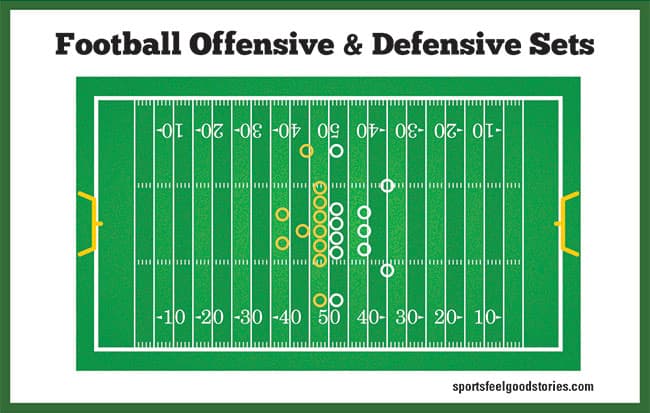
Organization of a Football Team
By rule, a football team can have 11 players on the field simultaneously. Teams assign players specific positions or roles to play. The defense, the offense, and special teams units make up the team.
You might like: NFL Logos Ranked Worst To First.
Defensive Positions
The defensive unit on a football team consists of three core areas: the defensive line, the linebackers, and the secondary—or defensive backfield.
In college and professional football, the defensive coordinator leads the Defensive team. The coordinator and the head coach are responsible for the defensive team’s strategy and execution, as well as in-game play-calling and decisions.
The job of the Defensive Coordinator and his players is to stop the opposing team’s offense by turning the ball over to their offense. This can be accomplished by tackling them short of the line to gain or taking the ball away. The interception or fumble recovery does this.
Ultimately, the defense keeps the opposing team from advancing the football down the field, scoring a touchdown, or kicking a field goal.
Check out: History of NFL and College Football.
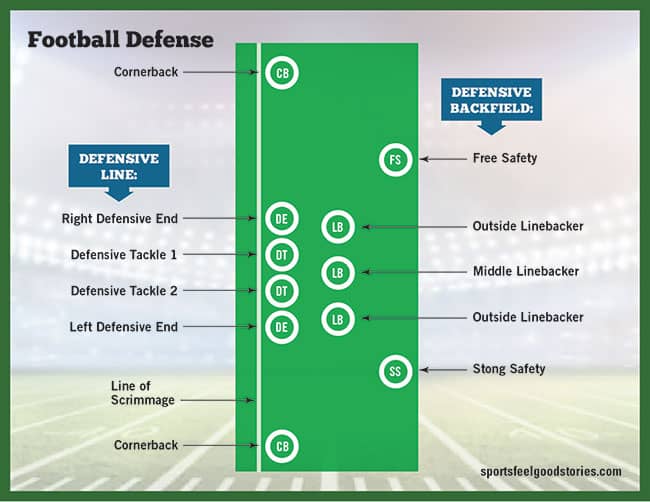
The Defensive Line
The group of players on defense that set up nearest the line of scrimmage is called the defensive line. Usually, three or four defensive linemen (depending on the defensive scheme) line up across from the offensive line with their hands on the ground.
Each defensive lineman sets up in a three-point or four-point stance before the ball snaps. They typically place either one or two hands on the ground.
See Needed: The NFL To Step Up In Stopping Gun Violence.
Standard defensive sets include the 4-3 and the 3-4 for the number of players on the defensive line and the number of linebackers behind them. The Defensive Coordinator determines the defensive set as part of the overall defensive scheme.
The defensive line usually includes two defensive tackles positioned in front of or near the center position of the offensive line. Flanking the defensive tackles are two defensive ends.
Here are definitions for each of football’s defensive positions.
Check out Fun Football Expressions.
Defensive Ends
The defensive end (DE) lines up on the outside of the defensive tackle position on either side of the defensive line.
Their job is to rush the passer and sack him behind the line of scrimmage or tackle ball carriers advancing upfield. The position requires speed and strength to maneuver around blockers and make tackles.
Typically, the most talented defensive end on the team is positioned on the right side of the defensive line to take advantage of a right-handed quarterback’s blindside.
Learn more about the AFL – American Football League
Defensive Tackles
Defensive tackles (DTs), sometimes called defensive guards, play at the center of the defensive line across from or near the offensive center position.
A defensive tackle’s job is to rush the passer and stop running plays.
In the 3-4 defense, the player lined up directly in front of the center is called a nose tackle or nose guard. While in the 4-3 defensive alignment, the tackles position themselves on either side of the offensive center.
In addition to tackling responsibilities, defensive tackle and defensive end positions use their height and jumping ability to knock down passed balls thrown by the quarterback.
Linebackers – Football Positions Explained
Moving away from the line of scrimmage, the next defensive group is the linebackers.
The linebackers can consist of three or four upright (without hands on the ground) players behind the defensive line. Their job is to tackle offensive players advancing the ball, rush the passer, cover receivers, and create turnovers.
Middle Linebacker
The middle linebacker, or “mike linebacker,” is the inside linebacker since they position themselves towards the inside or center of the play.
Outside Linebacker
The outside linebacker usually plays towards one side or another of the defensive set. Sometimes, they are called strongside or weakside linebackers, depending on the offensive use of tight ends. When a tight end is used on offense, a strongside linebacker, or “sam linebacker,” defends the tight-end side of the offense.
The weakside linebacker, or “will linebacker,” lines up on the side without a tight end. Responsibilities include blitzing the quarterback and covering receivers out of the backfield.
Cornerbacks
The cornerback (CB) position requires speed and athleticism—the cornerback lines up across from offensive receivers and attempts to disrupt or intercept the passed ball.
When the ball carrier gets past the defensive line on rushing plays, the cornerbacks attempt to contain the runner and make tackles.
Nickel Backs
Sometimes, a lineman or linebacker can be removed to use an extra defensive end, called a nickel back. The position is so-named because it is the fifth defensive back on the field.
The defense employs a dime package by adding one more nickel back to the formation (in place of another position). The second nickel back is sometimes called the dime.
Safeties – Football Positions Explained
The safeties are the last line of defense in that they are furthest from the line of scrimmage. Their job is to assist in pass coverage with cornerbacks and make tackles.
There are two types of safety: strong safety (SS) and free safety (FS).
The strong safety usually performs a role similar to the linebacker, providing support against run plays and playing closer to the line of scrimmage.
The free safety is more like an extra cornerback, quick and able to defend against deep pass plays.
Offensive Positions
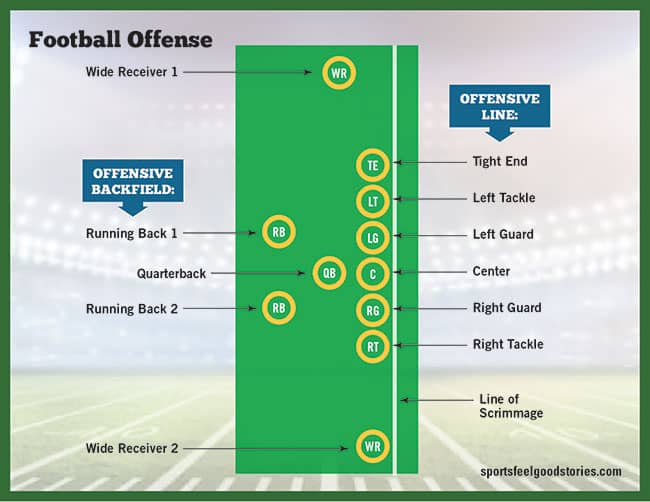
The offensive unit of a football team consists of the offensive line, the offensive backfield (including the quarterback and running backs), the tight ends, and wide receivers.
The offense is led by the Offensive Coordinator, who, along with the Head Coach, determines the offensive strategy and calls plays.
When a team’s offense is on the field, it controls the football, attempts to move it downfield, and ultimately scores a touchdown or kicks a field goal. A runner can carry the football, or a quarterback can pass the ball to a receiver to gain yardage.
See Fun Mic’d Up Patrick Mahomes Quotes.
Here are the critical positions on a football offense:
Quarterback
The quarterback is the “general” – and the most important player – of the offensive team. He communicates the play call to his team in the huddle and is responsible for distributing the ball or, in some cases, running it himself.
To receive the snapped ball, the quarterback stands directly behind the center (or “under center”). Alternatively, he may stand several yards back from the center in the shotgun formation. Play begins once the ball is snapped, and the quarterback may pass, run, or hand off the ball.
If the quarterback approaches the line and sees a defense that does not match favorably with the called play, he may call an audible. He can check the play using hand signals or verbally calling out, letting his team know the new play to run. Working hand-in-hand with the offensive coach calling plays, the QB is jointly responsible for sound clock management for the team.
Most NFL teams carry one starting quarterback and two backup quarterbacks. A backup quarterback must be prepared to take over the offensive unit if the starting QB goes down.
See NFL Teams and Their Success Drafting Quarterbacks.
Running Backs
Behind the quarterback are the running backs. They are responsible for taking a handoff and running upfield to gain yardage. Other responsibilities include catching passed balls and blocking to protect the quarterback.
There are different types of running backs. A tailback (or halfback) is a lighter, quicker running back style. A fullback (FB) is usually bigger and stronger than a halfback. He does more lead blocking for the halfback and blitz protection for the quarterback.
A running back’s (RB) value to the team in an NFL offense has recently diminished. Most running backs do not generate as much salary as a wide receiver (WR).
Faster running backs with the proper play calls force the defense to cover more of the football field, which is 53 and 1/3 yards wide. (Check out more about football field size.) This can tire defensive players out and make even routine plays more difficult.
You might like End Zone Celebrations.
Wide Receivers
The pass-catching specialists on the football team are the wide receivers (WRs). They run routes downfield so that the ball can be passed to them. A wide receiver (WR) supports blocking during run plays and screens.
A wide receiver who lines up on the line of scrimmage (but toward the sideline) is called a split end. He is a flanker if the receiver lines up off the line. He is called a slot receiver if a specialized receiver is used between the wideout and the offensive line. The slot receiver usually runs inside routes and shorter patterns across the middle of the field.
Some wide receivers are known as possession receivers. They help the team move down the field and maintain possession of the ball by moving the chains. Other receivers are sometimes called speed receivers because they can break away and create separation on longer routes.
Tight Ends – Football Positions Explained
The tight end is a pass-catching position alongside the tackle position on the offensive line. Tight ends (TEs) are usually large, physical players who can be offensive linemen but have soft hands for catching the ball.
The tight ends can stay home and block for running and pass plays or a route just like a receiver.
Depending on the offensive set, one or two tight ends may be used at any time.
Offensive Line
The offensive line comprises five core players: the center, two guards, and two tackles. Their job is to protect the quarterback from rushing defensive players, block running backs, and give the quarterback enough time to make a successful forward pass.
The offensive line must, by rule, line up behind the line of scrimmage and establish a set position (one hand on the ground) before the ball is snapped. An offsides penalty can be called if a player moves even slightly after setting his position.
Offensive linemen cannot handle the ball after being snapped unless it is fumbled or deflected in the air.
The offensive line positions are sometimes called thankless positions because you only notice if the person you’re blocking makes a sack or you incur a penalty—a holding penalty is frequently called.
Center
The play begins with the football being snapped from the center to the quarterback. Two offensive guards flank the center. The center’s two biggest tasks in each play are successfully snapping the ball to the quarterback and blocking.
The center’s job is to call out blocking assignments to the rest of the line, snap the football, and stop defenders.
Guards
The offensive guards’ primary duty is to block for the play that is called in the huddle. Occasionally, a pulling guard will come out of his position to lead in blocking for a play. The left guard (LG) and right guard (RG) play similar roles in the offensive. The “left” and “right ” refer to their placement regarding the center that hikes the football.
Offensive Tackles
The tackle position is on each end of the offensive line. Like their offensive line counterparts, tackles are responsible for blocking on passing and running plays. However, they also have the demanding requirement of defending outside rushers (often superior athletes) coming after the quarterback.
The ability to protect a quarterback’s blind side is especially prized in college football and the NFL. The left tackle (LT) position usually requires the most physically gifted and skilled offensive lineman. The left tackle’s role in pass blocking is critical because of the QB’s blind spot. The right tackle (RT) also plays a valuable role in protecting the QB, and the role takes on more meaning for a left-handed QB.
Special Team Positions
Special teams, a specialized group of players used for kicking plays, can significantly impact games. This unit of the football team consists of backup players, starters, and specialists.
Here are some of the positions within the special teams unit of the football team:
The Kicking Unit – Football Positions Explained
The kicking unit consists of specialized players who kick field goals, extra points, and kickoffs. It consists of a kicker, long snapper, holder (for field goals and extra points), and standard offensive line positions.
Kicker
The kicker uses his leg to kick the ball in three different situations: kickoffs, field goals, and extra points. Extra points are often referred to as points after touchdowns (PATs).
For kickoffs, a tee is used to hold the ball upright.
In bad weather or high winds, the kickoff tee may not be suitable to hold the ball. At these times, a teammate holds the ball.
Holder / Long Snapper
For field goals and extra points, the holder sets up 7-8 yards from the line of scrimmage to receive the snap. He receives the snapped ball from the long snapper (LS). The holder catches the ball from the long snapper, places the ball with one end of the football on the turf, and places a finger on the opposite end to stabilize the ball for the kicker.
Typically, a player with good hands is the holder in kicking situations, like a quarterback or punter.
Kick Returner / Punt Returner
Some of the fastest players on the team are used as kick returners. A kick returner (KR) should have good hands for catching a kicked ball without bobbling or fumbling it. A kicked football can behave unpredictably depending on variables like wind and ball spin.
If a kick returner receives the ball in the end zone, he may down the ball instead of running it out by putting one knee on the turf. The offense then takes possession at its 35-yard line.
If a punt returner feels pressure from the opposing team collapsing on him after the ball is punted, he can raise his hand in the air to signal a fair catch. When a fair catch is called, opposing players cannot tackle the returner without being penalized. The offense starts at the point on the field where the fair catch was made.
Punter
When an offense has reached fourth down and is short of the line to gain, they can punt the ball to the opposing team instead of going for a first down. At this point, the punting team comes out on the field.
The punter receives the snapped football directly from the center, about 15 yards from the line of scrimmage. He then typically tries to punt it to the awaiting punt returner downfield.
Gunner / Jammer
On kickoffs, gunners specialize in running downfield to tackle the kick returner. They are usually able to do so before others can get there. A jammer lines up across from a gunner. He attempts to slow down his progress and give the kick returner more time to run.
Further Reading
