
On any college campus in America during the 1980s and ’90s, you could hear it before you saw it: laughter, shouted names, the soft thwap of a tiny cloth bag bouncing from sneaker to sneaker in a loose circle of friends. No scoreboards. No referees. And no million-dollar endorsement deals. Just rhythm, creativity, and a strange little game that somehow felt equal parts sport, art form, and social movement.
Hacky Sack® was never supposed to become a cultural phenomenon. It started as a homemade exercise between friends and evolved into a worldwide pastime embraced by athletes, surfers, skaters, musicians, and anyone who preferred improvisation over structure. At its peak, the game occupied the same cultural territory as frisbee golf and pickup basketball — casual, communal, and endlessly addictive.
Even today, long after its boom years, Hacky Sack still survives in parks, gyms, festivals, and online trick-shot communities. The game’s appeal remains surprisingly timeless: it’s inexpensive, portable, social, and challenging enough to keep players obsessed for years.
The tiny beanbag may look simple, but Hacky Sack’s story is far richer than most people realize.
- What Is Hacky Sack?
- The History of Hacky Sack
- The Hacky Sack Boom of the 1980s and ’90s
- The Skills Behind the Game
- Famous People Who Played Hacky Sack
- The Global Footbag Community
- The Athletic Benefits of Hacky Sack
- Why Hacky Sack Declined
- The Reemergence of Hacky Sack
- More Than a Game
- The Future of Hacky Sack

What Is Hacky Sack?
Hacky Sack is a footbag game in which players keep a small fabric bag off the ground using their feet, knees, chest, shoulders, and head. Hands and arms are generally off-limits.
The basic version of the game is informal and cooperative. Players stand in a circle and attempt to keep the footbag airborne for as long as possible. Each touch is called a “kick,” though experienced players use a variety of controlled stalls, delays, and aerial tricks that blend soccer juggling, dance, and martial arts.
A standard footbag is typically about the size of a golf ball and filled with plastic pellets, sand, or metal beads. Modern versions come in a wide range of materials and stitching patterns, with specialized bags designed for freestyle tricks or competitive play.
At the beginner level, Hacky Sack is easy to understand:
- Don’t let the bag hit the ground
- Keep the circle moving
- Have fun
At the advanced level, however, it becomes astonishingly technical. Elite freestyle players execute spinning tricks, dexterities, delays, and combinations so complex they look choreographed. Competitive footbag routines can resemble breakdancing in midair.
Another backyard game you might be interested in is Kubb — Also called Viking Chess.
Different Types of Hacky Sack Games
Over time, several forms of organized footbag competition developed:
- Freestyle Footbag — judged trick routines and technical skill
- Footbag Net — similar to volleyball, played over a net
- Footbag Golf — players kick a footbag toward designated targets
- Consecutive Kicking Records — endurance-based juggling achievements
But for most people, Hacky Sack has always been about community more than competition. The circle itself became the game’s defining symbol — a democratic space where everyone could participate regardless of skill level.
That accessibility helped turn a niche pastime into a cultural icon.
The History of Hacky Sack
Hacky Sack was invented in the early 1970s by two friends in Portland: John Stalberger and Mike Marshall.
The story begins with injury and improvisation.
Stalberger had suffered a knee injury and was seeking a rehabilitation exercise to improve coordination and flexibility. Marshall introduced him to a kicking game inspired by an Asian footbag tradition involving a small bean-filled bag. The two friends began experimenting with their own version, kicking the bag back and forth while trying to keep it off the ground.
What started as rehab soon became an obsession.
Marshall and Stalberger refined both the bag and the style of play, eventually creating a product they called the “Hacky Sack.” The name reportedly came from the phrase “hack the sack,” referring to kicking the bag upward.
In 1972, they officially formed the Hacky Sack brand and began selling handmade footbags.
Explore our Funny Cornhole Team Names.
The Tragic Loss of Mike Marshall
Tragically, Marshall died of a heart attack in 1975 at just 28 years old. But Stalberger continued to promote the game and preserve the vision the two had created together.
Hacky Sack’s rise was initially slow and grassroots. There were no major marketing campaigns or television commercials. The game spread person-to-person, campus-to-campus, park-to-park. Someone would see a circle of players, ask to join, and become hooked.
That organic growth became part of Hacky Sack’s identity.
The Hacky Sack Boom of the 1980s and ’90s
Hacky Sack’s true cultural breakthrough arrived in the 1980s.
The sport aligned perfectly with several emerging youth cultures:
- Skateboarding
- Surf culture
- Alternative music scenes
- College campus life
- Outdoor recreation culture
It required almost no equipment, could be played nearly anywhere, and encouraged creativity instead of rigid rules. Players could gather for five minutes between classes or spend entire afternoons trying to master tricks.
In 1983, the sporting goods company Wham-O acquired Hacky Sack and began mass distribution. That move transformed the game from a niche pastime into a mainstream recreational activity.
Suddenly, Hacky Sack bags appeared:
- In sporting goods stores
- On college campuses
- In toy aisles
- At summer camps
- In gym classes
By the early 1990s, Hacky Sack circles had become almost unavoidable in youth culture. If a movie or television show needed to instantly communicate “laid-back college students,” a footbag circle often appeared in the background.
Why Hacky Sack Became So Popular
Hacky Sack’s success wasn’t accidental. The game satisfied several social and psychological needs at once.
It Was Inclusive
Unlike organized sports requiring teams, uniforms, fees, or elite ability, Hacky Sack welcomed nearly everyone immediately.
Age didn’t matter much.
Height didn’t matter.
Strength didn’t matter.
A beginner could join the circle within minutes.
It Encouraged Cooperation
Most sports revolve around defeating opponents. Hacky Sack often emphasized collective success.
The group wanted the circle to survive.
That subtle difference created a more relaxed atmosphere than many competitive activities.
It Was Portable
A footbag fits in your pocket. That portability allowed spontaneous games almost anywhere:
- Parking lots
- Beaches
- Dorm courtyards
- Parks
- Concert venues
It Had Endless Depth
Beginners could enjoy simple kicking games, while advanced players could spend decades mastering increasingly complex tricks.
That combination of accessibility and mastery exists in many enduring activities, from chess to skateboarding.
The Skills Behind the Game
To outsiders, Hacky Sack can look deceptively easy. In reality, becoming truly skilled requires balance, timing, flexibility, body control, and intense repetition.
Beginners usually learn a few foundational techniques:
- Inside kick
- Toe kick
- Knee stall
- Foot stall
Once players gain control, they move into freestyle techniques involving:
- Spins
- Delays
- Around-the-world moves
- Flying kicks
- Consecutive combinations
Elite footbag players often train similarly to gymnasts or dancers. Precision matters. A fraction of an inch can determine whether a trick lands cleanly or the bag tumbles away.
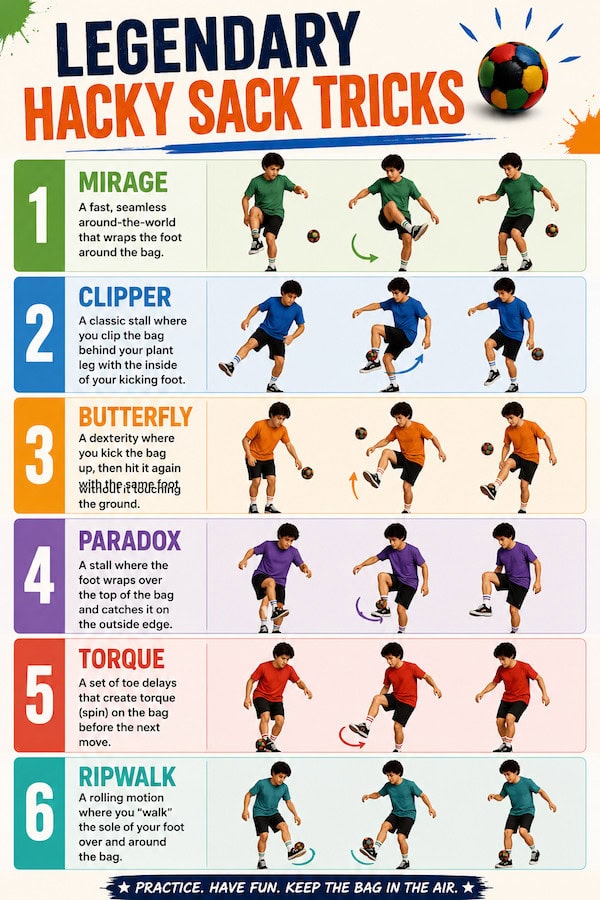
Legendary Hacky Sack Tricks
Competitive freestyle footbag eventually evolved into a highly structured discipline with ranking systems, world championships, and trick classifications.
Some legendary moves developed iconic names:
- Mirage
- Clipper
- Butterfly
- Paradox
- Torque
- Ripwalk
To dedicated players, these terms carry the same weight skateboarders attach to kickflips and snowboarders attach to corkscrews.
Famous People Who Played Hacky Sack
Hacky Sack attracted an eclectic mix of athletes, entertainers, musicians, and counterculture icons over the years.
Athletes
Steve Nash
The former NBA MVP was known for coordination-based training and footwork drills that aligned naturally with Hacky Sack culture.
Mia Hamm
Soccer players have long used footbag exercises to improve touch, balance, and foot-eye coordination.
Tony Hawk
Skateboard and Hacky Sack cultures overlapped heavily during the 1980s and ’90s.
Rodney Mullen
The legendary freestyle skateboard innovator appreciated highly technical, creative movement disciplines like footbag.
Musicians and Celebrities
Phish
Jam-band culture and Hacky Sack became deeply connected during the 1990s festival scene.
Red Hot Chili Peppers
The band’s California skate-surf aesthetic fit naturally alongside footbag culture.
Woody Harrelson
Harrelson became associated with the laid-back outdoor culture where Hacky Sack thrived.
Matthew McConaughey
McConaughey’s easygoing personality and outdoor lifestyle aligned perfectly with Hacky Sack’s vibe.
Competitive Footbag Legends
Kenny Shults
One of freestyle footbag’s most respected pioneers.
Vasek Klouda
The Czech superstar became one of the greatest freestyle footbag players ever.
Anz Lovrec
Known for creativity and fluid technical style.
Ryan Mulroney
A major figure in modern competitive freestyle.
The Global Footbag Community
Although many people associate Hacky Sack primarily with American college culture, the sport has become an international activity.
Organized footbag communities emerged across:
- Canada
- Germany
- Czech Republic
- Japan
- Finland
- Australia
The governing organization, the International Footbag Players’ Association, helped standardize rules and organize championships.
European players eventually became dominant forces in freestyle competition, pushing technical difficulty to astonishing levels.
The Athletic Benefits of Hacky Sack
Long before modern fitness culture emphasized coordination and mobility training, Hacky Sack naturally developed those qualities.
Regular play improves:
- Balance
- Reflexes
- Foot-eye coordination
- Agility
- Flexibility
- Cardiovascular endurance
Soccer coaches still occasionally use footbag exercises to help players improve touch and control.
Hacky Sack also develops spatial awareness and rhythm. Experienced players learn to anticipate angles and body positioning instinctively.
Perhaps most importantly, Hacky Sack disguises exercise as recreation.
Players often burn significant energy without realizing they’re working out.
Why Hacky Sack Declined
By the late 1990s and early 2000s, Hacky Sack’s mainstream visibility began fading.
Several factors contributed:
- The rise of digital entertainment
- Shifting youth trends
- Extreme sports evolution
- Competition from video games and internet culture
Like many recreational crazes, Hacky Sack eventually lost its novelty factor.
But unlike disposable trends, it never disappeared entirely.
The sport retained a loyal global community, particularly among freestyle competitors. Tutorials, tournaments, and online communities continued to develop the game’s technical side even while casual participation declined.
The Reemergence of Hacky Sack
For years, Hacky Sack felt like a relic of another era — a leftover symbol of 1990s college culture, jam bands, and afternoons spent hanging around campus lawns.
Then, almost unexpectedly, the circle returned.
Across high schools, college campuses, parks, and beaches in 2026, groups of teenagers and young adults have begun rediscovering the simple appeal of the footbag. Social media feeds suddenly filled with videos of students kicking in gym hallways, outside cafeterias, and on springtime quads.
What once seemed retro suddenly became cool again.
Why Gen Z Rediscovered Hacky Sack
In many ways, Hacky Sack is becoming a reaction against digital overload.
Teenagers who grew up entirely online are increasingly searching for activities that feel physical, spontaneous, and social in the real world. Unlike video games or curated social media posts, Hacky Sack requires face-to-face interaction.
Players stand shoulder-to-shoulder in a circle, reacting in real time, laughing at mistakes, celebrating saves, and building rhythm together.
The Return of Analog Fun
Hacky Sack’s revival fits perfectly into several modern cultural trends:
- The return of analog hobbies
- Interest in retro 1990s aesthetics
- Outdoor recreation culture
- Casual social fitness
- Low-cost entertainment
The game also carries something many modern activities lack: zero pressure.
There are no subscriptions, rankings, or expensive equipment requirements. A footbag costs only a few dollars and fits into a pocket. Anybody can join the circle regardless of athletic background.
That accessibility makes Hacky Sack feel authentic in an era dominated by hyper-competitive youth sports and screen-heavy entertainment.
More Than a Game
For many people, Hacky Sack represents something larger than sports.
It evokes:
- College friendships
- Summer afternoons
- Music festivals
- Simpler social experiences
- Pre-smartphone spontaneity
People rarely remember only the game itself. They remember:
- The circle
- The conversations
- The music
- The laughter after failed tricks
- The satisfaction of keeping a rally alive
Hacky Sack created moments.
And moments are often more memorable than scores.
The Future of Hacky Sack
Hacky Sack will probably never dominate popular culture the way it briefly did in the 1990s. But the game no longer needs mainstream validation to survive.
Modern freestyle communities remain highly active online, and younger athletes continue discovering the sport through social media clips and tutorial videos.
Its appeal remains remarkably durable:
- Cheap
- Portable
- Social
- Athletic
- Creative
Very few recreational activities check all those boxes simultaneously. And unlike heavily commercialized sports, Hacky Sack still retains much of its original spirit. The game remains rooted in participation rather than spectatorship.
Anyone can join the circle. That may be Hacky Sack’s greatest achievement.
It transformed a tiny cloth bag into a shared language of movement, rhythm, and connection. Decades after two friends in Portland started kicking around a homemade footbag, people across the world are still trying to keep it in the air just a little longer.
You are on our All About Hacky Sack feature.
You might also like:
