
Sports sayings in the workplace are everywhere, but have you ever wondered why so many business conversations rely on terms borrowed from athletics?
The answer is simple: sports and business share many of the same fundamentals. Both involve preparation, teamwork, competition, goal-setting, performance evaluation, success, and occasional setbacks. Because of these similarities, sports expressions often provide an easy and effective way to communicate business concepts.
I once had a manager who liked to use the phrase, “Willing to play ball,” especially when discussing contract negotiations. The line came naturally to him as a former baseball player.
A well-known sports phrase can serve as concise communication because it is familiar, relatable, and instantly understood by many people. Whether someone is asked to “step up to the plate,” deliver a “slam dunk” presentation, or put on a “full-court press,” sports-inspired language helps bring workplace discussions to life.
- Common sports terms used in business – listed by sport
- 1. Baseball – sports terms used in business
- 2. Football – sports terms used in business
- 3. Basketball phrases
- 4. Golf terms – Sports Sayings in the Workplace
- 5. Boxing – Sports Sayings in the Workplace
- 6. Horse Racing – Sports Sayings in the Workplace
- 7. Tennis idioms – Sports Sayings in the Workplace
- 8. Hockey – Sports Sayings in the Workplace
- 9. Olympics – Sports Sayings in the Workplace
- 10. Track & Field – Sports Sayings in Business
- 11. Wrestling – Sports Sayings in the Workplace
- 12. More Sports Sayings in the Workplace
- Closing Thoughts
Common sports terms used in business – listed by sport
Below is a list of idioms and sports terms commonly used in business, finance, investing, and other aspects of corporate culture. Each term is categorized by the sport from which it derives.
1. Baseball – sports terms used in business
Baseball has had a tremendous influence on everyday business language, contributing dozens of expressions that describe strategy, performance, risk, and success. From “step up to the plate” to “home run,” these terms help professionals communicate complex ideas with familiar and memorable imagery.
- Around the Horn – To go from person to person (in a meeting, for example). In baseball, when players throw the ball from one infield position to the next.
- On Deck – The next item or person to become the central focus. In baseball, the player who stands ready to step to the plate and bat next.
- Home Run – A major achievement. In baseball, a hit that clears the outfield fence, scoring the batter and anyone on base at the time.
- Knocked It Out Of The Park – Used as a compliment for a major achievement or job well done. In baseball, a home run (see above).
- Grand Slam – A major achievement. In baseball, a home run takes place with the bases loaded.
- Batter Up – When it’s time to step up and take action. In baseball, when a player steps up to the plate to bat.
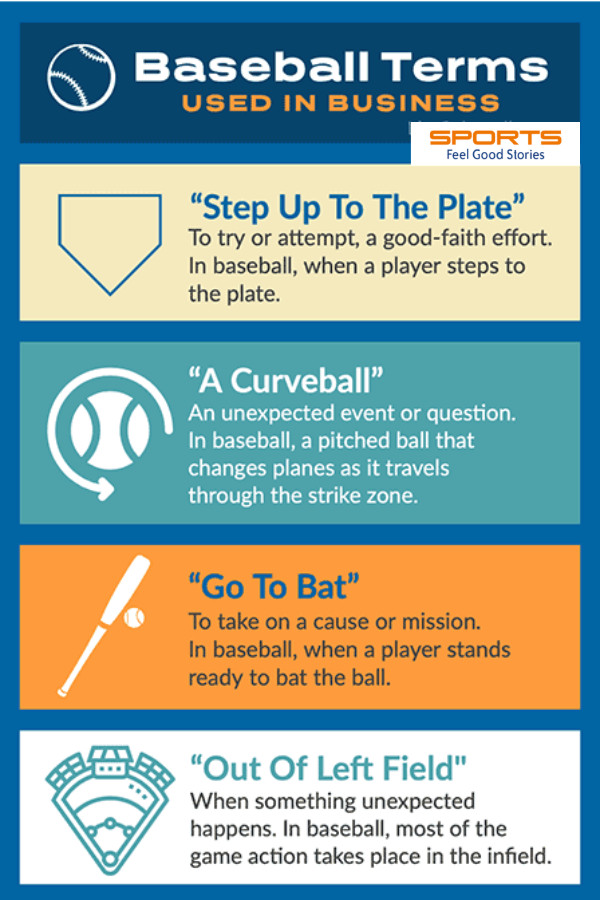
- Go To Bat – To take on a cause or mission. In baseball, when a player stands ready to bat the ball.
- In The Ballpark – A rough estimate or proximal guess, as in “a ballpark estimate.” In baseball, the ballpark consists of the stadium and the field of play.
- A Curveball – An unexpected event or question. In baseball, a pitched ball that changes planes as it travels through the strike zone.
- Pitch A Shutout – A complete and thorough achievement. In baseball, when a pitcher completes a game without any runs scored by the opponent.
More baseball idioms
- Keep Your Eye On The Ball – To maintain focus and concentration on your objective. In baseball, a reminder to the batter to stay focused at the plate.
- Pinch Hitter – A person who stands in for someone else. In baseball, a bench player who bats in place of a starter, usually for strategic advantage.
- Touch Base – To be in contact with someone. In baseball, when a base runner establishes or maintains contact with a base.
- Swing For The Fences – To take your best shot at something, hoping for a successful outcome. In baseball, hitting a home run.
- Out of Left Field – When something unexpected happens. In baseball, most of the game action takes place in the infield.
- Wally Pipp – Be careful because your replacement may take your job, and do it better than you. In baseball, a reference to the player (Wally Pipp) who was a starter for the New York Yankees until his backup, the Hall of Famer Lou Gehrig, took over.
- Inning – A reference to the stage of completion or point in time, as in “We’re only in the third inning.” In baseball, a normal game lasts nine innings.
- Off Base – To be incorrect or misplaced. In baseball, positioning a player away from the base.
- Two Strikes Against – To be near failure but have one more chance. In baseball, when a player has two strikes, they make an out on the next strike unless they get a hit.
- Step Up To The Plate – To try or attempt, a good-faith effort. In baseball, when a player steps to the plate to bat.
- Play Hardball – Negotiations without compromise. In baseball, the ball is called a hardball because it is harder and smaller than a softball.
Browse our Best Baseball Lingo and Slang feature.
More baseball phrases
- Bush League – Something or someone acting without high character or morals. In baseball, the minor leagues are known as bush leagues.
- Willing To Play Ball – When someone is willing to cooperate, discuss arrangements, or negotiate a deal. In baseball, the umpire declares to both teams, “Play ball!” at the beginning of the game.
- Strike Out – When a deal collapses or is terminated. In baseball, the third strike in an at-bat is an out.
- Utility Player – Someone who can step in and cover for someone else without any loss. In baseball, a utility player is usually a bench player (non-starter) who can play multiple positions.
- On The Bench – The personnel are ready to take over when needed. In baseball, the players who are not starters wait on the bench until needed in the game.
- Rain Check – To delay or postpone an event or meeting with the promise of revisiting it at a later time. In baseball, a rain check is issued when a game is canceled due to rain or inclement weather and is rescheduled for a later date.
- Wheelhouse – One’s area of expertise and skill. In baseball, the area of the strike zone is where the batter has the most success in hitting the ball.
2. Football – sports terms used in business
Football’s emphasis on planning, execution, and teamwork has made it a rich source of business vocabulary. From having a “game plan” to “moving the goalposts,” these expressions help describe everything from strategic initiatives to shifting expectations.
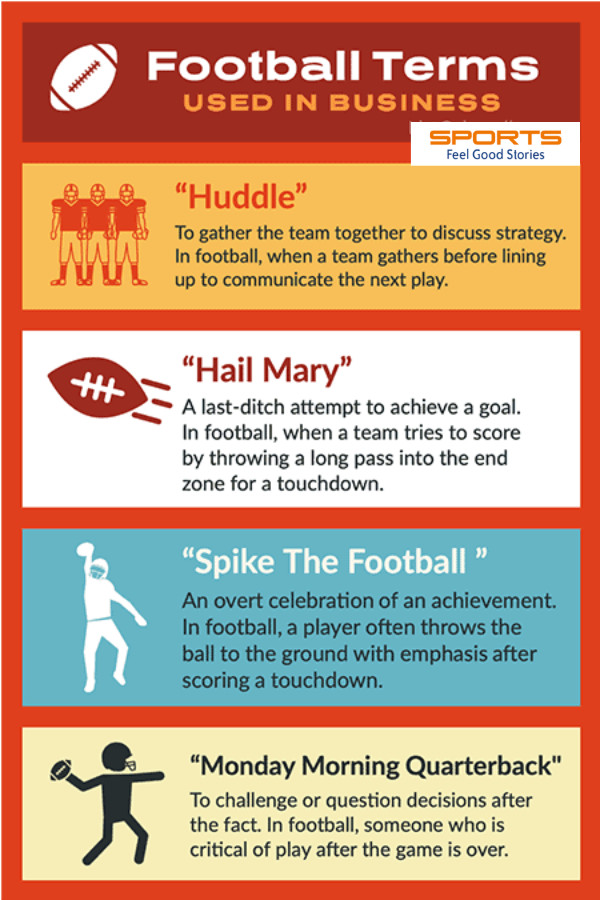
- Hail Mary – A last-ditch attempt to achieve a goal. In football, a team tries to score by throwing a long pass into the end zone for a touchdown.
- Go the Extra Yard – To give extra effort. In football, a rusher tries for extra yardage instead of yielding to oncoming tacklers.
- A Game Of Inches – A reference to the small details that matter for success. In football, announcers often point out the huge difference a small distance can make in a team’s success or failure.
- End Run – An unexpected or unorthodox strategy to achieve a goal. In football, a run around the end of the offensive line instead of running directly ahead.
- Split The Uprights – Precision exhibited in an achievement. In football, a field goal is made right down the middle.
- Cross the Goal Line – To finish your objective to the end. In football, a score is not made until the ball crosses the goal line.
- Take The Ball And Run – To be proactive in achieving your goals. In football, an aggressive approach to moving the ball down the field.
- Call An Audible – To change an approach or strategy. In football, a quarterback changes the play at the line of scrimmage just before the ball is snapped.
- Kick-Off – The beginning of a project or event. In football, a kick-off starts the game.
More football idioms
- Blitz – Make an aggressive move forward all together to achieve a goal. In football, defensive players rush the quarterback to force an offensive error.
- Huddle – To gather the team together to discuss strategy. In football, players gather before lining up to communicate the next play.
- Punt – To give up or cede power to another. In football, when a team has not achieved a first down after three downs, they sometimes punt the ball to put the opposition in a worse field position.
- Blindsided – When something unexpected happens. In football, the area behind the quarterback is known as the blindside, where he is most vulnerable to oncoming tacklers.
- Focus On Blocking And Tackling – To pay attention to the small details and fundamentals. In football, the foundational elements of the game.
- Fumbled The Ball – To err or make a mistake. In football, dropping the ball usually means turning it over to the other team.
- Spike the Football – An overt celebration of an achievement. In football, a player often throws the ball to the ground with emphasis after scoring a touchdown.
- Next Man Up – Seamlessly stepping into place if someone can’t or is unable to perform their role. In football, the players on the sideline spell the starters as needed.
- Move the Goalposts – To change the stated goals in the process to one’s benefit. In football, the goalposts are stationary and never change position.
- Monday Morning Quarterback – To challenge or question decisions after the fact. In football, someone who is critical of play calling after the game is over.
3. Basketball phrases
Basketball has contributed numerous expressions to the business world, particularly those related to teamwork, strategy, and quick decision-making. Terms like “slam dunk,” “full-court press,” and “team player” are now common in offices, boardrooms, and sales meetings.
- Full Court Press – To put all resources to work in pursuit of a goal. In basketball, players aggressively defend an offensive possession for the full length of the court instead of just from half-court.
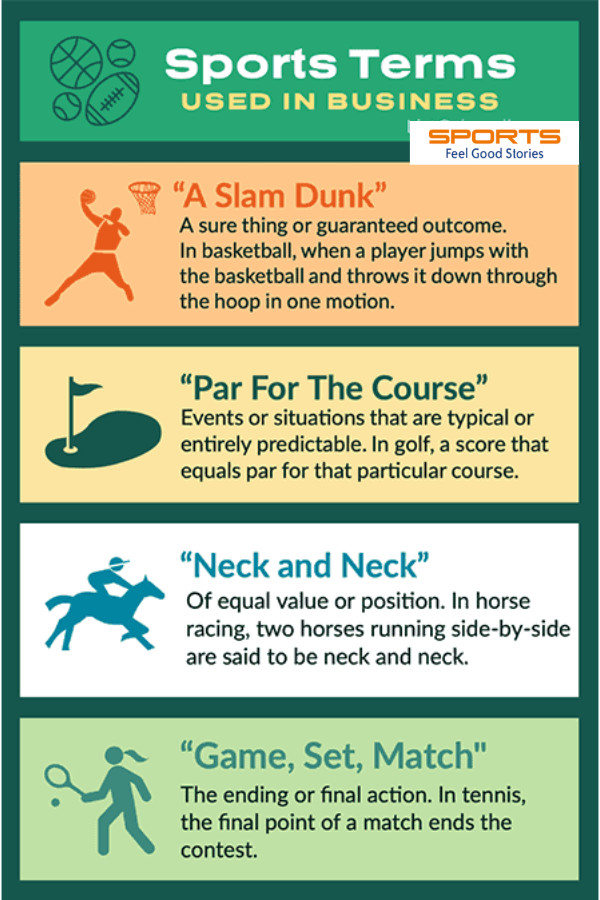
- A Slam Dunk – A sure thing or guaranteed outcome. In basketball, a player jumps with the basketball and throws it down through the hoop in one motion.
- Buzzer Beater – Achieving a goal at the very last moment. In basketball, a shot that scores just before the final buzzer sounds.
- Give It Your Best Shot – To give an honest effort in achieving a goal. In basketball, putting your best effort into your game.
- Running Point — Playing a leadership role much like a point guard runs the offense in basketball.
- Pass the Ball — Delegate responsibility or involve others in a project.
- Take the Shot — Seize an opportunity or make a bold decision.
- Run the Play — Execute the planned strategy or process.
- Fast Break — Acting quickly to capitalize on an opportunity before competitors can react.
4. Golf terms – Sports Sayings in the Workplace
Golf has influenced business language through terms associated with performance, precision, and risk management. Expressions like “par for the course,” “below par,” and “teeing up” are frequently used in professional settings.
- Hole In One – An unexpected and sometimes miraculous achievement. In golf, a ball that is hit with one stroke over the fairway and lands directly in the hole.
- Straight Down The Fairway – To take the conventional route to achieve a goal. In golf, a shot from the tee box that stays in the middle of the fairway.
- Par For The Course – Events or situations that are typical or entirely predictable. In golf, a score that equals par for that particular course.
- Tee It Up – To set up in preparation of a project or venture. In golf, to set the golf ball on a tee to begin play.
- The Leader Board – The generally accepted leaders in the field of business. In a golf tournament, the current leaders are displayed on the leaderboard.
- Up To Par – A suitably acceptable level of performance. In golf, a score that equals par.
Discover our Pickleball Dictionary of Terms to learn more about this popular sport.
5. Boxing – Sports Sayings in the Workplace
The language of boxing often appears in business discussions about competition, resilience, and negotiation. Phrases such as “throw in the towel,” “on the ropes,” and “go the distance” capture the challenges and determination required to succeed.
- On the Ropes – To be on the verge of defeat or failure. In boxing, a boxer retreats against the ropes, taking blows from his opponent and nearing defeat.
- Down For The Count – Nearing failure or defeat. In boxing, when a boxer is knocked down, the referee begins a ten-second count.
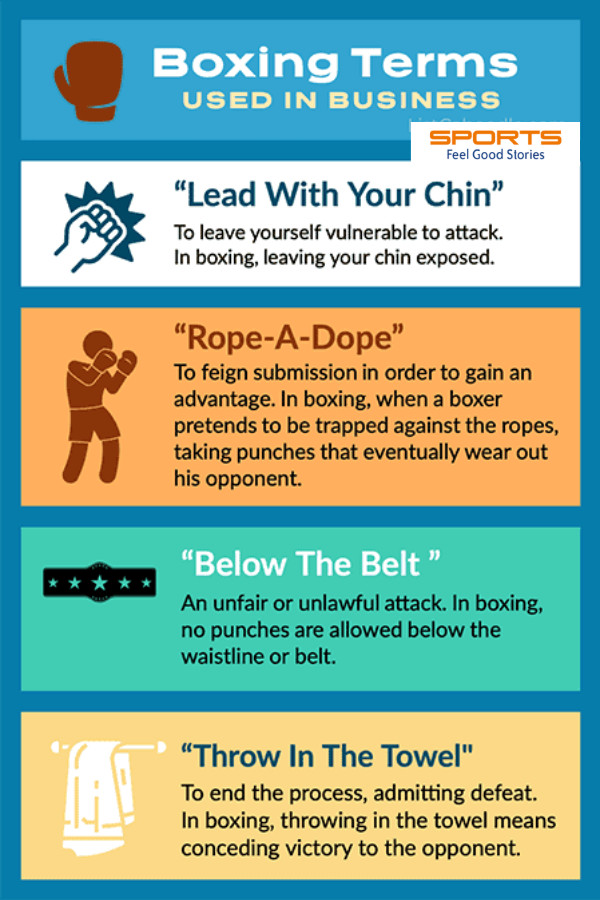
- Rope-A-Dope – To feign submission in order to gain an advantage. In boxing, a boxer feints, pretending to be trapped against the ropes, taking punches that eventually wear down his opponent.
- Lost A Step – A slowdown or misstep in the process. In boxing, a boxer shows a loss of skill, energy, or speed in his performance.
- Throw In The Towel – To end the process, admitting defeat. In boxing, throwing in the towel means conceding victory to the opponent.
- Beat Them To The Punch – Taking a tactical advantage of a situation before someone else. In boxing, taking advantage of the opponent’s defenses to score a punch.
- Come Out Swinging – An aggressive approach from the start. In boxing, the strategy is to attack the opponent right away.
- Heavy Hitter – A business person of significant power or standing in the corporate organization. In boxing, a boxer who punches hard against his opponent in the ring.
- Learning the Ropes – To learn and understand the nature of something before acting on it. In boxing, the ropes surround the ring on all sides. A boxer who negotiates with dexterity within the ropes holds the advantage.
More boxing idioms
- Heavyweight – A power player, skilled veteran, or someone not to be trifled with. In boxing, the heaviest class of pugilists.
- Lightweight – An inconsequential person or newbie. In boxing, a fighter who is not heavy.
- Lead With Your Chin – To leave yourself vulnerable to attack. In boxing, leaving your chin exposed.
- One-Two Punch – A two-step approach to success. In boxing, two punches are delivered sequentially, staggering the opponent.
- Bare Knuckle – Uncompromising dealmaking or negotiations (discarding all pleasantries). In boxing, fighting without gloves.
- Square Off – To ready oneself for a fight. In boxing, the beginning stance boxers take in the ring.
- Ringside Seat – Having a front-row view of things. In boxing, the seats are immediately in front of the ring.
- A Glass Jaw – A sensitive or fragile demeanor. A boxer who is easily injured or defeated is said to have a glass jaw.
- In Your Corner – Assistance and support from your team. In boxing, the support team assists a boxer between rounds.
- Blow-By-Blow – A detailed description of events. In boxing, a blow-by-blow is how the announcer describes the action in the ring.
- Punch Drunk – To feel overwhelmed or confused. In boxing, too many hits to the head will cause dizziness and confusion.
- Knock Out Blow (K.O.) – The final or decisive move or action that achieves success. In boxing, the knockout blow is the punch that drops the opponent, resulting in a win.
More boxing phrases – Sports Sayings in the Workplace
- Down And Out – To be destitute or without luck. A boxer who is down and out has been counted out and lost the match.
- Sucker Punch – An unfair and unexpected attack. In boxing, a sucker punch is when someone is hit with his guard down.
- Below The Belt – An unfair or unlawful attack. In boxing, no punches are allowed below the waistline or belt.
- Low Blow – (See ‘Below The Belt’ above.)
- Throw Your Hat In The Ring – To take part in something, participate. In boxing, an early tradition held that boxers signified their willingness to fight by tossing their hat in the ring.
- Roll With The Punches – To take adversity in stride. In boxing, success comes to the participant who can sustain himself through the match.
- Saved By The Bell – When the allotted time runs out before failure. In boxing, at the end of each round, the bell is rung, giving a boxer time to regain composure.
- Take It On The Chin – Earning your lumps. In boxing, the ability to get hit and still stand and fight.
- Pull Your Punches – To hold back from delivering a devastating blow for strategic purposes. In boxing, the idea is that not all blows are the same, introducing an element of surprise.
6. Horse Racing – Sports Sayings in the Workplace
Horse racing has produced some of the most colorful phrases in business, especially those related to competition and leadership. Expressions like “front-runner,” “dark horse,” and “neck and neck” are often used to describe market dynamics and business performance.
- Neck and Neck – Of equal value or position. In horse racing, two horses running side by side are said to be neck-and-neck.
- Front Runner – The person or company in the lead. In horse racing, the horse that is leading the pack is likely to win.
- Home Stretch – The final phase of a project or endeavor. In horse racing, the last section of track before the finish line.
- By A Nose – A close victory. In horse racing, a close win or photo finish.
- Cross The Finish Line – Completion of a project or goal. In horse racing, when horses reach the finish line to complete the race.
- Hands Down – Showing ease, without condition. In horse racing, the jockey drops his hands to his sides upon winning the race.
- Down To The Wire – To finish something at the very last second. In horse racing, an expression meaning the moment horses cross the finish line.
- Head Start – To gain an advantage by starting early. In horse racing, a horse with a head start has the advantage over other horses in the starting gate.
- A Sprint To The Finish – Giving extra effort in the last stages to achieve victory or success. In horse racing, the sprint to the finish line determines the winner.
- A Two-Horse Race – When the contest is down to two contestants. In horse racing, a race often comes down to two horses vying to finish first.
7. Tennis idioms – Sports Sayings in the Workplace
Tennis contributes a variety of business expressions focused on communication, responsiveness, and competition. Terms such as “the ball is in your court” and “serve and volley” help illustrate accountability and strategic action.
- The Ball Is In Your Court – The opportunity to act or not. In tennis, a player responds to the ball when it is played to their side of the court.
- Game, Set, Match – The ending or final action. In tennis, the final point of a match ends the contest.
- Aced It – A decisive, successful action. In tennis, a serve that is in-bounds and not returned is called an ace.
- Unforced Error – A mistake made of one’s own volition. In tennis, an unforced error leads to points for the opponent.
8. Hockey – Sports Sayings in the Workplace
Known for its speed and physicality, hockey has inspired business terms that emphasize action and adaptability. Phrases such as “drop the gloves,” “stickhandling,” and “skating to where the puck is going” are frequently used in discussions of leadership and innovation.
- Hat Trick – Three consecutive wins or scores. In hockey and cricket, three scores in a row or within a game constitute a hat trick.
- The Gloves Are Off (Drop The Gloves) – To cast all civil formalities aside. In hockey, the gloves come off in a fight on the ice.
- Light The Lamp – To score or win. In hockey, the red goal light is lit when a goal is scored.
Learn more about offside and icing at our Hockey Terms and Definitions feature.
9. Olympics – Sports Sayings in the Workplace
The Olympic Games symbolize excellence, dedication, and world-class achievement, making them a natural source of business metaphors. References to winning a “gold medal performance” or setting an “Olympic standard” highlight exceptional results and high expectations.
- Go For Gold – To achieve greatness. In the Olympics, the highest award given to participants is the gold medal.
- A Marathon – A long and challenging endeavor. In the Olympics, the marathon is a long-distance running event.
- Dive Into – To immerse oneself in something. In the Olympics, competitive diving is a staple of the summer games.
10. Track & Field – Sports Sayings in Business
Track and field events have inspired many business expressions centered on speed, endurance, and competition. Terms such as “passing the baton,” “hurdles,” and “a marathon, not a sprint” are commonly used to describe long-term goals and collaborative efforts.
- Jump The Gun – To start too early. In track and field, jumping the gun to start the race can disqualify you.
- Cleared the Hurdle – To get past barriers in a process. In track and field, runners must leap over a series of hurdles to get to the finish line.
- Go the Distance – To see a project or goal through to completion. In track and field, long-distance runners must pace themselves to endure the race.
- Pass The Baton – To pass off responsibility to another. In track and field, relay runners are responsible for a section of the race before they hand the baton to the next runner.
11. Wrestling – Sports Sayings in the Workplace
Wrestling has contributed a variety of expressions that describe competition, negotiation, and overcoming challenges. Terms such as “grappling with an issue,” “pin down the details,” and “heavyweight contender” are frequently used in business discussions and decision-making.
- Go To The Mat – To take a side in an argument or dispute. Wrestlers take on their opponents on the mat.
- No Holds Barred – When no restrictions are in place. In wrestling, sometimes certain holds are against the rules unless there are no restrictions.
12. More Sports Sayings in the Workplace
Beyond the major sports, countless athletic activities have contributed colorful expressions to the business world. From sailing terms like “learn the ropes” to cycling phrases such as “gain traction,” these sports-inspired expressions help professionals communicate ideas in memorable and relatable ways.
- Take One For The Team – A declaration of self-sacrifice. Giving of oneself for the greater good.
- On The Ball – Showing focus and skill.
- Dropped the Ball – Making an error or letting down the team.
- Get Your Head In The Game – Achieving focus and proper attention.
- MVP – The most valuable player on the team.
- Time Out – Taking time off or temporarily stopping action.
- Game Plan – The strategy for winning.
- Beat At Your Own Game – When someone uses your techniques against you to achieve victory.
- Team Player – All for one and one for all.
- Whole New Ball Game – When circumstances change for the better.
- Level Playing Field – To make sure the situation is fair to all players or individuals involved.
- Ahead Of The Game – To prepare ahead of time to achieve an advantage.
- Long Shot – An unlikely event or outcome.
- Wild Card – An outlier that has a chance to succeed.
- Make The Cut – The individuals or staff selected for a team or project.
- Get the Ball Rolling – The first moves to start a project or meeting.
- Take the Bull By the Horns – Make an aggressive move to gain an advantage.
Closing Thoughts
Sports sayings have become a natural part of workplace communication because they quickly convey ideas about teamwork, leadership, competition, and achievement. Whether you’re encouraging colleagues to “step up to the plate,” celebrating a “slam dunk” success, or reminding a team that a project is “a marathon, not a sprint,” these expressions bring energy and familiarity to everyday conversations.
From baseball and football to golf, tennis, and beyond, sports have given business professionals a rich vocabulary for describing challenges and opportunities. Understanding these popular sports sayings can help you communicate more effectively, connect with coworkers, and appreciate the athletic origins behind some of the workplace’s most commonly used phrases.

By Mike O’Halloran
Founder and Editor, Sports Feel Good Stories
Mike O’Halloran founded Sports Feel Good Stories in 2009. He has authored three books on sports jokes, co-authored four trivia books, and authored three books on basketball coaching. Mike has also written a book on sports slogans and captions. He coached youth basketball for 15 seasons, taught tennis, and was a contributing writer for USA Football, the youth arm of the NFL.
Mike is the publisher of the Well-Prepared Coach line of coaches’ practice plans and editable award certificates. He is the founder of the Fantasy Football Team Names Hall of Fame. Mike is married with four children.
You are on our Sports Sayings in the Workplace feature.
You might also like:
