
Baseball has always had two scoreboards.
The obvious one keeps track of runs, hits, and errors. The other is harder to measure. It records the laughs in the grandstand, the stories fans tell on the ride home, the promotions people remember 30 years later, and those wonderfully strange moments when somebody turns to the person sitting beside them and says, “I have never seen anything like that at a baseball game.”
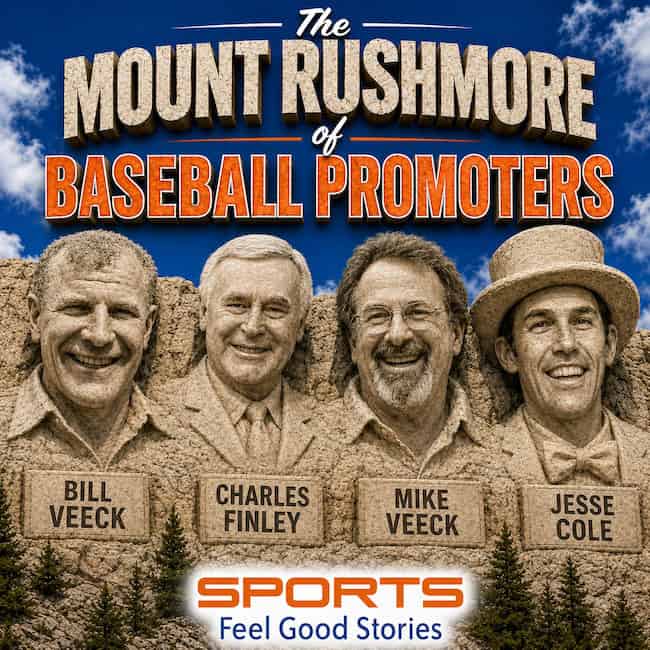
Nobody understood that second scoreboard better than the four men on our imaginary Mount Rushmore of Baseball Promoters: Bill Veeck, Charles Finley, Mike Veeck and Jesse Cole.
They arrived in different eras and operated at different levels of the game. Their personalities differed, too. Bill Veeck was baseball’s mischievous master showman. Finley was the relentless salesman and provocateur. Mike Veeck inherited his father’s appetite for the absurd and turned it into a philosophy. Cole has taken that philosophy into the social-media age and built something that increasingly resembles an entirely new branch of baseball.
All four shared one fundamental belief: a ticket to a baseball game should buy more than nine innings. It should buy an experience. There is another reason these four belong together. They were willing to be laughed at.
Baseball is an institution that treasures tradition, and that makes genuine innovation difficult. Suggest something different, and somebody will invariably explain that baseball has survived perfectly well without it for 100 years.
These four men heard that argument repeatedly. Sometimes their critics were right. Some promotions flopped spectacularly. Some ideas were ridiculous. A few became infamous. But other ideas that once seemed outrageous became normal.
So grab your imaginary chisel. We have four faces to carve. Here is the Mount Rushmore of Baseball Promoters.
- Bill Veeck: Baseball's Greatest Showman
- Charles Finley: Baseball's Relentless Innovator
- Mike Veeck: The Man Who Proved Fun Is Good
- Jesse Cole: Baseball Promotion for the Social-Media Age
- Other Great Baseball Promoters
- FAQ About the Greatest Baseball Promoters
- Final Thoughts: The Mount Rushmore of Baseball Promoters
Bill Veeck: Baseball’s Greatest Showman
If baseball promotion has a founding father, William Louis Veeck Jr. gets the largest face on the mountain.
Veeck was born in Chicago in 1914 and practically grew up inside a baseball park. His father, William Veeck Sr., became president of the Chicago Cubs when Bill was a child. Young Bill sold tickets, worked as a vendor and groundskeeper, and learned baseball from places most owners never visited—the bleachers, concession stands, box office, and field.
That education mattered.
Veeck never viewed spectators as anonymous customers. They were participants in the evening. Before he owned a major-league franchise, he was already leaving fingerprints on one of baseball’s most recognizable landmarks.
Bill Veeck and the Wrigley Field Ivy
In the late 1930s, while working for the Cubs, Veeck helped plant the ivy along Wrigley Field’s brick outfield walls.
Today it seems inevitable. Wrigley without ivy would be like Fenway Park without the Green Monster. But somebody had to put it there.
Veeck later told the story of planting the vines with groundskeepers, and SABR accounts credit him with planting or supervising the installation. Modern research has complicated the legend: Cubs historian Ed Hartig has said the Clavey family supplied and planted the ivy and that owner Philip Wrigley deserves more credit for the idea. The safest historical conclusion is that Veeck was directly involved in the 1937-38 installation, even if the famous story he later told grew taller with age.
In a way, the disputed details make the story even more Veeckian.
Bill Veeck didn’t merely promote baseball. Bill Veeck became part of baseball folklore.
Learning to Sell the Experience
Veeck’s first great laboratory was the minor leagues.
In 1941, he and former Cubs star Charlie Grimm purchased the Milwaukee Brewers of the American Association. The young executive immediately started experimenting.
He scheduled morning games for workers coming off night shifts. Veeck staged weddings at home plate. He gave away live animals.
More important, people noticed.
The Brewers also won. During Veeck’s five years, Milwaukee captured three American Association pennants, and Veeck eventually sold his interest at a substantial profit. That combination—winning baseball plus irresistible entertainment—became the ideal Veeck formula.
World War II interrupted his career. Veeck served in the Marines and eventually lost his right leg. It didn’t slow him much.
By 1946, he was part of an ownership group that purchased the Cleveland Indians. Now the entire American League was about to discover what happened when Bill Veeck had a major-league stage.
Cleveland: Promotion With a Purpose
The easy version of the Veeck story focuses on the stunts. The fuller version includes something far more important.
In 1947, Veeck signed Larry Doby, making him the first Black player in the American League. The following year, Veeck signed legendary Negro Leagues pitcher Satchel Paige. These weren’t promotions masquerading as baseball decisions. They were important baseball decisions that also challenged the era’s racial conventions.
Cleveland won the World Series in 1948 and drew approximately 2.6 million fans, then a major-league attendance record. Veeck demonstrated something that would define his career: progressive thinking, good baseball and good business did not have to be enemies.
He also understood ordinary fans. When Cleveland supporter Joe Earley wrote to complain that teams had special nights for seemingly everybody except the average fan, Veeck responded by staging Good Old Joe Earley Night.
That was pure Veeck. Listen to the customer. Then turn the customer’s complaint into a party.
Eddie Gaedel and Grandstand Managers Day
Veeck’s next stop was St. Louis, where he purchased the struggling Browns.
Here the showman became a legend.
On August 19, 1951, Veeck sent 3-foot-7 Eddie Gaedel to bat against the Detroit Tigers. Gaedel wore uniform No. 1/8 and had such a tiny strike zone that pitcher Bob Cain walked him on four pitches. It remains one of the most famous plate appearances in baseball history. American League president Will Harridge quickly voided Gaedel’s contract, but Veeck had accomplished what promoters dream about: people who had no interest in the Browns were suddenly talking about the Browns.
Five days later came another masterpiece.
For Grandstand Managers Day, fans received cards allowing them to vote on strategic decisions. Manager Zack Taylor sat back while the crowd decided when the Browns should bunt, steal, or change pitchers.
The remarkable part? The fans won. St. Louis beat Philadelphia 5-3.
Veeck wasn’t simply staging gimmicks. He was experimenting with something that now dominates sports marketing: participation. Don’t make fans watch the experience. Put them inside it.
The Exploding Scoreboard
When Veeck purchased the Chicago White Sox in 1959, he brought his carnival home.
His most enduring innovation may have been the exploding scoreboard at Comiskey Park. When a White Sox player homered, the scoreboard erupted with lights, sound effects and fireworks. To traditionalists, it was excessive.
To modern fans, it would look completely familiar. Think about today’s ballparks. Home runs trigger music, flashing LED boards, fireworks, sirens, light shows and elaborate scoreboard animations. Veeck was doing the ancestor of all that in 1960.
He also put players’ names on the backs of White Sox uniforms, another innovation that became commonplace. Later, Veeck encouraged broadcaster Harry Caray to lead fans in singing “Take Me Out to the Ball Game,” helping create another enduring Chicago baseball tradition.
Browse our Baseball Captions, Mottos, and Sayings feature.
Disco Demolition Night
No discussion of Veeck can ignore July 12, 1979. Disco Demolition Night at Comiskey Park was promoted around Chicago radio personality Steve Dahl’s anti-disco campaign. Mike Veeck, then working for his father’s White Sox, helped organize the promotion.
Fans bringing disco records received discounted admission to a doubleheader against Detroit. The records were to be blown up between games. Far too many people arrived.
After the explosion, thousands poured onto the field. The playing surface was damaged, police were called, and the White Sox eventually forfeited the second game. It became one of baseball’s most notorious promotions.
It also offers an important distinction. Great promoters are not people whose every idea succeeds. They’re people willing to have ideas.
Bill Veeck’s Impact on Baseball
Veeck’s greatest contribution wasn’t Eddie Gaedel, fireworks or any single stunt.
It was a philosophy. He believed baseball existed because people bought tickets. That sounds obvious. Baseball executives nevertheless have periodically behaved as if spectators should consider themselves fortunate merely to be admitted.
Veeck reversed the relationship. The club should be grateful the fan came. Make that person laugh. Surprise them. Give the kid something to remember. Let the people in the cheap seats feel as important as the people in the boxes.
Veeck was elected to the Baseball Hall of Fame in 1991. His plaque describes him as “A Champion of the Little Guy.” That’s about right. On our Mount Rushmore, Bill Veeck gets the first carving. And somewhere nearby, naturally, we’d plant some ivy.
Editor’s Note: One of my favorite baseball books is Veeck As in Wreck: The Autobiography of Bill Veeck.
Charles Finley: Baseball’s Relentless Innovator
If Bill Veeck was baseball’s merry prankster, Charles O. Finley was its mad scientist.
Finley could be abrasive, exhausting, and extraordinarily difficult. Players fought with him. Commissioners fought with him. Other owners fought with him. Yet dismissing Finley as merely baseball’s loudmouth eccentric misses something important.
The man had ideas. Lots of them. And baseball eventually adopted some of his best ones.
From Insurance Salesman to Baseball Owner
Finley made his fortune in insurance and spent years trying to purchase a major-league franchise. He finally succeeded in 1960, buying the Kansas City Athletics.
Finley was a salesman at heart, and he looked at baseball through a salesman’s eyes. If the product wasn’t attracting enough attention, change the presentation. The Athletics became his laboratory.
There was a mechanical rabbit named Harvey that delivered baseballs to the umpire. A mule mascot named Charlie O added to the fun. There were sheep beyond the outfield fence. Finley experimented with promotions, presentation, and virtually anything else that might make the Athletics distinctive.
He even challenged baseball’s visual identity.
Green, Gold and White Shoes
Baseball uniforms in the early 1960s generally looked as they had always looked. Finley saw no reason for that.
His Athletics began wearing green and gold. Eventually came white shoes, an especially radical departure in a sport dominated by black footwear. The A’s looked different. That was the point.
Finley understood branding decades before “branding” became a daily term in sports front offices. A fan flipping through a magazine or turning on a television could immediately recognize his club. The Athletics weren’t merely a team. They had a personality.
Orange Baseballs and Other Experiments
Finley proposed orange baseballs because he believed they would be easier for players and spectators to see. The idea was tested and disappeared.
He experimented with a three-ball walk. That disappeared, too.
He proposed a designated runner and eventually hired world-class sprinter Herb Washington for precisely that role. Washington appeared in 105 major-league games without ever batting or playing the field.
Another Finley experiment failed to spread. But that’s the point about experimentation. If every idea succeeds, you aren’t experimenting. You’re playing it safe.
Finley rarely played it safe.
The Ideas That Baseball Eventually Adopted
Mixed among Finley’s oddities were ideas that seemed much less odd over time.
- He advocated playing World Series games at night, when more people could watch. Baseball eventually did.
- Finley advocated the designated hitter. The American League adopted it in 1973, and decades later MLB expanded the DH to both leagues.
- He wanted interleague play. Baseball eventually adopted it.
- He wanted faster games and even pushed a 20-second limit between pitches. Sound familiar? Explore our How Long is a Baseball Game feature.
Finley’s specific proposals weren’t always identical to the rules baseball eventually enacted, but the larger theme is striking: he repeatedly identified issues—pace, television audiences, offense and scheduling—that baseball would spend decades addressing.
Finley wasn’t always right. But he was often and nearly always early.
The Swingin’ A’s
And unlike many colorful owners, Finley built a powerhouse. The Athletics moved from Kansas City to Oakland for the 1968 season. By the early 1970s, they had become one of baseball’s great teams. Oakland won five consecutive American League West titles from 1971 through 1975 and three consecutive World Series championships from 1972 through 1974.
Finley wasn’t thrilled when star player Reggie Jackson showed up to spring training in 1972 with a mustache. Instead of ordering him to shave, he encouraged the rest of the team to grow facial hair. He reportedly offered $300 bonuses to players to grow mustaches. The “Mustache Gang,” as they became known, included Rollie Fingers with his iconic handlebar mustache, Catfish Hunter, Sal Bando, and others.
Finley then turned the whole mustache thing into a promotion. On Father’s Day in 1972, the A’s held Mustache Day, offering free admission to fans sporting a mustache.
It was classic Finley: take something baseball considered unconventional and turn it into part of the team’s brand.
When Finley signed the young Jim Hunter in 1964, he decided “Jim Hunter” wasn’t colorful enough. Finley invented the nickname “Catfish” and even concocted a backstory about Hunter catching a large catfish as a boy. Hunter later acknowledged that the story wasn’t true. Finley essentially created the Catfish Hunter persona because he thought it would be more memorable and marketable.
The club was colorful in every sense. These were the Swingin’ A’s. And they won.
Explore our Best Baseball Nicknames feature.
Finley’s Complicated Legacy
It is impossible to romanticize Finley completely. His relationships with players could be poisonous. Finley’s feuds were legendary. His relentless control alienated employees and contributed to a chaotic atmosphere around otherwise brilliant teams.
“Oakland is the luckiest city since Hiroshima,” is a line frequently and incorrectly attributed to Missouri U.S. Senator Stuart Symington when Finley moved the Athletics from Kansas City to Oakland.
SABR’s biography of Finley captures the contradiction: he was deeply disliked by many people around baseball, yet possessed more imagination than most of his fellow owners and built a championship roster largely through players his organization signed and developed.
That makes him a fascinating figure on this mountain.
Bill Veeck wanted fans to laugh. Finley wanted baseball to change. Sometimes he wanted it to change simply because Charlie Finley had thought of something new. But change it did.
Modern baseball includes night postseason games, designated hitters, interleague schedules, colorful uniforms and clocks designed to improve pace. Finley didn’t single-handedly create all of those things.
He simply spent years telling baseball it should try them. For a sport famously resistant to change, that counts for something.
Mike Veeck: The Man Who Proved Fun Is Good
Imagine being the son of Bill Veeck. Your father put a 3-foot-7″ batter at the plate, installed an exploding scoreboard, let fans manage a major-league game and became the most famous promoter in baseball history. How exactly do you follow that act?
Mike Veeck found the answer. You don’t imitate your father. You inherit the philosophy and make it your own.
Growing Up Veeck
Mike Veeck was born into baseball’s strangest family business. For most children, going to work with Dad doesn’t involve major-league owners, circus-like promotions, and people brainstorming ways to make thousands of strangers laugh. For Mike, that was normal.
Then came Disco Demolition Night. Mike was working in White Sox promotions and played a central role in organizing the 1979 event. When it descended into chaos, he became associated with one of baseball’s greatest promotional disasters. His career in baseball essentially collapsed.
That could have been the end of the story.
Instead, it became the first act.
The St. Paul Saints and the Resurrection of Mike Veeck
In 1993, independent baseball returned to St. Paul, Minnesota. The Saints didn’t have Major League Baseball affiliation, a glamorous stadium, or blue-chip prospects supplied by an MLB organization.
What they did have was Mike Veeck.
The Saints became a laboratory for irreverent baseball entertainment. They had a ball pig deliver baseballs to the umpire. The first was simply named Saint; successors received increasingly ridiculous names. There were massages in the stands. Many unusual theme nights were scheduled. There were jokes aimed at celebrities, politicians, popular culture and sometimes the baseball establishment itself.
Actor Bill Murray joined the Saints’ ownership group, which somehow seemed perfect.
The Saints demonstrated something important for the independent baseball movement: a team didn’t need major-league affiliation to become an attraction. It needed a relationship with its community.
Discover Mike Veeck’s Father’s Day Tribute to His Dad, Bill Veeck.
Nobody Night and the Art of the Absurd
Mike’s influence extended well beyond St. Paul through involvement with clubs including the Charleston RiverDogs.
One of the greatest examples came in Charleston in 2002. Nobody Night. The objective was to set the lowest attendance record in professional baseball. Fans weren’t allowed inside until the game became official. Instead, they gathered outside the stadium while the game proceeded before essentially nobody. Think about the glorious absurdity of that. Most promoters spend their careers trying to break attendance records.
Veeck tried to break one in reverse. And, of course, the promotion attracted attention. That’s the Veeck gene.
Promotions as a Conversation
Mike Veeck’s clubs have produced a staggering collection of ideas. The Charleston RiverDogs’ promotional history includes Nobody Night, Silent Night, Go Back to Ohio Night and an All-Star Game home run contest staged on the deck of the USS Yorktown.
The point wasn’t simply to be weird. The weirdness was an invitation. Fans understood that the organization didn’t take itself too seriously. That creates affection.
Traditional sports marketing often communicates downward: the team tells fans what is happening. Veeck-style promotion communicates sideways: the team and fans are in on the joke together. That’s much more powerful.
Fun Is Good
Mike eventually distilled his philosophy into three words: Fun Is Good. Simple? Absolutely. But that’s precisely why it works.
His approach argues that fun shouldn’t be a gimmick layered onto an organization. It should be part of the culture—affecting employees, customer service, and the way fans experience the ballpark.
Mike Veeck’s lasting contribution may be democratizing his father’s philosophy. Bill operated on major-league stages. Mike showed that the same thinking could transform minor-league and independent baseball.
You don’t need a $300 million payroll to make a fan smile. You need imagination.
Mike Veeck’s Impact
Walk into a modern minor-league stadium, and Bill and Mike Veeck’s fingerprints are everywhere. Creative theme nights. Costumed races. Bat dogs. Unusual mascots. Between-inning contests. Self-deprecating humor. Promotions designed specifically for social sharing. The willingness to acknowledge that some spectators are attending primarily for entertainment rather than the standings.
Mike helped turn that philosophy into a business model. His career also contains perhaps the most fitting redemption story in baseball promotion. The young promoter associated with Disco Demolition Night could have become a historical footnote. Instead, he spent decades making people love going to baseball games.
That’s worth a place on the mountain.
Jesse Cole: Baseball Promotion for the Social-Media Age
The fourth person on our Mount Rushmore is wearing a yellow tuxedo. Of course it is.
Jesse Cole represents the newest branch of the promotional family tree, but the roots are easy to recognize. There is Veeck-style showmanship. There is Finley-style willingness to question baseball conventions. And there is Mike Veeck’s conviction that fun isn’t merely a promotion—it is the product.
Cole combined those principles with modern media and built the Savannah Bananas. Then he went further. He started reinventing the game itself.
Before the Bananas
Cole’s promotional education came in Gastonia, North Carolina, where he became general manager of the struggling Gastonia Grizzlies in his early 20s. Attendance was poor. So Cole started experimenting.
There was Flatulence Fun Night. There was a Salute to Underwear Night. Interactive promotions, music and other efforts to turn a sleepy summer-collegiate baseball game into an event.
Attendance improved dramatically. The lesson stuck. Fans didn’t necessarily dislike baseball. They disliked being bored.
The Savannah Gamble
In 2015, Jesse and Emily Cole arrived in Savannah after affiliated minor-league baseball had left the city. Their new summer-collegiate franchise was in trouble before it played a game. Ticket sales were miserable. Money was disappearing. According to the Bananas’ own history, the Coles sold their home to help keep the operation alive.
Then they announced the team name. Savannah Bananas. Some people hated it. Everybody remembered it. Opening Night sold out. And then the games kept selling out.
Fans First
Cole’s central philosophy is almost aggressively simple: Fans first.
That means examining the traditional baseball experience from the customer’s perspective. Why make people wait? Do games have to drag? Why charge separately for every little thing? Why have dead time between innings? Should players stand around when they could be entertaining?
Cole didn’t merely add promotions between innings. He started treating the entire evening as a production. Players danced. Coaches participated. Umpires became entertainers. A senior-citizen dance team —the Banana Nanas— became part of the show.
The baseball game wasn’t interrupted by entertainment. The baseball game and entertainment merged.
From the Savannah Bananas to Banana Ball
Eventually, Cole made his most radical move. He stopped limiting innovation to what happened around baseball and began changing what happened inside the lines. Banana Ball developed rules designed around pace and participation. Games were built to move quickly. Fans could influence outcomes—including a rule that would make a foul ball caught by a spectator an out. At an August 8 Bananas’ game at Target Field, fans had 10 put-outs by catching foul balls.
The Bananas left the Coastal Plain League after the 2022 season and committed to Banana Ball full-time. That changed the scale of the experiment.
The Bananas were no longer simply a creatively promoted baseball team. Banana Ball was becoming its own sports-entertainment property.
From Grayson Stadium to Giant Venues
The growth has been remarkable. The operation moved from a struggling summer-collegiate team at historic Grayson Stadium to national tours drawing crowds at major-league and football stadiums.
By 2026, Fans First Entertainment’s Banana Ball Championship League had expanded to six teams. The Bananas and their companion teams have become social-media machines, reaching audiences far beyond the number of people who can attend games. In 2026, Banana Ball sold out consecutive games at the Caesars Superdome in New Orleans, drawing more than 140,000 fans across the weekend.
Consider the journey. A baseball organization that once struggled to sell tickets in Savannah was now filling an NFL dome.
That’s not a promotion. That’s a movement.
Cole’s Biggest Innovation: Designing for the Fan
Cole’s genius isn’t that he invented dancing at baseball games. He didn’t. It isn’t costumes, music, comedy, or unusual rules individually.
It’s the obsessive redesign of the experience around the spectator.
Traditional baseball begins with the game and asks: How can we promote this?
Cole begins with the fan and asks: What would make this unforgettable?
That reversal is enormously important. It also makes him a natural descendant of Bill Veeck. Veeck would almost certainly recognize the philosophy.
He might wonder why everyone is holding a smartphone. But he’d recognize the showman in the yellow tuxedo.
Jesse Cole’s Impact on Baseball
Cole’s ultimate place in baseball history is still being written. That makes him different from the other three faces on this mountain.
We know what Bill Veeck’s legacy became. Finley ideas survived. We can trace Mike Veeck’s influence across decades of minor-league promotion.
Banana Ball is still expanding. It could remain a wildly successful alternative form of baseball entertainment. It could grow into something substantially larger.
Either way, Cole has already demonstrated that enormous numbers of young fans and families will embrace baseball when the experience is designed differently.
That is a lesson the baseball industry can’t ignore.
Other Great Baseball Promoters
Our Mount Rushmore only has room for four faces. Baseball history, fortunately, has produced plenty of other executives and showmen who understood the value of attracting and entertaining a crowd.
Larry MacPhail — Cincinnati Reds and Brooklyn Dodgers
Hall of Fame executive Larry MacPhail was one of baseball’s most important promotional innovators. With Cincinnati, he helped bring night baseball to the major leagues when the Reds hosted MLB’s first night game at Crosley Field in 1935. Later, running the Brooklyn Dodgers, he expanded night games, embraced radio broadcasts, and hired Red Barber. MacPhail understood a basic promotional truth: baseball had to make itself available when its customers could actually consume it. Millions of working fans could attend or listen because executives like MacPhail were willing to challenge baseball’s daytime traditions.
Effa Manley — Newark Eagles
No discussion of baseball promotion should be limited to the American and National leagues. Effa Manley co-owned and operated the Newark Eagles of the Negro National League with her husband, Abe, from 1935 through 1948. The Eagles won the 1946 Negro World Series, but Manley’s influence extended beyond the standings. She promoted the club, managed its business affairs, and connected baseball with community and civil rights causes, even using Eagles games to promote civic initiatives. In 2006, Manley became the first woman elected to the National Baseball Hall of Fame.
Abe Saperstein — Birmingham Black Barons
Abe Saperstein is remembered primarily as the founder of the Harlem Globetrotters, but his promotional influence reached baseball as well. He became a co-owner of the Birmingham Black Barons during the club’s successful 1940s period, when the team won Negro American League pennants in 1943, 1944 and 1948. Saperstein understood barnstorming, entertainment and the economics of attracting crowds perhaps better than almost anyone in American sports. Some Black Barons even supplemented their baseball incomes by playing basketball during the offseason, demonstrating the crossover sports ecosystem Saperstein helped cultivate.
Max Patkin — The Clown Prince of Baseball
Max Patkin didn’t own a team or run a front office. He promoted baseball simply by showing up and making people laugh. Known as the “Clown Prince of Baseball,” Patkin entertained crowds for decades with his exaggerated routines, comic coaching, and physical humor. He traveled throughout professional baseball and became particularly beloved at minor-league parks, where his appearance could itself become a promotional event. Patkin represented another important side of baseball entertainment: sometimes the attraction doesn’t have to reinvent the sport. It just has to make a Tuesday night at the ballpark feel special.
FAQ About the Greatest Baseball Promoters
Who is the greatest baseball promoter of all time?
Bill Veeck is the strongest choice. His combination of creativity, longevity, and influence is unmatched. Promotions such as Eddie Gaedel and Grandstand Managers Day made headlines, while innovations including the exploding scoreboard helped change the ballpark experience permanently. His Hall of Fame career also included consequential baseball decisions such as signing Larry Doby and Satchel Paige.
What was Bill Veeck’s most famous promotion?
Eddie Gaedel’s 1951 plate appearance is arguably Veeck’s most famous successful stunt. Veeck’s tongue-in-cheek direction to Gaedel was, “Eddie, I’m going to be up on the roof with a high-powered rifle watching every move you make. If you so much as look as if you’re going to swing, I’m going to shoot you dead.”
What innovations did Charles Finley propose?
Finley experimented with orange baseballs, a designated runner, and a three-ball walk, while advocating ideas including the designated hitter, World Series night games, interleague play, and measures to speed up games. Some failed spectacularly; others anticipated changes baseball eventually embraced.
What is Mike Veeck best known for?
Mike Veeck is best known for bringing the Veeck family’s promotional philosophy to independent and minor-league baseball, particularly through the St. Paul Saints and Charleston RiverDogs. His “Fun Is Good” philosophy emphasizes creativity, affordable entertainment, customer service and building an emotional connection with fans.
Who created the Savannah Bananas?
Jesse and Emily Cole own Fans First Entertainment and created the Savannah Bananas phenomenon. Jesse Cole is the organization’s most visible promoter, known for wearing his signature yellow tuxedo while championing the company’s “Fans First” philosophy.
What is Banana Ball?
Banana Ball is a faster, entertainment-focused variation of baseball developed by the Savannah Bananas organization. Its modified rules emphasize pace, action and fan involvement, while the overall presentation incorporates music, dancing, comedy, trick plays and other entertainment.
What do the four Mount Rushmore promoters have in common?
All four were willing to question the assumption that baseball’s traditional presentation should never change. Bill Veeck made spectators participants. Finley challenged baseball’s rules and visual conventions. Mike Veeck made fun an organizational philosophy. Jesse Cole redesigned the experience around the fan.
Final Thoughts: The Mount Rushmore of Baseball Promoters
Stand far enough away from our imaginary mountain and something becomes apparent. The four faces are connected.
Bill Veeck planted more than ivy at Wrigley Field. He planted an idea: baseball could respect its traditions without becoming imprisoned by them.
Charles Finley took a sledgehammer to convention. For every orange baseball that disappeared, there was another idea—night World Series games, the designated hitter, faster play—that sounded less ridiculous with every passing decade.
Mike Veeck carried his father’s spirit into independent and minor-league baseball and proved that creativity could be a competitive advantage. He turned “Fun Is Good” into something larger than a slogan.
And Jesse Cole took many of those principles into the digital age. The yellow tuxedo replaced the sports coat. TikTok joined the newspaper sports page. A struggling collegiate summer team became a traveling spectacle, and promotions eventually evolved into an entirely different version of the game.
Their greatest promotions weren’t necessarily the strangest ones. Their greatest promotion was baseball itself. Each understood that the sport is competing for something more valuable than a ticket sale. It’s competing for people’s time, attention and affection.
A child doesn’t remember the turnstile count. A family probably won’t remember who went 2-for-4.
But they’ll remember the pig delivering baseballs. They’ll remember the fireworks. How could anyone forget catching a foul ball that counted as an out. They’ll remember laughing with their parents. And years later, they might bring their own children back to the ballpark.
That’s promotion at its best. Not getting people through the gate once. Giving them a reason to come back.
On baseball’s promotional Mount Rushmore, Bill Veeck, Charles Finley, Mike Veeck and Jesse Cole didn’t simply sell the game.
They reminded us that baseball is supposed to be fun.
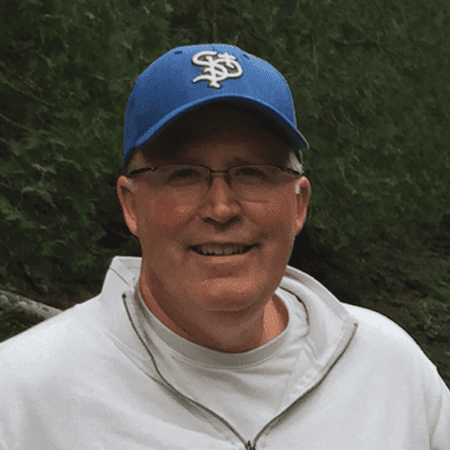
By Mike O’Halloran
Founder and Editor, Sports Feel Good Stories
Mike O’Halloran founded Sports Feel Good Stories in 2009. He has authored three books on sports jokes, co-authored four trivia books, and authored three books on basketball coaching. Mike has also written a book on sports slogans and captions. He coached youth basketball for 15 seasons, taught tennis, and was a contributing writer for USA Football, the youth arm of the NFL.
Mike is the publisher of the Well-Prepared Coach line of coaches’ practice plans and editable award certificates. He is the founder of the Fantasy Football Team Names Hall of Fame. Mike is married with four children.
You are on The Mount Rushmore of Baseball Promoters feature.
