
The best flag football plays for high school players don’t require a complicated playbook, a miniature Patrick Mahomes, or a coach who spends 40 hours a week watching game film.
They require something much simpler: a good idea, a little practice, and five or seven kids who understand where they’re supposed to go when somebody yells, “Hike!”
Youth flag football is a wonderful introduction to football. Kids learn teamwork, passing, catching, running, defensive positioning, and how to celebrate a touchdown without accidentally tackling a teammate.
But here’s something every new coach should understand: A simple play executed well will beat a complicated play executed poorly almost every time.
That’s why we’ve assembled 25 easy flag football plays for kids, complete with a free printable playbook featuring diagrams, offensive formations, defensive strategies, and coaching tips.
Whether you’re coaching enthusiastic first-graders who sometimes run the wrong direction or older players beginning to understand offensive strategy, these plays will help your team move the football, score touchdowns, and have fun.
And with a little luck, nobody will run off the field because they spotted the ice cream truck.
- How to Use These Flag Football Plays and Diagrams
- 10 Easy Passing Plays for Youth Flag Football
- 6 Easy Running Plays for Flag Football
- 4 Misdirection and Trick Plays for Kids
- 3 Flag Football Plays for the Red Zone
- 2 More Plays Every Youth Coach Should Have
- Five-on-Five vs. Seven-on-Seven Flag Football: What's Different?
- 3 Defensive Flag Football Formations Every Coach Should Teach
- 10 Coaching Tips for First-Time Flag Football Coaches
- A Simple 60-Minute Youth Flag Football Practice Plan
- How to Choose the Right Plays During a Game
- Frequently Asked Questions About Flag Football Plays for Kids
- Final Thoughts: Good Plays Are Nice. Good Coaching Is Better.
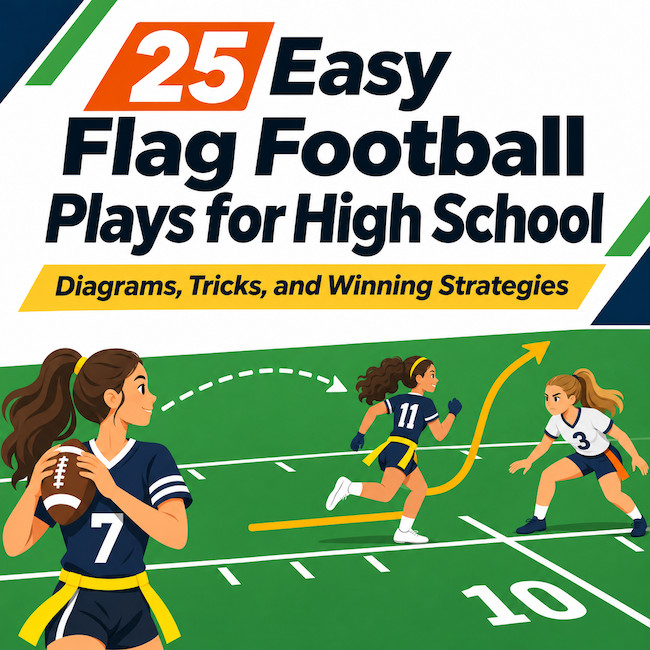
How to Use These Flag Football Plays and Diagrams
Before introducing the plays, let’s establish a simple system.
Our diagrams use a basic five-player offense, with adjustments for seven-on-seven football explained later.
Offensive positions:
- QB — Quarterback: Receives the snap and hands off or passes.
- C — Center: Snaps the football and can run a passing route.
- X — Left Receiver: Usually lines up toward the left sideline.
- Y — Inside or Right Receiver: Runs short, intermediate, or crossing routes.
- Z — Receiver or Running Back: Can line up wide or in the backfield, depending on the play.
Understanding the diagram symbols:
- Solid arrows show where players run.
- Dashed red arrows indicate the ball’s intended path.
- The line of scrimmage (LOS) separates the offense from the defense.
- Players move toward the top of the diagram to advance the football.
The play diagrams are simplified teaching tools, not exact yard-by-yard field measurements.
Free printable resource: Our accompanying 25-play PDF includes every offensive diagram, three defensive formations, a seven-on-seven conversion guide, and blank play-design sheets.
Important Flag Football Rules Coaches Should Know
Flag football rules aren’t identical across leagues.
Under standard NFL FLAG rules, the quarterback cannot advance the ball directly after receiving the snap. Running plays are restricted in designated no-run zones near midfield and the goal line. Offensive blocking and screening are prohibited.
USA Football’s five-on-five and seven-on-seven rules also restrict blocking and direct quarterback runs, but its standard no-run zones are located near the goal line rather than midfield.
Passing clocks, motion rules, defensive rushing, and younger-age modifications can also vary.
Always consult your league’s rulebook before installing a play. You don’t want to practice the perfect trick play for three weeks, only to discover it’s illegal.
For clarification, visit NFL FLAG or USA Football’s official flag football rules.
10 Easy Passing Plays for Youth Flag Football
Passing is the foundation of an effective flag football offense.
Young quarterbacks generally benefit from short, predictable throws. Coaches should emphasize proper spacing, catching with two hands, and throwing to open areas rather than forcing the football toward a favorite teammate.
These first 10 plays provide a dependable foundation.
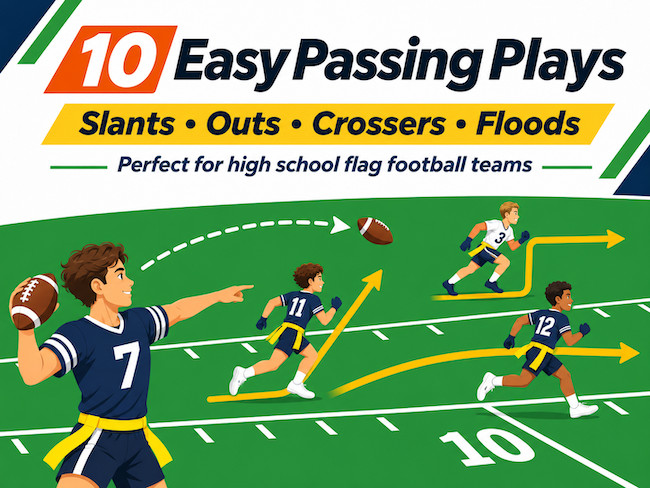
Play 1: Quick Slant
Best for: Beginners, short-yardage situations, and quick completions.
The X receiver takes several steps forward before cutting diagonally toward the middle. The quarterback delivers the ball as the receiver makes the cut.
The center runs a short route to occupy another defender, while Y and Z create space on the opposite side.
Coaching tip: Tell the receiver to cut decisively. A slant should look like a sudden change of direction, not somebody wandering toward the concession stand.
Explore our Football Captions and Hashtags for adding fun to your football photos.
Play 2: Twin Outs
Best for: Attacking the sidelines and gaining short yardage.
X and Y run short routes before breaking toward opposite sidelines. The quarterback identifies which receiver has the most separation and throws quickly.
The center releases through the middle, providing another passing option.
Coaching tip: Have receivers turn their heads toward the quarterback immediately after making their cuts. Timing matters more than speed.
Play 3: Center Pop
Best for: Younger players and defenses that forget about the center.
After snapping the football, the center releases straight into the middle of the field.
The outside receivers run routes that pull defenders toward the sidelines, leaving a short opening for the center.
A simple completion can produce surprising yardage when the defense is paying attention to everybody except the player who snapped the ball.
Coaching tip: Practice the snap and release as one smooth sequence.
Play 4: Hitch Stop
Best for: Easy completions against defenders playing several yards off the receivers.
X runs approximately five yards, stops, turns toward the quarterback, and presents a target.
The quarterback should throw as the receiver turns, not after the receiver has been standing around long enough to introduce himself to the defender.
Coaching tip: Teach the receiver to stop under control and return slightly toward the ball when appropriate.
Play 5: Crossing Trails
Best for: Attacking zone defenses and teaching route combinations.
X runs a shallow crossing route from left to right. Y crosses from the opposite side at a different depth.
The quarterback watches how defenders react and throws to the open receiver.
The routes should cross at different depths to reduce congestion and accidental contact.
Coaching tip: Cross routes are designed to create open passing lanes, not illegal picks or screens.
Play 6: Right-Side Flood
Best for: Stretching a zone defense toward one sideline.
Three receivers attack different depths on the right side of the field.
One runs short, another intermediate, and the third deeper toward the sideline.
This forces defenders to decide which area to protect. The quarterback chooses the uncovered receiver.
Coaching tip: Teach the quarterback to read from the short route to the deeper routes unless the defense clearly gives up an easy throw.
Play 7: Left-Side Flood
Best for: Giving young quarterbacks a familiar play in the opposite direction.
This is the mirror image of the Right-Side Flood.
The center releases toward the left flat, while other receivers occupy intermediate and deeper areas.
The beauty is simplicity. Kids already know the concept; they merely reverse the direction.
Coaching tip: Practice both Flood plays consecutively so players recognize the similarities.
Enjoy our favorite football quotes for more insights into the game.
Play 8: Corner and Flat
Best for: Creating a high-low passing choice near the sideline.
One receiver runs a short route toward the sideline. Another attacks deeper toward the corner.
If a defender stays deep, throw underneath. If the defender comes forward, look toward the deeper receiver.
The quarterback must recognize the opening without waiting too long.
Coaching tip: Draw two imaginary windows on the field and ask the quarterback which one is open.
Play 9: Stick and Sprint
Best for: Short-yardage plays against zone coverage.
Y runs forward several yards, plants a foot, and turns into an open passing window. Z releases toward the sideline as a second option.
The quarterback reads the nearby defender and chooses the easier throw.
This is an excellent play for teaching receivers how to find open spaces rather than simply running away from defenders.
Coaching tip: The receiver should show the quarterback an easy target with hands ready.
Play 10: Quick Swing
Best for: Getting the football to an athletic player near the sideline.
Z releases toward the right side and catches a quick pass just beyond the line of scrimmage.
The receiver then attempts to turn upfield before defenders can pull a flag.
Other receivers run legitimate passing routes to stretch the defense. They must not block or interfere with defenders.
Coaching tip: Keep the throw short and accurate. This play works best when the receiver catches while moving into open space.
6 Easy Running Plays for Flag Football
Running plays offer several advantages for younger teams.
They’re relatively easy to learn, don’t require a quarterback with a cannon for an arm, and create opportunities for players who are still developing their catching skills.
Remember that the player receiving the original snap generally cannot run directly across the line of scrimmage under standard NFL FLAG and USA Football rules. Use legal handoffs or backward passes, and avoid running plays in designated no-run zones.
Play 11: Right Sweep
Best for: Fast runners and defenses that crowd the middle.
Z lines up behind and to the right of the quarterback.
After receiving the handoff behind the line of scrimmage, Z runs toward the right sideline before turning upfield.
The outside players run their assigned routes, creating space without blocking defenders.
Coaching tip: Teach the runner to look for an open lane rather than automatically racing all the way to the sideline.
Play 12: Left Sweep
Best for: Keeping the offense unpredictable.
The concept is identical to the Right Sweep, but the runner attacks the left side.
Young players appreciate the familiarity, and coaches appreciate having two different plays without teaching two entirely different systems.
Coaching tip: Give the plays memorable calls such as “Blue Right” and “Blue Left.”
Play 13: Middle Burst
Best for: Defenses that spread too far toward the sidelines.
Z takes a direct handoff and accelerates through an opening in the middle of the defense.
The center releases into a passing route after snapping rather than attempting to block.
The runner’s job is to recognize space and attack it immediately.
Coaching tip: Have the runner choose an opening before taking the handoff, then adjust if the defense moves.
Play 14: Counter Cut
Best for: Defenders who aggressively chase the first movement they see.
The running back initially steps toward the right before cutting toward an available lane on the left.
That little change of direction can cause defenders to overcommit.
The runner must remain balanced, keep the football secure, and avoid flag guarding.
Coaching tip: A sharp change of direction is more important than a dramatic fake.
Play 15: Jet Handoff
Best for: Quick players who can catch a handoff while moving.
Z begins moving laterally behind the quarterback, following whatever motion rules the league allows.
The quarterback hands off while Z is still behind the line of scrimmage.
Z continues toward the opposite sideline and turns upfield when an opening appears.
Coaching tip: Practice the exchange at walking speed before increasing speed. A spectacular fake means little if the football lands on the grass.
Play 16: Double Handoff
Best for: Introducing misdirection to teams with reliable ball-handling skills.
The quarterback hands to Z behind the line of scrimmage. Z then hands the ball to X, who has moved into the backfield to receive the exchange.
X attacks the opposite side.
Both exchanges must occur legally behind the line of scrimmage.
Coaching tip: Start with stationary exchanges. Add movement only after the players can consistently complete both handoffs.
It’s a fun play, but it requires enough backfield space and time to execute without collisions.
4 Misdirection and Trick Plays for Kids
Once a team can handle basic passing and running, introduce a few surprises.
The purpose of a trick play isn’t to fool the defense with an elaborate theatrical production. It’s to make defenders react to one possibility while the offense executes another.
Start with these four.
Play 17: Fake Sweep, Center Pop
Best for: Defenses that react aggressively to running plays.
The quarterback pretends to hand the ball to Z on a sweep, then delivers a short pass to the center releasing into the middle.
The outside movement draws attention away from the intended receiver.
Coaching tip: The quarterback should keep the ball secure during the fake. Defenders won’t be fooled if the QB announces, “This is fake!”
Play 18: Play-Action Slant
Best for: Teams that have already established an effective running game.
The quarterback shows a handoff to Z before throwing to X on a quick slant.
The fake is designed to make underneath defenders hesitate.
The receiver must execute the same slant route used in Play 1.
Coaching tip: Reuse familiar routes in trick plays. Change only one or two assignments to reduce mistakes.
Play 19: Jet Fake, Cross
Best for: Defenses that chase motion across the formation.
Z moves across the backfield as though receiving a Jet Handoff.
The quarterback keeps the football and throws to X crossing behind the area vacated by the defenders.
The timing of the fake and crossing route is the key.
Coaching tip: Practice the quarterback’s eyes. Looking toward the motion briefly can help sell the fake without delaying the throw.
Play 20: Handoff and Throw
Best for: Older or more experienced youth teams.
The quarterback hands the ball to Z behind the line of scrimmage.
Instead of running, Z sets up and throws a forward pass to Y downfield.
This can surprise defenses that immediately charge toward a potential runner.
Coaching tip: The new passer must have room to throw, remain behind the line of scrimmage, and understand the league’s passing rules.
Don’t attempt it merely because your team watched a spectacular trick play on television the night before.
3 Flag Football Plays for the Red Zone
As the offense approaches the goal line, open space becomes harder to find.
Defenders have less ground behind them to protect, which means receivers must make precise cuts and quarterbacks must make quick decisions.
In no-run zones, these passing concepts become especially valuable.
Play 21: Goal-Line Speed Out
Best for: Short touchdowns and extra-point attempts.
Y runs several steps toward the goal line before breaking sharply toward the sideline.
The quarterback throws quickly to a spot in front of the receiver.
The timing should be practiced repeatedly because the boundary and defenders leave little room for error.
Coaching tip: Tell the quarterback to throw toward open space, where the receiver is going, instead of directly at a defender-covered player.
Play 22: Back-Line Break
Best for: Finding an open receiver toward the back corner of the end zone.
Y begins with a vertical route and angles toward a back corner.
Other receivers occupy defenders with legitimate routes at shorter depths.
The quarterback looks for an available throwing lane and must avoid forcing a late pass near the boundary.
Coaching tip: Practice keeping feet inbounds. An impressive catch three feet beyond the end line is still an incomplete pass.
Play 23: Delayed Center
Best for: Goal-line defenses focused on outside receivers.
The center snaps the ball, pauses briefly, and releases into an open middle area.
The quarterback should be prepared to throw as soon as the center reaches the passing window.
The delay should be modest, especially in leagues with a short passing clock.
Coaching tip: Teach the center to release cleanly without initiating contact with a defender.
2 More Plays Every Youth Coach Should Have
A good playbook needs more than runs, short passes, and tricks.
It also needs a few reliable plays for situations when the defense has figured out your favorite calls.
Play 24: Two-Level Choice
Best for: Converting important downs.
X runs a short out route while Y breaks inward at a deeper distance.
The quarterback reads the nearby defenders and chooses whichever receiver has room to catch the ball.
This creates an easy short-versus-intermediate decision.
Coaching tip: Avoid telling young quarterbacks to throw deep simply because it’s an important down. Take the open completion.
Play 25: Four Corners
Best for: Spreading defenses and creating several passing choices.
All four eligible receivers release into different areas.
X and Y threaten deeper outside spaces, Z provides a shorter sideline option, and the center occupies the middle.
The quarterback identifies the easiest completion.
Coaching tip: Give the quarterback a designated first read. Four available receivers shouldn’t mean four simultaneous decisions.
This is an excellent final play because it reinforces spacing, timing, and reading the defense.
Five-on-Five vs. Seven-on-Seven Flag Football: What’s Different?
The most important difference is obvious: seven-on-seven puts four additional players on the field, two on each team.
But the strategic differences are more interesting.
| Coaching consideration | 5-on-5 | 7-on-7 |
|---|---|---|
| Offensive players | 5 | 7 |
| Typical passing options | Center plus 3 other receivers | Center plus 5 other receivers or backs |
| Offensive design | More open field and simple reads | More route combinations and congestion |
| Defensive strategy | Often 2-2-1, 3-2, or man coverage | Additional underneath and deep coverage responsibilities |
| Coaching challenge | Teaching every player multiple responsibilities | Coordinating more routes and defensive assignments |
These are coaching comparisons, not universal formation requirements. Local rulebooks govern legal alignments and permitted contact.
How to Convert a Five-on-Five Play to Seven-on-Seven
You don’t need 25 entirely new plays.
Start with your existing five-player formation and add two players, called A and B.
For example, on Quick Slant:
- X runs the original slant.
- Y runs the original intermediate route.
- Z runs the original outside route.
- C releases through the middle.
- A runs a short out route.
- B runs a deeper seam route.
- QB makes the passing decision.
The basic play remains familiar.
On running plays, extra players can run legitimate passing routes to occupy defenders. They should not be used as blockers or moving screens in non-contact formats.
For younger seven-on-seven teams, avoid sending every player into the same section of the field. More receivers don’t automatically produce more open space.
Sometimes they produce a traffic jam featuring seven children in matching jerseys.
3 Defensive Flag Football Formations Every Coach Should Teach
A good offense helps your team score touchdowns. A good defense makes sure the opposing team doesn’t score quite as many.
For younger players, three defensive formations provide an excellent starting point.
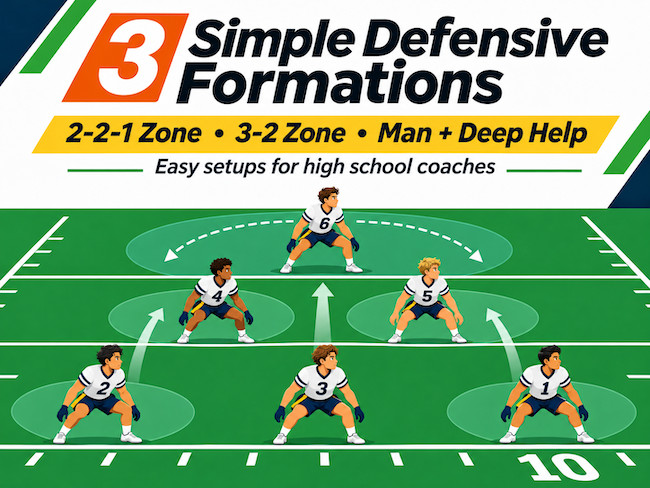
2-2-1 Zone Defense
This is one of my favorite starting defenses for five-on-five youth teams.
Alignment:
- Two defenders protect short passing areas.
- Two defenders cover intermediate and deeper areas.
- One safety plays deepest and protects against long throws.
The goal is to defend space rather than chase individual receivers everywhere.
Advantages: Players develop an understanding of defensive positioning and avoid becoming completely confused by crossing routes.
Weakness: Smart offenses can exploit openings between defenders.
Coaching tip: Teach everyone to call out receivers entering or leaving their zone.
3-2 Zone Defense
The 3-2 places three defenders across underneath passing areas and two defenders farther back.
It’s especially useful against opponents relying on short passes and quick crossing routes.
Advantages: Provides more short-field coverage and immediate flag-pulling opportunities.
Weakness: Fewer deep defenders can create vulnerable areas against long passing plays.
Coaching tip: The two deep defenders must communicate constantly and avoid chasing the same receiver.
Man-to-Man With a Deep Helper
Four defenders match up against the offense’s four eligible receivers in a standard five-on-five passing formation.
The fifth defender plays deeper, providing additional protection against long throws.
Advantages: Responsibilities can be straightforward, especially for players who enjoy covering one opponent.
Weakness: Talented receivers can create mismatches, and crossing routes require communication to prevent collisions.
Coaching tip: Make sure somebody is assigned to the center. Leaving the center uncovered is a wonderful defensive strategy—if your goal is helping the other team.
What About Rushing the Quarterback?
In leagues that allow designated quarterback rushers, a defender may rush from the prescribed starting distance.
The exact rule varies by competition and age group. Many standard formats require the designated rusher to start at least seven yards behind the line of scrimmage.
A rusher can pressure an inexperienced quarterback, but rushing removes someone from pass coverage.
For beginners, I prefer teaching coverage responsibilities first.
For seven-on-seven teams, a four-underneath, three-deep zone is a useful starting framework. Coaches can adjust those responsibilities when deploying a legal rusher.
10 Coaching Tips for First-Time Flag Football Coaches
Being a successful youth flag football coach involves much more than drawing plays.
Your players need to understand the basics, feel confident, and believe they’re contributing.
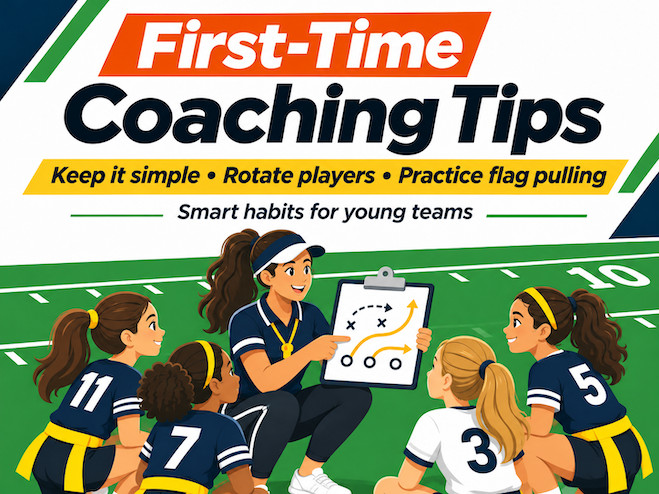
Here’s where I would concentrate.
- Start with five or six plays. Don’t introduce all 25 during your first practice. Begin with two short passes, two runs, and a simple crossing play.
- Use memorable names. “Blue Sweep” is easier for a seven-year-old to remember than “Trips Right Motion 42 Counter.”
- Teach routes without defenders first. Walk players through assignments, then progress to half speed and full speed.
- Rotate positions. Give everyone opportunities to run, catch, throw, and defend. The player who struggles catching in Week 1 may become your most reliable receiver in Week 6.
- Practice flag pulling every week. Teach defenders to approach under control, focus on the runner’s hips, and pull a flag without grabbing clothing.
- Prioritize ball security. Young players need repetition handling snaps, handoffs, and catches.
- Keep instructions short. Most children respond better to one correction at a time than to an extended explanation of offensive philosophy.
- Teach safe movement. Players should avoid blocking, screening, illegal contact, diving, and flag guarding, consistent with their league’s rules.
- Praise decisions, not just touchdowns. Celebrate players who find an opening, make a good defensive read, or execute an assignment correctly.
- Make sure every player participates. A winning season shouldn’t depend on handing the ball to the same two athletes on every possession.
Remember: Children usually sign up for flag football because they want to play football.
Not because they dream of standing on the sideline watching somebody else play football.
A Simple 60-Minute Youth Flag Football Practice Plan
The following schedule works particularly well for introductory teams and can be adjusted for older players.
| Time | Activity | Coaching emphasis |
|---|---|---|
| 0–8 minutes | Warm-up and movement games | Running, changing direction, coordination |
| 8–18 minutes | Passing and catching pairs | Accuracy, ready hands, basic routes |
| 18–28 minutes | Flag-pulling drills | Positioning, safe technique, control |
| 28–43 minutes | Install three offensive plays | Assignments, spacing, timing |
| 43–53 minutes | Small-sided competition | Executing plays against defenders |
| 53–60 minutes | Fun challenge and team huddle | Confidence, teamwork, review |
My Favorite Beginner Practice Drill
Set up a square with four cones.
One player starts with the football while another begins approximately five yards away.
The ball carrier tries to reach the opposite side while the defender attempts to pull a flag.
Rotate roles after every attempt.
This simple activity helps teach:
- Controlled defensive approach.
- Proper flag-pulling technique.
- Changes of direction.
- Running toward open space.
- Sportsmanship and confidence.
As players improve, increase the starting distance or adjust the square’s size.
Don’t turn the drill into a full-contact wrestling match. The flags are there for a reason.
How to Choose the Right Plays During a Game
Your playbook should function like a toolbox.
You don’t need every tool on every possession. You need the right tool for the situation.
| Game situation | Plays to consider |
|---|---|
| First down | Right Sweep, Quick Slant |
| Short yardage | Center Pop, Hitch Stop |
| Defense crowding the middle | Right Sweep, Left Sweep |
| Defense protecting sidelines | Middle Burst, Crossing Trails |
| Aggressive defenders | Counter Cut, Play-Action Slant |
| Defenders dropping deep | Twin Outs, Stick and Sprint |
| Important conversion | Two-Level Choice |
| No-run zone | Goal-Line Speed Out, Delayed Center |
| Need a bigger gain | Corner and Flat, Four Corners |
| Defense anticipating your usual plays | Fake Sweep, Center Pop |
This chart is a starting point rather than a guarantee.
Pay attention to what the defense is doing, which players are executing confidently, and the down-and-distance requirements.
A five-yard completion might be terrific on second-and-four.
It might be considerably less exciting on fourth-and-twelve.
Build a Five-Play Opening Script
For a young team, consider opening a game with:
- Quick Slant.
- Right Sweep.
- Center Pop.
- Left Sweep.
- Crossing Trails.
These five plays establish your basic offense while helping you learn how opponents defend the run, middle, and sidelines.
Then adjust as the game develops.
Frequently Asked Questions About Flag Football Plays for Kids
What are the easiest flag football plays for beginners?
Quick Slant, Center Pop, Right Sweep, Left Sweep, and Hitch Stop are excellent introductory choices. They feature relatively simple assignments, predictable timing, and opportunities for success without complicated formations.
How many plays should a youth flag football team have?
For young beginners, five to eight well-practiced plays are generally better than a large playbook. As players develop, coaches can add variations, misdirection, and situational calls.
The important measure isn’t how many plays the team knows. It’s how many plays the team can execute successfully.
What is the best flag football offense for five-on-five?
A spread formation with a quarterback, center, and three receivers or backs is an excellent starting point. It creates space and supports quick passes, handoffs, crossing routes, and multiple formations without extensive complexity.
Can a quarterback run in flag football?
Under standard NFL FLAG and USA Football five-on-five rules, the player receiving the initial snap cannot simply run across the line of scrimmage. Some variations permit a player to run after a legal exchange, but specific rules differ.
Always check your league’s regulations before designing quarterback running plays.
Can flag football players block defenders?
NFL FLAG and USA Football’s standard non-contact formats prohibit blocking and screening. Players without the football may run legitimate routes but cannot deliberately impede defenders.
Some independent leagues use different rules, so confirm the restrictions for your competition.
What’s the best defense for youth flag football?
A 2-2-1 zone is an excellent starting choice for five-on-five teams because it establishes understandable responsibilities for underneath coverage and deeper passes.
As players improve, add 3-2 coverage, man-to-man assignments, and legal quarterback rushing strategies.
Final Thoughts: Good Plays Are Nice. Good Coaching Is Better.
There’s a special kind of joy in watching a young flag football team execute a play perfectly.
The quarterback delivers a clean snap exchange. A receiver makes the right cut. The football arrives on time. A flag defender misses by inches.
Touchdown. The kids celebrate as though they’ve just won the Super Bowl.
But great youth coaching isn’t measured entirely by touchdowns, victories, or the number of plays on your laminated wristband. It’s measured by improvement, confidence, teamwork, sportsmanship, and whether your players are excited to return next week.
Start with a handful of these 25 easy flag football plays. Teach them patiently. Practice them consistently. Add variety as your team develops.
Most importantly, make sure every child gets opportunities to contribute.
Because someday, your young players might forget whether they won their third game of the season. But they’ll remember the touchdown they scored, the friend who threw them the football, and the coach who believed they could make the play.
And that’s a pretty good definition of winning.
Printable coaching resource:
It features route diagrams, defensive formations, and blank play-design sheets.
Rule references: NFL FLAG Rules | USA Football Flag Football Rulebooks

By Mike O’Halloran
Founder and Editor, Sports Feel Good Stories
Mike O’Halloran founded Sports Feel Good Stories in 2009. He has authored three books on sports jokes, co-authored four trivia books, and authored three books on basketball coaching. Mike has also written a book on sports slogans and captions. He coached youth basketball for 15 seasons, taught tennis, and was a contributing writer for USA Football, the youth arm of the NFL.
Mike is the publisher of the Well-Prepared Coach line of coaches’ practice plans and editable award certificates. He is the founder of the Fantasy Football Team Names Hall of Fame. Mike is married with four children.
You’re on our 25 Easy Flag Football Plays for High School (With Free Diagrams) feature.
You might also like:
