
Talent can win a drill. Teamwork can rescue a season. And sometimes the difference begins with something less glamorous than a championship speech: a five-minute game involving a ball, four cones, and a kid finally learning everyone’s name.
These 40 quick team-building games for youth sports teams help coaches develop communication, trust, inclusion, leadership, and resilience without sacrificing an entire practice. They work with basketball, soccer, baseball, softball, volleyball, and hockey teams, with simple equipment substitutions.
Most are suited to roughly ages 8–16; simplify language and movement for younger players, or raise the decision-making challenge for teens.
You’ll find five-minute icebreakers, ten-minute communication challenges, indoor activities for rainy days, and spirited competitions that reward team play. Twenty-nine are new formats or substantial coaching variations developed for this guide, marked ★. The rest are dependable favorites with youth-sports adjustments.
- How to Choose the Right Team-Building Game
- 12 Five-Minute Team-Building Games and Icebreakers
- 12 Ten-Minute Challenges That Build Communication and Trust
- 8 Indoor Team-Building Activities for Rainy Days and Team Meetings
- 8 Competitive Team-Building Games That Work Across Sports
- How to Adapt the Games for Five Popular Youth Sports
- A Simple 15-Minute Team-Chemistry Routine
- Free Printable Team-Building Game Cards for Coaches
- Final Thoughts: The Best Teams Build More Than a Scoreboard
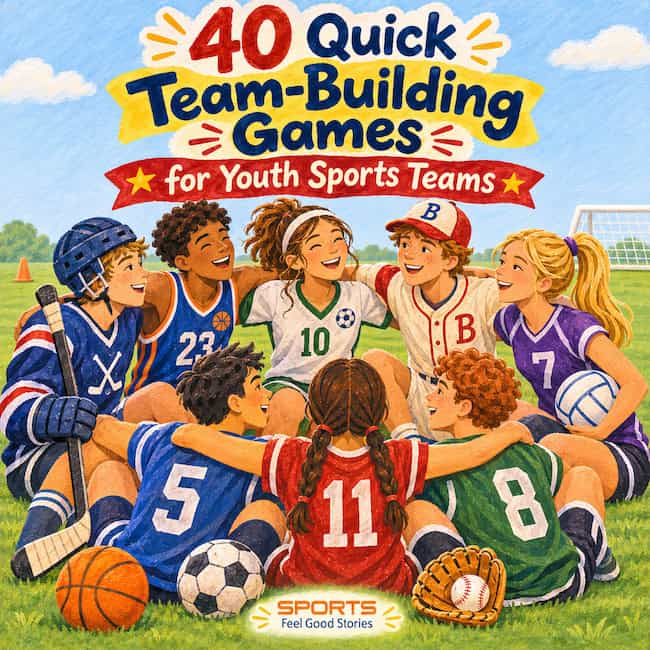
How to Choose the Right Team-Building Game
A little planning makes these activities more than entertaining time-fillers. Start with the problem you want to solve. New teammates need names and common ground. A quiet group needs opportunities to speak. Players who blame one another after mistakes need practice resetting together.
Every activity below lists its time, players, equipment, and primary teamwork skill. Player counts are flexible: split larger rosters into simultaneous groups or stations.
Use soft balls and low-contact rules, supervise all activities, and adjust for players’ abilities and comfort. No child should have to reveal private information or tolerate unwanted physical contact to participate.
Keep the postgame discussion short. Ask one question, listen to two or three answers, and connect the lesson to an actual game situation.
12 Five-Minute Team-Building Games and Icebreakers
These work before warmups, after a difficult practice, or while waiting for the last carpool to arrive.
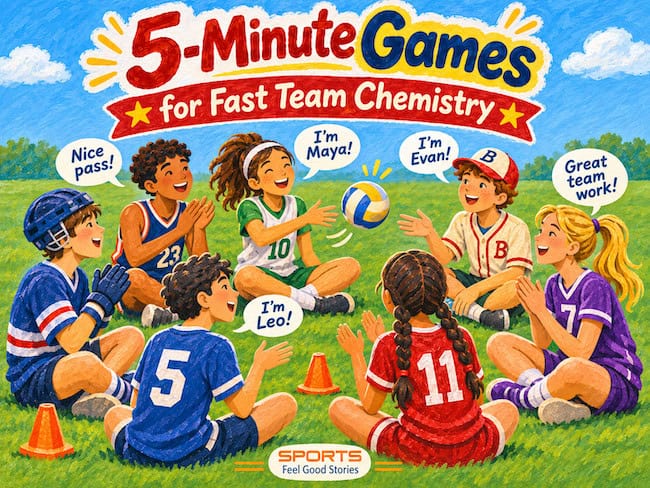
1. Name & Assist
Time: 5 minutes | Players: 6–20 | Equipment: One soft ball | Skill: Names and awareness
Players form a circle. One calls a teammate by name and passes the ball. The receiver thanks the passer by name, then sends it to someone who hasn’t received a pass.
Complete two rounds without skipping anyone. Basketball and soccer teams may use their usual passing methods; hockey players can pass on a safe off-ice surface.
Coaching point: A teammate’s name is the simplest useful play call.
Discover our Five Parenting Tips To Increase the Fun Factor in Youth Sports.
2. Three-Word Huddle ★
Time: 5 minutes | Players: 4–20 | Equipment: None | Skill: Shared identity
Groups of four or five invent a three-word description of the team they want to become: “Fearless, Kind, Prepared,” for instance.
Everyone contributes a word or a reason. Each group shares its slogan, then the whole team chooses one quality to demonstrate during practice.
This works especially well at a season’s first meeting, when “undefeated” isn’t yet an option.
3. High-Five Map ★
Time: 5 minutes | Players: 6–24 | Equipment: Four cones | Skill: Appreciating different strengths
Give four corners a quality: hustle, creativity, listening, and encouragement. Players move to the corner representing the quality they value most.
Pair athletes from different corners and ask them to describe how those qualities complement each other. Don’t require actual high-fives; a wave works perfectly.
The message is that strong teams need more than twelve copies of their leading scorer.
4. One Thing in Common
Time: 5 minutes | Players: 6–24 | Equipment: None | Skill: Personal connection
Pair unfamiliar teammates. Give them one minute to find an interest they share outside sports, then rotate twice.
Afterward, each player introduces someone and mentions the common ground: books, pets, tacos, or inexplicable enthusiasm for algebra.
Coaches should discourage teasing and steer clear of sensitive topics.
Explore our 15 Tips for Motivating Youth Athletes.
5. Compliment Relay
Time: 5 minutes | Players: 6–20 | Equipment: None | Skill: Positive feedback
In a circle, each athlete gives the next person one specific compliment about effort or behavior.
“You encouraged me after I missed” beats “You’re awesome,” although both have their moments.
Continue until every player gives and receives encouragement.
6. Sideline Signal ★
Time: 5 minutes | Players: 6–20 | Equipment: None | Skill: Nonverbal communication
Pairs create a silent signal meaning “I’m open,” “Help me,” or “Nice effort.”
Combine pairs into groups of four and see whether everyone understands the signals. Let players invent accessible gestures or visual cues.
Sometimes the best teammate says something without making a sound.
7. Two Truths & a Team Wish
Time: 5 minutes | Players: 4–20 | Equipment: None | Skill: Getting acquainted
Give the familiar icebreaker a sports twist. Each athlete shares two harmless true facts and one hope for the season; teammates guess which statement is the wish.
A player might love fishing, have three siblings, and hope to become a better passer.
End by asking how teammates could help make one wish happen.
8. Captain for 60 Seconds ★
Time: 5 minutes | Players: 6–20 | Equipment: Timer | Skill: Shared leadership
Invite successive one-minute captains to lead a simple stretch, team chant, or mobility-friendly warm-up.
Record who has led so everyone gets a turn across multiple practices.
The goal isn’t to discover a pint-sized drill sergeant. It’s to show that leadership can sound like a calm invitation rather than a shouted order.
9. Quiet Lineup
Time: 5 minutes | Players: 6–20 | Equipment: None | Skill: Observation and patience
Without speaking, athletes arrange themselves by birthday month or alphabetical first name. They can gesture, point, or write if necessary.
Check the finished line and give one retry. Avoid ordering players by height, weight, or other personal attributes.
You’ll quickly discover who communicates clearly, who notices confusion, and who believes February comes after September.
10. Find Your Echo ★
Time: 5 minutes | Players: 8–24 | Equipment: None | Skill: Active listening
Partners explain how they like to be encouraged after a mistake. Before responding, each partner repeats the other’s answer in their own words, then checks for accuracy.
Rotate once. Nobody should be required to discuss private experiences.
For coaches, this game provides a valuable scouting report: some players want a pep talk; others want a simple “Next play.”
11. Reverse Introductions ★
Time: 5 minutes | Players: 6–20 | Equipment: None | Skill: Empathy and listening
Pairs exchange names, favorite positions, and one skill they’re learning.
Each introduces the other in the first person: “I’m Sam, and I’m getting better at passing with my left foot.” The teammate can gently correct mistakes.
The challenge is listening accurately enough to represent somebody else. That’s a useful habit for defenders, teammates, and future sports broadcasters.
12. One-Word Reset ★
Time: 5 minutes | Players: 4–24 | Equipment: None | Skill: Recovering from mistakes
Each athlete chooses a reset word such as “next,” “steady,” or “together” and explains it briefly.
Have the group imagine a missed free throw, dropped fly ball, or blown assignment. Everyone practices saying their word and refocusing on the next action.
A team that learns to reset doesn’t need to pretend mistakes never happen.
12 Ten-Minute Challenges That Build Communication and Trust
These activities ask athletes to solve something together. The trick is rewarding collaboration, not simply finishing first.
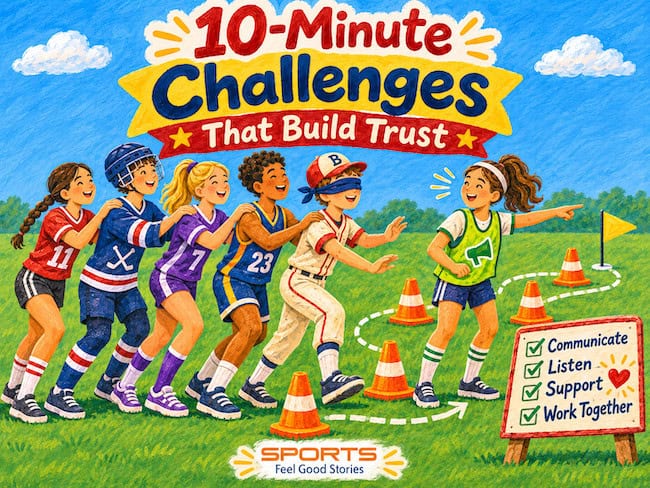
13. Four-Pass Rescue ★
Time: 10 minutes | Players: 8–20 | Equipment: Ball and cones | Skill: Inclusion and timing
Divide players into small teams. To reach a marked target zone, the ball must pass through four different teammates.
A dropped ball means calmly starting the sequence again. Younger groups can use handoffs or a roll.
Stop once to ask whether everyone is moving to support the ball carrier.
The real achievement isn’t a perfect pass; it’s making the next pass possible.
14. The Missing Voice ★
Time: 10 minutes | Players: 6–20 | Equipment: Cones and ball | Skill: Inclusive decision-making
Give groups a simple passing maze. After one attempt, pause for suggestions, inviting players who haven’t spoken to share first while allowing anyone to pass.
Run it again using two proposed changes. Ask which idea helped.
15. Silent Shape
Time: 10 minutes | Players: 6–20 | Equipment: Optional cones | Skill: Nonverbal cooperation
Teams must form a triangle, rectangle, or letter without speaking.
On a hockey rink, arrange cones off the ice or conduct the activity in a safe open area.
After the first attempt, let players discuss what gestures worked, then give them a harder shape. A simple geometry lesson becomes a demonstration of patience and shared problem-solving.
16. Copycat Coach ★
Time: 10 minutes | Players: 6–18 | Equipment: Cones or cups | Skill: Clear instructions
Work in trios. The architect sees a cone pattern; the coach describes it to a builder without pointing; the builder recreates it.
Rotate jobs after each attempt. Start with three cones and add complexity as the group improves.
The lesson lands quickly: “Put it over there” is not a particularly good play call, especially when nobody knows where “there” is.
17. Mission: Everyone Touches ★
Time: 10 minutes | Players: 6–24 | Equipment: One or two balls | Skill: Awareness and support
Groups move a ball from one marker to another, ensuring each player touches or safely directs it once.
Repeat using less time or a more challenging route. Adapt the contact method for different needs.
Teams soon learn that their fastest athlete isn’t necessarily the answer; they need a route that works for everybody.
18. Puzzle Piece Huddle
Time: 10 minutes | Players: 6–20 | Equipment: Paper puzzle pieces | Skill: Cooperation and asking for help
Give each group most pieces of a simple picture or team motto.
Place a few needed pieces with other groups so finishing requires polite requests and trades. Nobody can take another team’s pieces.
It’s a surprisingly useful rehearsal for asking for help without feeling weak.
19. Back-to-Back Builder
Time: 10 minutes | Players: 6–20 | Equipment: Cups or blocks | Skill: Precise communication
One player studies a cup arrangement and describes it to a partner facing away.
The second tries to duplicate the model using spoken instructions only. Compare results and switch roles.
The debrief practically writes itself: clear details beat louder instructions.
20. Traffic-Light Timeout ★
Time: 10 minutes | Players: 6–20 | Equipment: Red, yellow, and green cards | Skill: Judgment and composure
Describe a game situation: your team is rushing, players are arguing, or a passing lane opens.
Players choose green for continue, yellow for slow down and communicate, or red for stop and reorganize.
Groups explain their reasoning. Teach players to recognize a problem before it becomes a three-possession disaster.
21. Three-Call Attack ★
Time: 10 minutes | Players: 6–20 | Equipment: Ball and cones | Skill: Useful game communication
Run a small, low-contact possession game.
Before a scoring attempt, the offense must make three purposeful calls: a teammate’s name, a direction, and a support cue.
Reward useful information, not sheer volume. The objective is conversation with a purpose, not turning the court into a livestock auction.
22. Plan B Relay ★
Time: 10 minutes | Players: 6–24 | Equipment: Cones and ball | Skill: Adaptability
Groups tackle a simple movement or passing route.
Midway through, the coach closes one lane or changes a harmless rule. Give teams 30 seconds to build a new plan, then resume.
Sport is basically an endless series of Plan Bs wearing different jerseys.
23. Coach-Free Minute ★
Time: 10 minutes | Players: 6–20 | Equipment: Optional ball | Skill: Athlete leadership
Ask players to choose a small challenge, then give them a full minute without coach directions.
They organize, attempt it, and decide how to improve. Debrief and repeat with shared leadership.
24. Huddle Translator ★
Time: 10 minutes | Players: 6–20 | Equipment: Prompt slips | Skill: Constructive feedback
Give pairs vague sideline phrases such as “Try harder,” “Talk more,” or “Be smart.”
Ask them to translate each into an action: “Call the receiver’s name” or “Check your shoulder before passing.”
Have players share improved versions. This teaches teammates how to help rather than criticize—and may quietly improve the coach’s vocabulary, too.
8 Indoor Team-Building Activities for Rainy Days and Team Meetings
No field, gym, or ice time? No problem. A classroom, clubhouse, meeting room, or lobby can still produce real team chemistry.
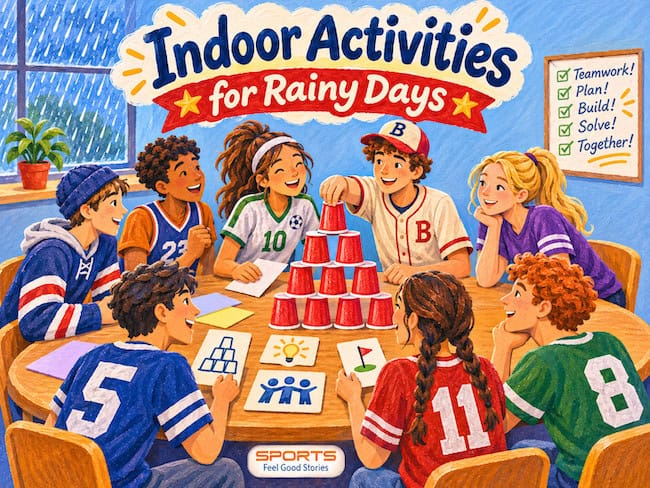
25. Locker-Room Draft ★
Time: 8 minutes | Players: 6–20 | Equipment: Paper and pencils | Skill: Respecting different strengths
Instead of drafting famous athletes, groups draft six qualities for an imaginary championship team: kindness, courage, patience, humor, effort, or focus.
They explain their selections without ranking real teammates.
There is no salary cap on kindness, which makes the general manager’s job easier.
26. Paper Bridge Challenge
Time: 10 minutes | Players: 4–20 | Equipment: Paper, tape, books, coins | Skill: Planning and collaboration
Teams have five minutes to build a bridge between two books using limited paper and tape.
Test its strength with coins, then allow an improvement round. Assign builder, planner, tester, and encourager roles and rotate them.
27. Postgame Headlines ★
Time: 8 minutes | Players: 4–20 | Equipment: Index cards and pens | Skill: Optimism and accountability
Ask groups to write tomorrow’s imaginary newspaper headline about a team behavior: “Bench Energy Fuels Comeback” or “Unselfish Passing Saves the Day.”
This turns a vague hope into a practical goal. Bonus points if the headline doesn’t include “Coach Finally Stops Yelling.”
28. Teammate Bingo
Time: 10 minutes | Players: 8–24 | Equipment: Bingo sheets and pens | Skill: Building friendships
Create bingo squares with friendly prompts: likes to cook, enjoys reading, plays an instrument, or has visited another state.
Players circulate, meet teammates, and write down names. Let players skip prompts they don’t want to answer.
The prize is learning that your backup goalkeeper also plays violin.
29. Playbook Telephone ★
Time: 8 minutes | Players: 6–20 | Equipment: Paper and pencils | Skill: Accuracy and clarification
The first player studies a simple three-step play diagram and verbally passes it down a line.
The last player draws the play. Compare it with the original, then repeat, this time allowing each listener one clarifying question.
That’s precisely the lesson.
30. The Mistake Museum ★
Time: 8 minutes | Players: 4–20 | Equipment: Sticky notes and pens | Skill: Resilience and empathy
Players anonymously write a common sports mistake and a helpful response to it: “Dropped catch—tell the player you’re ready for the next one.”
Post notes, group similar solutions, and discuss the best. Do not pressure anyone to disclose personal failures.
31. Team Values Auction ★
Time: 10 minutes | Players: 6–20 | Equipment: Value cards and tokens | Skill: Prioritizing and negotiating
Small groups receive ten pretend tokens to spend on values such as respect, trust, preparation, joy, and courage.
They negotiate which matter most and defend their purchases. Then the whole roster selects three behaviors the team can actually practice.
32. Thank-You Film Reel ★
Time: 8 minutes | Players: 6–24 | Equipment: Paper strips and pens | Skill: Recognizing contributions
Each player anonymously describes a teammate action deserving a place in an imaginary highlight reel: encouraging a substitute, hustling back on defense, or helping clean up.
Read examples without identifying authors unless they volunteer.
Finish by choosing one team behavior to celebrate next game. Not every great sports moment appears in the box score.
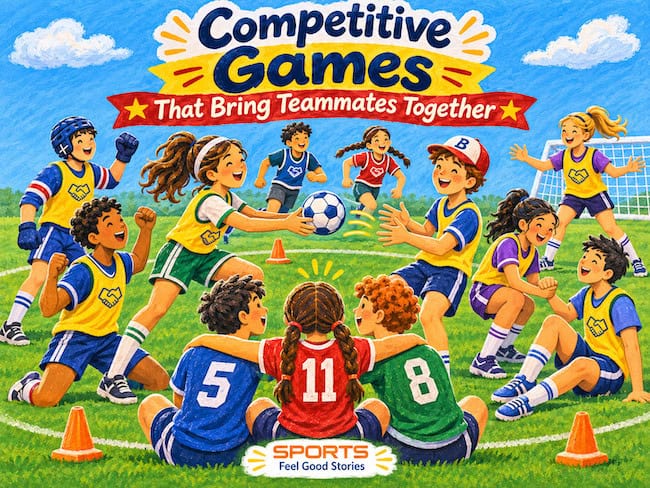
8 Competitive Team-Building Games That Work Across Sports
These challenges have a scoreboard, but team habits remain the main event. Keep matchups balanced and adjust difficulty so every player has a meaningful role.
33. Assist Wins ★
Time: 10 minutes | Players: 8–20 | Equipment: Ball and cones | Skill: Unselfish play
In a 3-on-3 or 4-on-4 game, a scoring attempt counts only when a teammate creates it with a pass or another clear support action.
Rotate players and reward the setup as enthusiastically as the finish.
For baseball, count a successful relay or backing-up play instead of a basket or goal.
This is a wonderful antidote to hero-ball fever.
34. Everyone Scores Relay ★
Time: 10 minutes | Players: 6–24 | Equipment: Balls and targets | Skill: Inclusion and encouragement
Set up shooting, passing, serving, or throwing targets.
Players work in teams, and every athlete makes an attempt before anyone takes a second turn. Track each team’s combined successes.
Adjust distances and equipment so beginners contribute meaningfully.
Notice which players coach, applaud, and reassure others. Those are the assists that won’t appear on a stat sheet.
Explore our Winning Habits of the Best Youth Basketball Coaches.
35. Target Tower ★
Time: 10 minutes | Players: 6–20 | Equipment: Cups and soft balls | Skill: Coordination between roles
One group earns tower-building pieces by hitting a separate target with soft balls; another group constructs the tower.
Rotate roles every two minutes. Keep throwing targets safely away from builders.
There’s your offense-and-defense partnership, minus a three-hour film session.
36. Comeback Clock ★
Time: 10 minutes | Players: 6–20 | Equipment: Timer, ball, cones | Skill: Resilience under pressure
Start a short, low-contact mini-game with one team trailing by two points.
Both sides set a process goal, such as three support calls or better spacing. Play again with the deficit reversed.
The comeback mindset is less about heroic speeches and more about doing the next useful thing.
37. No-Star Scrimmage ★
Time: 10 minutes | Players: 8–20 | Equipment: Ball and cones | Skill: Balanced participation
In a modified small-sided game, no athlete takes a second scoring chance until at least three teammates have tried one.
For volleyball, vary who initiates the ball; for baseball, cycle through every batter in a short skill station.
It simply opens the door for teammates who seldom get the spotlight.
38. Rotating Captain Cup ★
Time: 10 minutes | Players: 6–24 | Equipment: Cones and ball | Skill: Inclusive leadership
Create three short cooperative stations—passing accuracy, a cone route, and a communication challenge.
Assign a new captain at every station. Captains must ask two teammates for input before starting.
An effective leader doesn’t have all the answers; sometimes the job is remembering to ask the right people.
39. Beat Your Best
Time: 10 minutes | Players: 4–24 | Equipment: Ball and timer | Skill: Collective improvement
Set an achievable team benchmark: consecutive passes, clean catches, safe puck relays, or target hits.
Give two attempts with a short strategy huddle between them.
A one-pass improvement counts. Progress is more motivating when everyone helped create it.
40. Fair-Play Finale ★
Time: 10 minutes | Players: 8–24 | Equipment: Ball, cones, scorecard | Skill: Sportsmanship
Run a friendly mini-game with two scoreboards: one for traditional points and one for positive team habits.
Award the second kind for supporting a teammate, acknowledging mistakes, inviting others into play, and showing respect.
How to Adapt the Games for Five Popular Youth Sports
- Basketball: Use chest passes, give-and-go actions, shooting spots, and 3-on-3 half-court play. Try Four-Pass Rescue, Assist Wins, and Three-Call Attack.
- Soccer: Use feet-only passing, space awareness, cone gates, and low-contact possession. Try Mission: Everyone Touches, Plan B Relay, and No-Star Scrimmage.
- Baseball and softball: Use safe throws, relay lines, fielding rotations, and batting stations rather than continuous possession. Try Everyone Scores Relay, Beat Your Best, and Playbook Telephone.
- Volleyball: Use cooperative volleys, toss-and-catch for beginners, target serves, and player rotations. Try Sideline Signal, Rotating Captain Cup, and Fair-Play Finale.
- Hockey: Use off-ice balls or floor-hockey equipment for meeting-room activities, and safe stickhandling or puck-passing lanes on the ice. Try Silent Shape, Three-Call Attack, and Comeback Clock. Follow the rink’s protective-equipment and contact rules.
A Simple 15-Minute Team-Chemistry Routine
You don’t have to run all 40 games or dedicate half of every practice to building camaraderie. Try this short routine once a week:
- Minutes 0–5: A connection game, such as Name & Assist or Find Your Echo.
- Minutes 5–13: A problem-solving game, such as The Missing Voice or Coach-Free Minute. Pick an eight-minute version or shorten a ten-minute activity.
- Minutes 13–15: Ask what worked, what didn’t, and how that lesson applies to the next game.
At the first practice, emphasize names and belonging. Midseason, emphasize communication and shared leadership. After a losing streak, favor reset routines and improvement challenges.
If cliques develop, change partners and groups deliberately—not as a punishment, but as an opportunity to build new connections.
Free Printable Team-Building Game Cards for Coaches
The downloadable set contains 40 cut-out coaching cards, four per US-letter page.
Each has a game title, duration, player count, equipment list, teamwork objective, how-to instructions, and one debrief question.
Print the pages you need, cut along the card edges, and keep a few cards in your practice bag. For outdoor use, plastic sleeves help protect against spilled drinks and the occasional suspiciously enthusiastic sprinkler.
Pick a card according to the team’s needs rather than randomly assigning exercises. Ask players to nominate favorites, too: ownership is part of team chemistry.
And remember that a five-minute activity succeeds when players use the skill later, not merely when the timer sounds.
Final Thoughts: The Best Teams Build More Than a Scoreboard
Youth sports are full of beautiful moments that don’t make a highlight reel: a veteran player welcoming a newcomer, a teammate giving up a shot for a better one, or a nervous athlete discovering that others will support them after a mistake.
Those moments don’t happen solely because a coach says, “We’re a family.” They grow through repeated opportunities to listen, lead, solve problems, and encourage one another.
Give these team-building games a regular place in practice. The payoff might be a better pass, a calmer huddle, or a friendship that lasts much longer than the season.

By Mike O’Halloran
Founder and Editor, Sports Feel Good Stories
Mike O’Halloran founded Sports Feel Good Stories in 2009. He has authored three books on sports jokes, co-authored four trivia books, and authored three books on basketball coaching. Mike has also written a book on sports slogans and captions. He coached youth basketball for 15 seasons, taught tennis, and was a contributing writer for USA Football, the youth arm of the NFL.
Mike is the publisher of the Well-Prepared Coach line of coaches’ practice plans and editable award certificates. He is the founder of the Fantasy Football Team Names Hall of Fame. Mike is married with four children.
You are on our 40 Fun Team-Building Games for Youth Sports Teams feature.
