
Great drills, smart coaching tips, game-winning plays, and a free 90-minute basketball practice plan.
Youth basketball practice should be about more than layup lines, wind sprints, and the coach yelling, “Get your hands up!” for the 47th time.
A great practice develops basketball skills, builds confidence, fosters teamwork, and excites kids to come back. Ideally, players should leave the gym tired, smiling, and convinced they’ve gotten better at something.
Unfortunately, plenty of youth basketball practices feature too much standing around, too much talking, and not nearly enough basketball. If eight players are watching one kid dribble through cones, seven players are learning the ancient art of waiting.
Whether you’re coaching fifth graders who occasionally dribble off their feet or eighth graders who think they’re ready for the NBA Draft, these 25 youth basketball practice ideas will help you get more out of every minute.
We’ll cover what to do before practice, basketball drills that actually develop skills, small-sided competitions, a few dependable plays for important game situations, and what to do after the final whistle.
And because no coach should have to invent a practice plan while driving to the gym, there’s a free printable 90-minute practice plan included below.
- A. Before Practice: Win the First Five Minutes
- B. Youth Basketball Drills That Actually Make Players Better
- C. Small-Sided Games: Where Basketball Skills Become Basketball IQ
- D. Three Go-To Basketball Plays for Situations Every Youth Coach Faces
- E. After Practice: Finish Strong Instead of Just Blowing the Whistle
- Free Printable: A Complete 90-Minute Youth Basketball Practice Plan
- Coach's Clipboard
- How to Adapt Basketball Practice for Different Age Groups
- Seven Coaching Principles That Make Every Basketball Practice Better
- Frequently Asked Questions About Youth Basketball Practice
- Final Thoughts: The Best Youth Basketball Practice Is the One Kids Want to Attend
A. Before Practice: Win the First Five Minutes
The best youth basketball coaches understand a simple truth: practice doesn’t begin when the whistle blows. It begins with preparation.
1. Show Up With a Plan, Not Just a Whistle
Walking into the gym without a practice plan is like showing up for a road trip without directions. You’ll eventually get somewhere, but there’s a decent chance nobody will enjoy the ride.
Before practice, identify one major priority and two supporting skills.
For example, if the priority is improving offensive spacing, your supporting skills might be passing and cutting.
Your drills, coaching points, and scrimmage rules should reinforce that priority.
Coach’s tip: Write down your practice segments and their starting times. A practice plan isn’t a prison sentence, but it keeps you from spending 25 minutes teaching a drill that should take seven.
2. Have the Equipment Ready Before Players Arrive
Cones, basketballs, pinnies, and clipboards should be ready before the first player walks through the door.
Every minute spent digging through an equipment bag is a minute your players could be improving.
Try to have enough basketballs for every player during ball-handling work. Set up stations when possible so multiple players can participate simultaneously.
Coach’s tip: Assign one or two players to help set up or collect equipment. It’s a small responsibility that builds ownership and leadership.
3. Greet Every Player and Check Their Energy
Not every kid arrives at practice in the same frame of mind.
One player just aced a math test. Another had a rotten day at school. A third apparently consumed enough sugar to power a small municipality.
A quick greeting helps you understand how everyone is doing.
Ask something simple:
“How’s your day going?” or “What’s one thing you want to get better at tonight?”
You’ll learn about your players, build relationships, and sometimes discover that a kid needs encouragement more than another lecture about defensive rotations.
Explore our complete season’s worth of basketball practice plans (30 plans in all).

4. Give Early Arrivals Something Productive to Do
There’s no reason players who arrive ten minutes early should spend that time launching half-court shots.
Well, at least not all ten minutes.
Establish an early-arrival routine in which players can choose among ball-handling, form shooting, free throws, or partner passing.
Make these activities informal and enjoyable. Basketball should still have room for experimentation and creativity.
Coach’s tip: Try an early-bird challenge. Can players make five shots with good form from three different close-range spots before practice officially begins?
No prizes necessary. A little personal competition is usually enough.
B. Youth Basketball Drills That Actually Make Players Better
The best youth basketball drills accomplish three things: they keep players moving, develop a specific skill, and resemble game situations.
A drill that looks terrific on a whiteboard isn’t worth much if players are standing around half the time.

5. Start With a Dynamic Warm-Up That Includes a Basketball
Forget ten minutes of jogging around the gym while the coach discusses last night’s NBA game.
Instead, combine movement with basketball skills.
Have players alternate among jogging, defensive slides, skipping, controlled lunges, and dribbling while varying speed.
Finish with short bursts of movement, stopping under control, and pivoting.
Coach’s tip: Give every player a basketball when possible. If they can warm up while improving ball control, you’re getting two benefits for the price of one.
6. Play Dribble Traffic
Every youth basketball player needs to dribble while keeping their head up.
This drill teaches that skill in a controlled, competitive environment.
Create a square approximately 20 feet by 20 feet. Give every player a basketball and have them dribble inside the square without colliding.
Gradually add instructions:
- Switch hands on the whistle.
- Change directions when approaching another player.
- Dribble with the weaker hand for 20 seconds.
- Use a retreat dribble when trapped.
Players must constantly observe their surroundings.
Coach’s tip: Remind players that the basketball isn’t going anywhere without them. They can look up occasionally.
Browse our interesting basketball slang and jargon.
7. Bring Back Red Light, Green Light
Sometimes the best youth basketball drills are games kids already understand.
Have players line up on the baseline, each with a basketball.
Call out commands as they advance down the court.
Green light means dribble forward. Yellow light means slow down. Red light means stop under control.
Add a few basketball-specific variations: blue light for a crossover, purple light for a retreat dribble, and orange light for a jump stop.
Players who lose control retrieve their basketball and continue. There’s no need to eliminate anyone.
This drill develops ball control, listening skills, balance, and the ability to change speeds.
8. Teach Passing and Pivoting Under Pressure
Youth basketball games feature plenty of turnovers caused by poor pivots and panicked passes.
Pair players 10–12 feet apart. One player holds the ball while the partner becomes a passive defender.
The offensive player establishes a pivot foot, protects the basketball, and delivers a crisp chest or bounce pass to a nearby teammate.
Rotate roles frequently. As players improve, allow the defender to apply moderate pressure without reaching or fouling.
Coach’s tip: Teach players to pivot away from pressure rather than spinning randomly like they’re auditioning for Dancing With the Stars.
9. Run the Pass-and-Cut Drill
Passing is important. Moving after passing is just as important.
Put three players around the perimeter and one defender near the basket.
Player A passes to Player B, then immediately cuts toward the basket.
Player B looks for the cutter. If the passing lane is open, deliver the ball for a layup. If not, the cutter clears to an open perimeter position.
Rotate players and introduce additional defenders as the group improves.
This simple drill teaches a fundamental offensive principle: Don’t stand around admiring your pass.
That advice also applies to celebrating a shot that hasn’t gone in yet.
10. Make Form Shooting a Daily Habit
Shooting from three feet is rarely glamorous.
It’s also one of the smartest things a young basketball player can do.
Start players close to the basket, working on balance, alignment, shooting-hand placement, and a relaxed follow-through.
Have them make several shots with sound technique before stepping farther away.
Don’t rush the process. A player who can make 30-foot shots with terrible form isn’t necessarily a good shooter.
They’re simply a young person with an impressive willingness to throw things.
Coach’s tip: Let players choose the distance at which they can maintain proper mechanics. Younger players should use age-appropriate basketballs and hoop heights whenever available.
11. Practice Layups From Both Sides
The right-handed layup gets plenty of attention. The left-handed layup sometimes receives the same treatment as broccoli at a birthday party.
Make finishing with both hands a regular part of practice.
Set up players on opposite sides of the basket. Use short lines or multiple baskets to keep everyone involved.
Practice right-hand finishes from the right and left-hand finishes from the left, emphasizing proper footwork.
Progress to finishes with a defender trailing or giving light pressure.
Coach’s tip: Award bonus points for successful weak-hand layups during competitions. Players improve the skills that coaches regularly reward.
12. Add Catch-and-Shoot With Movement
Standing still and shooting is helpful for mechanics. Games, however, rarely provide shooters with unlimited time to admire the scenery.
Position three players: a passer, a shooter, and a rebounder.
The shooter starts away from the shooting spot, moves into position, receives the pass, squares up, and shoots.
After several repetitions, rotate roles.
Emphasize arriving balanced, showing hands, catching ready to shoot, and following through.
For beginners, begin close to the basket and eliminate any artificial time pressure.
13. Teach the Closeout and Contain
Many youth defenders have two speeds: standing still and charging at shooters like an enthusiastic golden retriever.
Neither is ideal.
Start a defender under the basket and an offensive player on the wing.
The coach passes to the offensive player. The defender moves quickly toward the ball, then slows into a balanced defensive stance with controlled steps and active hands.
Once players have mastered the closeout, allow the offense two or three dribbles to attack.
The defensive goal is simple: keep the offensive player in front without fouling.
Coach’s tip: Praise good defensive possessions even when the offensive player scores a difficult shot. Good defense doesn’t guarantee a miss.
14. Practice Rebounding With the Find-and-Seal Drill
Rebounding isn’t just about jumping high. Positioning, timing, and determination matter enormously.
Start two offensive players near the perimeter and two defenders inside.
The coach takes a shot.
Each defender locates an offensive player, establishes legal rebounding position, and pursues the basketball.
After securing possession, the rebounder makes an outlet pass to a teammate or coach.
Rotate roles frequently.
Emphasize three actions: Find your player. Establish position. Pursue the ball.
And please teach kids that rebounding does not require shoving someone into the next zip code.
Explore our Basketball Shooting Games to improve your shooting percentage.
C. Small-Sided Games: Where Basketball Skills Become Basketball IQ
Drills teach the mechanics. Games teach kids when, where, and why to use them.
15. Play One-on-One With a Defensive Disadvantage
Traditional one-on-one basketball can become an endless parade of dribbling.
Change the starting conditions.
Position the offensive player on the wing and the defender a step or two behind.
On the coach’s signal, the offensive player attempts to score while the defender recovers.
Give the offensive player up to 3 dribbles.
This forces quick decisions and teaches defenders how to recover without fouling.
Change starting positions regularly so players experience attacking from the wing, top of the key, and baseline.
16. Run Two-on-One Advantage Basketball
This might be the most useful fast-break drill you can teach.
Start two offensive players near half court with one defender positioned between them and the basket.
The offense attacks.
The ball handler must determine whether to drive for a layup or pass to the teammate.
The defender tries to slow the ball and prevent an easy basket.
After several repetitions, rotate positions so everybody experiences both offense and defense.
Coach’s tip: The ball handler should make the defender commit before passing. Throwing the ball immediately isn’t necessarily teamwork; sometimes it’s just avoiding responsibility.
17. Play Two-on-Two Give-and-Go
Set two offensive players near the perimeter with two defenders guarding them.
The offense begins with a pass and an immediate basket cut.
The receiver reads the defense and decides whether to pass to the cutter, drive, or reverse the ball.
Allow players to continue until they score, turn it over, or the defense secures possession.
This game teaches spacing, timing, communication, and making decisions against real defenders.
Don’t stop every possession to lecture. Let players experiment, then offer one clear correction.
18. Introduce Three-on-Three Paint-Touch Basketball
Three-on-three is one of the most valuable activities in youth basketball.
It’s also an excellent cure for players who believe the best offensive strategy is to dribble until a teammate becomes bored enough to go home.
Play half-court three-on-three with one additional rule:
An offensive possession must include a legal touch in the paint before a basket counts.
The paint touch can come from a drive, a pass to a cutter, or a post entry.
That simple rule encourages players to attack, move without the ball, and create opportunities near the basket.
It also teaches the defense to help and recover.
Give players short games to three or five points, then rotate teams.
19. Use a Scrimmage With a Special Scoring System
Every practice needs opportunities for players to apply skills in realistic game situations.
But instead of simply saying, “Let’s scrimmage,” create a competitive challenge that reinforces your teaching priorities.
For example, if you’re working on passing and teamwork, award three points for a basket created by a pass to a cutter, two points for a normal basket, and one bonus point for securing a defensive rebound and completing a good outlet pass.
If you’re emphasizing defense, reward consecutive defensive stops.
Change the scoring system throughout the season.
Coach’s tip: Keep the rules simple and avoid rewarding sloppy play just because it produces a point. During a scrimmage, one well-chosen coaching point is usually better than interrupting every possession.
D. Three Go-To Basketball Plays for Situations Every Youth Coach Faces
Young teams don’t need 27 offensive plays, 14 defensive schemes, and a playbook requiring a graduate degree.
They need a handful of dependable actions they understand.
Here are three situations worth practicing.
20. Baseline Out-of-Bounds: The Box-to-Basket Play
Situation: Your team has the ball under the opponent’s basket and needs a good scoring opportunity.
This is a simple baseline out-of-bounds play, often abbreviated BLOB.
The setup: Have four offensive players form a box, with two players near the elbows and two near the low blocks. The fifth player is the inbounder on the baseline.
The action:
- On the inbounder’s signal, the player at the ball-side low block moves quickly to the near corner.
- The opposite low-block player cuts hard across the lane toward the basket, looking for an immediate pass and layup.
- The player at the opposite elbow moves toward the top of the key as a safe passing option.
- The remaining elbow player presents another passing target, staying clear of the cutter.
The inbounder’s first read is the cutter near the basket. If that player isn’t open, look to the corner or top-of-key safety option.
Why it works: It gives a young team an organized scoring opportunity without asking players to remember complicated screens and counteractions.
Run it against live defenders after teaching the movements, and remind the inbounder to act before the official’s throw-in count expires.
21. Sideline Out-of-Bounds: The Safety-First Play
Situation: Your team must inbound the ball from the sideline against pressure.
Every youth coach knows this moment.
The referee hands your player the ball. Four teammates immediately start running around like they’ve spotted a mouse.
The Safety-First Play gives everyone a job.
The setup: The inbounder stands on the sideline in the frontcourt. Place one teammate near the ball-side low block, another near the elbow, one on the opposite wing, and a safety guard near the top.
The action:
- The low-block player moves up to set a legal, stationary screen for the elbow player.
- The elbow player cuts toward the basket, looking for a scoring pass.
- The screener then moves into open space to receive the inbound pass.
- The safety guard moves toward the inbounder as a reliable passing option.
- The opposite-wing player maintains spacing and becomes available for a subsequent pass.
The inbounder looks first for the open cutter, then for the screener or safety guard.
Why it works: Players know where their first-, second-, and third-pass options should be.
For inexperienced teams, getting the ball safely into play is often more important than creating a spectacular scoring opportunity.
22. Eight Seconds Left: The Need-a-Basket Play
Situation: Your team trails by one or two points with approximately eight seconds remaining.
This is the moment when the gym gets loud, parents become assistant coaches, and every player suddenly believes they’re Stephen Curry.
Keep the play straightforward.
The setup: Put your most dependable decision-maker near the top of the key, with teammates spaced on both wings and in the corners.
The action:
- Begin with the basketball in a player’s hands on the wing.
- That player passes to the teammate at the top and cuts immediately toward the basket.
- The player at the top looks for the cutter and a possible layup.
- If the cutter isn’t open, the ball handler attacks an available driving lane.
- Teammates maintain spacing so the ball handler can finish or pass to an open shooter.
Practice this scenario with a simulated eight-second clock.
Then change it to six seconds, ten seconds, or a situation where your team needs a three-pointer.
Coach’s tip: Teach players to understand the score before the possession starts. When trailing by one, a high-percentage two-point opportunity is better than an unnecessary desperation three.
Also, make sure your team understands when it has a timeout available and how your particular league handles clock stoppages.
For youth teams, knowing what to do during the final ten seconds is a legitimate competitive advantage.
Discover our funny basketball jokes for kids.
E. After Practice: Finish Strong Instead of Just Blowing the Whistle
The final few minutes shouldn’t be an afterthought.
Good coaches use them to reinforce skills, recognize progress, and keep players looking forward to the next practice.
23. Finish With a Short Cooldown and Water Break
After a demanding practice, give players a few minutes to bring their activity level down.
Walk, breathe normally, and drink water. Use gentle stretching when appropriate, particularly if players want to address tight muscles.
Make sure every player has access to water throughout the session, not just at the end.
Coach’s tip: Don’t make players earn water or use conditioning as punishment. The goal is to build healthy habits and better basketball players, not train them for a military obstacle course.
24. Ask Players to Explain One Thing They Learned
Before dismissing the team, ask a question:
“What’s one thing we worked on tonight that will help us in Saturday’s game?”
Invite two or three players to respond.
One might mention boxing out. Another might describe how to move after passing.
This quick conversation reinforces the connection between practice and game performance.
It also tells you whether your coaching message landed.
If nobody remembers the practice’s main objective, consider whether you introduced too many ideas at once.
25. End With Recognition and a Small Challenge
Finish every practice by recognizing something specific.
It might be a player’s improved weak-hand dribbling, a teammate’s outstanding effort, or a defensive possession when all five players communicated.
Try recognizing a different player each practice rather than always celebrating the leading scorer.
Then give everyone a simple challenge to complete before the next session.
For example: Make 25 form shots, practice 30 controlled dribbles with each hand, or complete 20 accurate passes with a partner where safe and practical.
Keep the assignment short and optional, especially for young players with other sports and family responsibilities.
Coach’s tip: Kids often forget the final score of a youth basketball game. They are far more likely to remember a coach who noticed their effort.
Free Printable: A Complete 90-Minute Youth Basketball Practice Plan
A good 90-minute practice doesn’t mean spending an hour and a half on 90 different coaching points.
It means putting together a sensible sequence that moves from individual skills to teamwork, competition, and application.
The following practice plan is designed primarily for middle-school-age players. It uses five- and ten-minute segments so coaches can follow it with a watch rather than a stopwatch and a Ph.D. in scheduling.
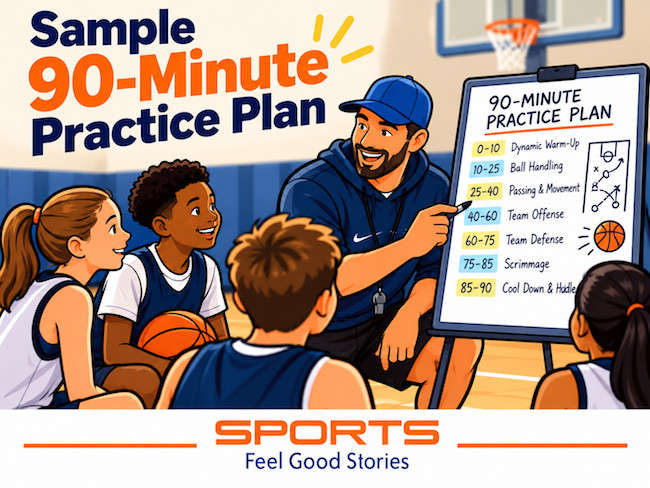
Coach’s Clipboard
90-minute practice • Ages 12–14
| Time | Activity | Minutes |
| 0:00–0:05 | Huddle and practice goal | 5 |
| 0:05–0:15 | Dynamic warm-up and ball handling | 10 |
| 0:15–0:25 | Dribble Traffic | 10 |
| 0:25–0:35 | Passing, pivoting and cutting | 10 |
| 0:35–0:45 | Layups and finishing, both sides | 10 |
| 0:45–0:55 | Form shooting and catch-and-shoot | 10 |
| 0:55–1:00 | Water break and coaching reset | 5 |
| 1:00–1:10 | Defensive closeouts and rebounding | 10 |
| 1:10–1:20 | Three-on-three Paint-Touch game | 10 |
| 1:20–1:25 | Box-to-Basket inbound play | 5 |
| 1:25–1:30 | Recap, recognition, and dismissal | 5 |
| Total | 90 |
Includes the complete schedule, coaching cues, team/date fields, and post-practice checklist. The plan is 3 pages long with diagrams.
Download the FREE 90-Minute Basketball Practice Plan (PDF)
How to Make the 90-Minute Practice Plan Work
The schedule isn’t intended to be rigid. It’s a framework.
Keep the warm-up moving, explain drills in short bursts, and ensure players aren’t spending most of their practice in lines.
During the ten-minute ball-handling segment, all players should have a basketball whenever possible. During shooting drills, divide into multiple groups to reduce waiting time.
In defensive drills, emphasize effort, positioning, and communication over simply winning the possession.
The final live competition is especially important. It’s where you find out whether players can apply what they’ve learned.
Feel free to replace the five-minute inbound-play segment with another game situation, or occasionally add a longer scrimmage by shortening other activities.
One important coaching rule: If your kids are deeply engaged in a productive basketball activity, you don’t have to stop it merely because your clipboard says it’s time.
Sometimes the best coaching decision is to let them play.
How to Adapt Basketball Practice for Different Age Groups
Not every basketball team needs the same practice length, intensity, or complexity.
The USA Basketball and NBA recommendations offer a useful starting point. USA Basketball+1
| Age | Recommended practice length | Main emphasis |
|---|---|---|
| 7–8 | 30–60 minutes | Fun, coordination, basic skills |
| 9–11 | 45–75 minutes | Fundamentals, confidence, simple teamwork |
| 12–14 | 60–90 minutes | Skill development, decision-making, situational play |
For Younger Players
Use plenty of games, short instructions, and frequent changes of activity.
Emphasize dribbling, passing, shooting, balance, and learning the basic rules.
Don’t worry too much about complicated offenses or defensive schemes.
For Middle-School Players
Gradually introduce more challenging decisions, realistic defensive pressure, rebounding responsibilities, and situational basketball.
Increase the amount of small-sided competition and encourage players to recognize what the defense is doing.
Remember that players of the same age may differ significantly in physical development and basketball experience.
For all age groups: Confidence, enjoyment, safety, and steady improvement should remain priorities.
Seven Coaching Principles That Make Every Basketball Practice Better
The 25 activities above provide the ingredients. The following principles help coaches put them together.
- Keep lines short. When too many players are standing, create additional stations or smaller groups.
- Teach one main point at a time. Correcting six things simultaneously usually means teaching none of them particularly well.
- Use competition wisely. Games create enthusiasm, but effort, improvement, and teamwork deserve recognition too.
- Teach both hands. Strong fundamentals matter more than short-term success that relies on a player’s dominant hand.
- Give everyone meaningful repetitions. Your most experienced player doesn’t need every touch while beginners watch.
- Make mistakes part of learning. Kids who fear making mistakes are less likely to experiment and improve.
- Finish with success. End on an accomplishment, encouraging message, or fun challenge whenever possible.
One other principle deserves special attention: talk less.
When a coach talks for five uninterrupted minutes, ten players have collectively lost 50 minutes of potential basketball participation.
That’s a lot of time to spend listening to somebody explain a bounce pass.
Frequently Asked Questions About Youth Basketball Practice
What Should Youth Basketball Players Practice Most?
For most young players, the greatest emphasis should be on ball handling, passing, shooting fundamentals, finishing, defensive positioning, and rebounding.
As players develop, introduce more decision-making activities and small-sided games that require them to apply those skills.
How Much of Youth Basketball Practice Should Be Scrimmaging?
There is no single ideal percentage for every team.
Younger players can benefit enormously from playing games, but traditional five-on-five scrimmages shouldn’t replace fundamental skill development.
Use small-sided games throughout practice. They provide game-like learning while keeping players actively involved.
Should Youth Basketball Teams Practice Plays?
Yes, but keep the playbook manageable.
Start with basic offensive concepts such as spacing, passing, cutting, and moving without the ball.
Teach one or two dependable inbound plays and a simple late-game situation before introducing more complicated offensive sets.
How Do You Make Basketball Practice Fun?
Give players plenty of touches, introduce manageable challenges, celebrate individual improvement, and make drills competitive without turning every mistake into a punishment.
Variety helps, but familiarity matters, too. Kids enjoy games when they understand how to play them and can see themselves improving.
What Should a New Youth Basketball Coach Focus On?
Begin with a consistent practice structure, a few reliable drills, and clear expectations for effort, respect, and teamwork.
Don’t feel obligated to imitate the coaching style of a college or NBA coach.
Your primary responsibility is to help kids learn basketball and enjoy playing it.
Final Thoughts: The Best Youth Basketball Practice Is the One Kids Want to Attend
The most successful youth basketball practices aren’t necessarily the ones with the most sophisticated drills, the loudest coaches, or the most impressive-looking plays.
They’re the practices where kids are engaged, learning, competing, laughing, and discovering what they’re capable of doing.
A player who learns to finish with their weak hand, makes a smart pass under pressure, or finally understands how to box out has accomplished something important.
So use these 25 basketball practice ideas as a menu, not a checklist you must complete every Tuesday. Pick the activities that fit your team’s needs, give everyone opportunities to improve, and keep basketball fun.
Because someday, long after the final buzzer of their youth basketball careers, most kids won’t remember whether their team finished 8–4 or 4–8.
But they’ll remember the teammates they played with, the confidence they gained, and the coach who made them believe they could get better.
And that’s a pretty good return on 90 minutes in the gym.

By Mike O’Halloran
Founder and Editor, Sports Feel Good Stories
Mike O’Halloran founded Sports Feel Good Stories in 2009. He has authored three books on sports jokes, co-authored four trivia books, and authored three books on basketball coaching. Mike has also written a book on sports slogans and captions. He coached youth basketball for 15 seasons, taught tennis, and was a contributing writer for USA Football, the youth arm of the NFL.
Mike is the publisher of the Well-Prepared Coach line of coaches’ practice plans and editable award certificates. He is the founder of the Fantasy Football Team Names Hall of Fame. Mike is married with four children.
You are on our 25 Youth Basketball Practice Ideas feature.
You might also like:
Winning Habits of the Best Youth Basketball Coaches
