
The most creative NFL play calls in history have one thing in common: They make perfectly intelligent football players look as though somebody just handed them a calculus exam written in Portuguese.
A quarterback catches a touchdown pass. A running back becomes a quarterback. A coach voluntarily gives his opponent two points. And somewhere, a defensive coordinator wonders whether selling insurance might be a less stressful profession.
Football is often described as a game of inches, but it’s equally a game of imagination.
Throughout NFL history, innovative coaches have used deception, unconventional formations, and extraordinary timing to outsmart opponents. Sometimes their ideas have produced spectacular touchdowns. Sometimes they’ve won Super Bowls. And occasionally, they’ve generated arguments that continue decades later.
Of course, there’s a difference between a great football play and a great play call.
The Immaculate Reception was an astonishing play, but its greatness came largely from improvisation and an extraordinary bounce. The plays on this list stand out because of the decisions, designs, and strategies behind them.
We’ve selected 10 remarkable examples of football creativity, from legendary trick plays to daring strategic gambles.
Not all of them worked. But every one provides a fascinating glimpse into the minds of football’s greatest—or most adventurous—play callers.
- 1. The Philly Special: When the Quarterback Became the Receiver
- 2. Dan Marino's Fake Spike: The Greatest Bluff in Football?
- 3. Ambush: The Onside Kick That Changed a Super Bowl
- 4. The Music City Miracle: A Lateral That Saved Tennessee's Season
- 5. The Hook and Lateral: Miami's Backyard Football Masterpiece
- 6. The Reverse Pass: Pittsburgh's Receiver Becomes the Quarterback
- 7. The Wildcat: Miami Reinvents the Running Back
- 8. Bill Belichick's Intentional Safety: Losing Points to Win the Game
- 9. Seattle's Goal-Line Pass: The Most Controversial Call in Super Bowl History
- 10. Corn Dog: Andy Reid's Deceptively Delicious Masterpiece
- What Do the Most Creative NFL Play Calls Have in Common?
- Final Thoughts: Football's Greatest Surprises
1. The Philly Special: When the Quarterback Became the Receiver
Philadelphia Eagles vs. New England Patriots — Super Bowl LII, February 4, 2018
Imagine telling a coach that his best option on fourth-and-goal in the Super Bowl is to throw a touchdown pass to his quarterback.
Most coaches would suggest getting your head examined. Philadelphia Eagles coach Doug Pederson had a different reaction.
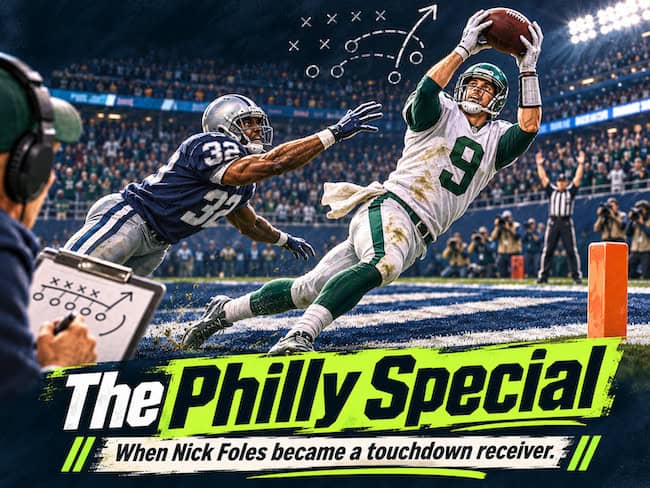
With 38 seconds remaining in the first half, the Eagles led New England 15-12. They faced fourth-and-goal from the Patriots’ 1-yard line.
The conventional approach was simple: Kick a field goal and take a six-point lead into halftime.
Instead, quarterback Nick Foles approached Pederson and suggested running the Philly Special.
Pederson agreed.
Foles lined up in the shotgun, then casually moved toward the right side of the offensive line as if communicating with teammates.
The ball was snapped directly to running back Corey Clement, who pitched it to tight end Trey Burton.
Burton, a former college quarterback, rolled toward the middle of the field.
Then he threw a pass to Foles, who was standing wide open in the end zone.
Touchdown.
The Eagles took a 22-12 halftime lead and eventually defeated New England 41-33, earning their first Super Bowl championship.
Check out our funny football puns and captions to make game day more enjoyable.
Why It Was Genius
The Philly Special exploited the Patriots’ expectations.
Defensive players are accustomed to tracking quarterbacks as passers, runners, or potential blockers—not receivers.
When Foles moved away from his traditional position, New England’s defenders failed to account for him as an eligible receiving threat.
The result was a touchdown requiring considerably more imagination than physical difficulty.
The play’s real brilliance, however, was the situation.
Pederson risked coming away with zero points in the Super Bowl against Bill Belichick and Tom Brady.
Had the trick failed, he would have faced years of second-guessing.
Instead, he became a Philadelphia legend.
The takeaway: Sometimes the best offensive weapon is the player nobody expects to touch the football.
2. Dan Marino’s Fake Spike: The Greatest Bluff in Football?
Miami Dolphins vs. New York Jets — November 27, 1994
Dan Marino threw 420 touchdown passes during his Hall of Fame career.
Few were more memorable than the one he threw while pretending he wasn’t going to throw anything at all.
Late in a crucial AFC East matchup, Miami trailed the New York Jets 24-21. Marino had moved the Dolphins to the Jets’ 8-yard line with the clock running and time disappearing.
The obvious decision was to spike the football, stop the clock, and prepare for a possible game-tying field goal.
Marino appeared ready to do exactly that.
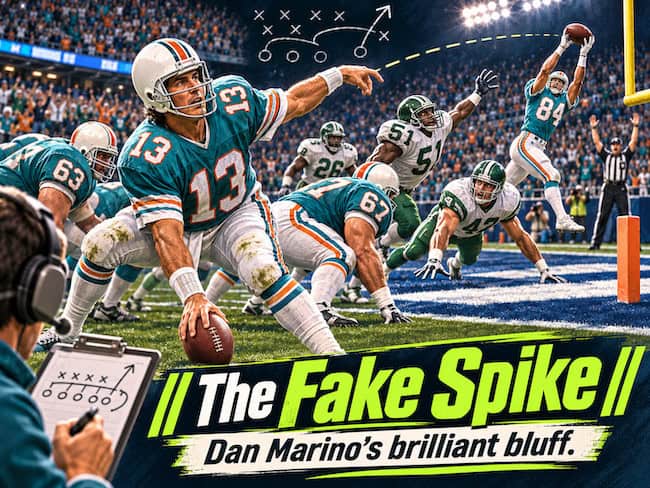
He shouted instructions and motioned toward the ground, signaling that he intended to stop the clock.
The Jets relaxed, expecting a routine spike.
Then Marino took the snap.
Instead of throwing the ball into the turf, he fired an 8-yard touchdown pass to receiver Mark Ingram.
Miami won 28-24, completing a remarkable comeback.
The play became famous as the “Fake Spike,” but its origins weren’t entirely Marino’s.
Backup quarterback Bernie Kosar had suggested the concept, which Miami had practiced before the game.
Why It Was Genius
This play wasn’t about sophisticated blocking or an elaborate formation.
It was about manipulating expectations.
Defenders recognize familiar situations. When an offense hurriedly approaches the line with the clock running, a spike seems predictable.
Marino used that expectation against New York.
The deception worked because his teammates knew the plan while the Jets believed they were witnessing a routine clock-management decision.
The actual pass was relatively simple.
The psychological setup was extraordinary.
Marino also demonstrated why football intelligence can be every bit as valuable as arm strength.
He didn’t merely identify an open receiver. He helped create one by convincing defenders there was no reason to defend.
The takeaway: The most effective deception sometimes involves convincing an opponent that nothing interesting is about to happen.
Take the Thanksgiving Football Trivia Challenge to test your football knowledge.
3. Ambush: The Onside Kick That Changed a Super Bowl
New Orleans Saints vs. Indianapolis Colts — Super Bowl XLIV, February 7, 2010
Sean Payton has never been accused of being overly conservative.
But even by his standards, the opening play of the second half of Super Bowl XLIV was audacious.
The New Orleans Saints trailed Peyton Manning and the Indianapolis Colts 10-6 at halftime.
Indianapolis was scheduled to receive the second-half kickoff.
Normally, the Saints would have kicked deep, played defense, and hoped to regain possession.
Payton preferred a more adventurous approach.
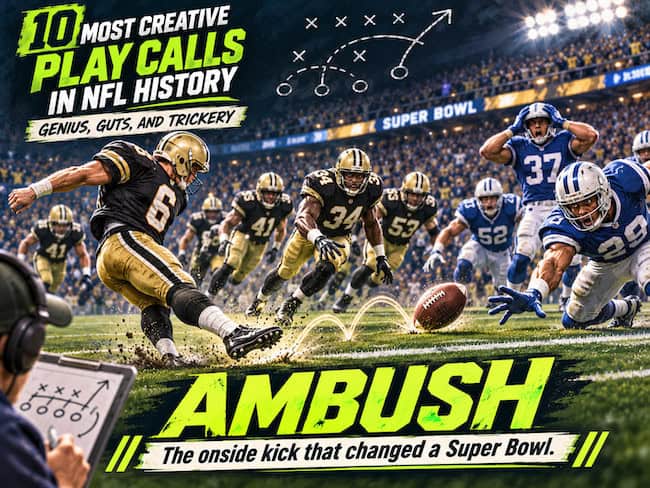
He called a surprise onside kick.
The play had an appropriate name: “Ambush.”
Saints rookie Thomas Morstead approached the football and drove a low kick toward the Colts’ unsuspecting return team.
A chaotic scramble followed.
New Orleans linebacker Jonathan Casillas eventually secured possession.
Drew Brees then led the Saints on a touchdown drive, and New Orleans took a 13-10 lead.
The Saints eventually won 31-17, capturing the franchise’s first Super Bowl championship.
Explore our Best Football Quotes and Insights.
Why It Was Genius
An onside kick isn’t inherently complicated. Teams practice recovering them regularly.
What made Ambush brilliant was its timing.
The Colts expected to begin the second half with possession and an opportunity to extend their lead.
Instead, Payton exploited their assumption that New Orleans would behave conventionally.
The call also reflected an understanding of the opponent.
Manning was one of football’s most dangerous quarterbacks. Preventing him from getting the football was itself a defensive achievement.
Of course, failure would have given Indianapolis outstanding field position.
That’s what made the decision so risky.
Payton recognized that the opportunity to steal a possession outweighed the danger of surrendering one.
It was a calculated gamble that helped transform the game’s momentum.
The takeaway: A brilliant coach doesn’t always choose the safest option. Sometimes he recognizes that the unexpected option offers the greatest advantage.
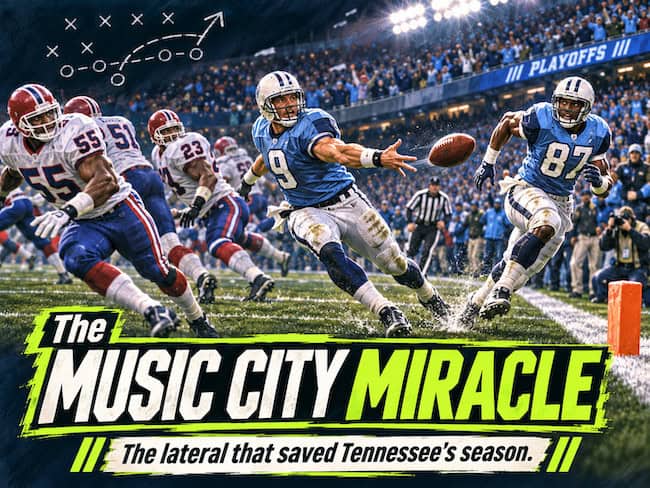
4. The Music City Miracle: A Lateral That Saved Tennessee’s Season
Tennessee Titans vs. Buffalo Bills — AFC Wild Card Playoff, January 8, 2000
With 16 seconds remaining, the Tennessee Titans appeared to be finished.
Buffalo kicker Steve Christie had just made a field goal, giving the Bills a 16-15 lead.
Tennessee needed a miracle.
Fortunately, special teams coordinator Alan Lowry had prepared one.
The Titans had practiced a kickoff return called “Home Run Throwback.”
The design involved drawing Buffalo’s coverage toward one side of the field before sending the football across to the other.
Fullback Lorenzo Neal caught the kickoff near Tennessee’s 25-yard line and handed the ball to tight end Frank Wycheck.
Wycheck ran toward the right side, pulling Buffalo defenders in his direction.
Then he stopped, turned, and threw a lateral across the field to receiver Kevin Dyson.
Dyson caught the football and raced 75 yards down the sideline for a touchdown.
Tennessee won 22-16.
The play survived a replay review examining whether Wycheck’s lateral had illegally traveled forward.
The touchdown stood, and the Music City Miracle entered NFL folklore.
Why It Was Genius
The return exploited a fundamental instinct of kickoff coverage teams: Pursue the football.
As Buffalo’s defenders flowed toward Wycheck, Tennessee’s blockers helped create a running lane on the opposite side.
The play required precise timing, coordinated blocking, and a legal lateral.
It also required extraordinary confidence. One mishandled exchange could have ended the Titans’ season.
An interesting detail: Dyson wasn’t even the original intended participant. He replaced injured returner Derrick Mason, making the successful execution even more remarkable. Nashville Scene
The Titans eventually advanced to Super Bowl XXXIV, where they lost to the St. Louis Rams.
But their playoff journey might never have continued without Home Run Throwback.
The takeaway: The best football improvisation often starts with excellent preparation.
5. The Hook and Lateral: Miami’s Backyard Football Masterpiece
Miami Dolphins vs. San Diego Chargers — AFC Divisional Playoff, January 2, 1982
If you’ve ever played backyard football, you’ve probably attempted a hook and lateral.
Usually, the receiver catches the football, tosses it toward a teammate, and someone ends up arguing about whose fault the fumble was.
The Miami Dolphins showed how beautiful the play can be when executed properly.
In the 1981 season’s divisional playoffs, San Diego jumped to a stunning 24-0 lead over Miami.
Dolphins coach Don Shula replaced struggling quarterback David Woodley with Don Strock, who helped engineer a comeback.
Late in the first half, Miami still trailed 24-10.
The Dolphins needed something extraordinary.
Strock completed a pass to receiver Duriel Harris, who appeared ready to be tackled after a modest gain.
Instead, Harris lateraled the ball to running back Tony Nathan, who was sprinting past him.
Nathan caught the pitch and raced into the end zone.
The 40-yard touchdown play reduced San Diego’s lead to 24-17 at halftime.
Why It Was Genius
The strategy depended on turning a defense’s natural aggressiveness against itself.
When Harris caught the pass, defenders converged on him.
Their pursuit opened space for Nathan, who arrived from behind the initial receiver.
Because NFL rules allow backward laterals after a completed forward pass, the Dolphins could legally create a second opportunity to advance the ball.
The play combined a conventional pass with an unexpected second phase.
It also demonstrated how football creativity can transform a seemingly harmless completion into a touchdown.
Miami eventually took the lead, but San Diego rallied to win 41-38 in overtime.
The game became known as the “Epic in Miami,” remembered particularly for Chargers tight end Kellen Winslow’s extraordinary performance.
Even in defeat, Miami contributed one of the most memorable trick plays in postseason history.
The takeaway: Sometimes a completed pass isn’t the end of a play. It’s merely the opening act.
6. The Reverse Pass: Pittsburgh’s Receiver Becomes the Quarterback
Pittsburgh Steelers vs. Seattle Seahawks — Super Bowl XL, February 5, 2006
The Pittsburgh Steelers built their reputation on power running, punishing defense, and a general preference for making football opponents physically uncomfortable.
But in Super Bowl XL, Pittsburgh decided a little trickery might be useful.
Leading Seattle 14-10 in the fourth quarter, the Steelers faced first-and-10 from the Seahawks’ 43-yard line.
Offensive coordinator Ken Whisenhunt called “Fake 39 Toss X-Reverse Pass.”
The play began with quarterback Ben Roethlisberger handing the football to running back Willie Parker.
Parker transferred it to receiver Antwaan Randle El, who headed across the field on a reverse.
Seattle’s defenders reacted to the apparent running play.
Then Randle El stopped and launched a deep pass toward Hines Ward.
Ward caught the football and raced into the end zone for a 43-yard touchdown.
Pittsburgh extended its lead to 21-10, which became the final score.
Randle El became the first wide receiver to throw a touchdown pass in Super Bowl history.
Why It Was Genius
Randle El had played quarterback at Indiana University, so the Steelers knew he could throw accurately.
That background made him an unusually dangerous receiver.
The reverse presented Seattle with multiple possibilities. Parker could run, Randle El could continue around the edge, or Randle El could throw.
By the time the Seahawks recognized the passing threat, Ward was running open downfield.
The Steelers didn’t invent the receiver pass. But they recognized the perfect opportunity to use it.
Rather than relying entirely on superior blocking or athleticism, Pittsburgh created confusion by asking defenders to process several possibilities in rapid succession.
The touchdown provided the breathing room the Steelers needed to secure their fifth Super Bowl championship.
The takeaway: A player’s unusual secondary skill can become a devastating weapon when deployed at exactly the right moment.
7. The Wildcat: Miami Reinvents the Running Back
Miami Dolphins vs. New England Patriots — September 21, 2008
In 2007, the Miami Dolphins finished 1-15.
Their offense needed help. Preferably the kind that didn’t require waiting for several years of favorable draft picks.
Enter the Wildcat.
During a September 2008 matchup against New England, Miami unveiled an unconventional offensive package.
Instead of having quarterback Chad Pennington take every snap, the Dolphins positioned him as a receiver and put running back Ronnie Brown directly behind center.
Ricky Williams provided another dangerous rushing option.
The Patriots suddenly confronted an offense that looked suspiciously like something from a college playbook.
And they had enormous difficulty defending it.
Brown repeatedly took direct snaps, rushing for touchdowns while New England struggled to adjust.
On one memorable play, Brown rolled left and threw a 19-yard touchdown pass to tight end Anthony Fasano.
By the end of the afternoon, Brown had scored four rushing touchdowns and thrown for another.
Miami won 38-13, snapping New England’s remarkable regular-season winning streak.
Why It Was Genius
The Wildcat wasn’t a new invention. Variations of direct-snap formations had existed for generations.
Miami’s achievement was recognizing how effectively the concept could disrupt a modern NFL defense.
With Brown receiving the snap, the Dolphins introduced additional running threats and forced defenders to identify the ballcarrier immediately.
The offense also incorporated motion, deception, and the possibility of an unexpected pass.
New England had prepared for conventional Miami formations.
Instead, it received a crash course in alternative offensive philosophy.
The Wildcat eventually lost much of its surprise value as opponents adapted.
But its success helped accelerate the NFL’s interest in unconventional formations, option concepts, and using versatile athletes in multiple offensive roles.
The Dolphins demonstrated that an old idea can become revolutionary when introduced at the right time.
The takeaway: Innovation doesn’t always require inventing something new. Sometimes it means recognizing the value of something everyone else has forgotten.
8. Bill Belichick’s Intentional Safety: Losing Points to Win the Game
New England Patriots vs. Denver Broncos — November 3, 2003
Bill Belichick built a legendary coaching career by understanding details that other coaches sometimes overlooked.
In 2003, he demonstrated that occasionally the smartest way to win a football game is to deliberately give your opponent points.
The Patriots trailed Denver 24-23 with 2:49 remaining.
New England faced fourth down from its own 1-yard line.
The normal decision would have been to punt.
Unfortunately, punting from your own end zone often produces excellent field position for the opponent.
Belichick considered an alternative.
He instructed long snapper Lonie Paxton to snap the football through the back of the end zone for an intentional safety.
Denver received two points, increasing its lead to 26-23.
On the surface, the Patriots had made their situation worse.
But the safety allowed New England to execute a free kick rather than punt from deep inside its own territory.
Denver subsequently started at its own 15-yard line.
The Patriots forced a punt, regained possession, and watched Tom Brady engineer a winning touchdown drive.
Brady connected with David Givens for an 18-yard score with 30 seconds remaining.
New England won 30-26.
Why It Was Genius
Belichick recognized that field position mattered more than the two additional points.
Whether New England trailed by one or three, a field goal could give the Patriots the lead or tie the game, respectively.
More importantly, the free kick improved New England’s chances of forcing Denver to punt and giving Brady another possession.
The decision challenged football’s most basic assumption: Allowing points is bad.
Normally, that’s excellent advice.
But Belichick understood that strategy requires evaluating the entire game rather than one isolated play.
The intentional safety wasn’t particularly flashy.
Nobody threw a touchdown pass while standing on his head.
It was simply an extraordinary example of understanding probabilities, field position, and clock management.
The takeaway: Winning the next play matters less than maximizing your chances of winning the game.
9. Seattle’s Goal-Line Pass: The Most Controversial Call in Super Bowl History
Seattle Seahawks vs. New England Patriots — Super Bowl XLIX, February 1, 2015
Not every creative play call works.
Some produce celebrations.
Others produce arguments that last for decades.
With 26 seconds remaining in Super Bowl XLIX, Seattle trailed New England 28-24.
The Seahawks faced second-and-goal from the Patriots’ 1-yard line.
Their running back was Marshawn Lynch, one of football’s most powerful runners.
The situation seemed obvious.
Give Lynch the football.
Instead, Seattle called a pass.
Quarterback Russell Wilson took the shotgun snap and threw a quick slant toward receiver Ricardo Lockette.
Patriots cornerback Malcolm Butler anticipated the route, broke toward the football, and intercepted it.
New England won 28-24.
Within seconds, millions of viewers became self-appointed offensive coordinators.
Was the Decision Really That Terrible?
The decision deserves more thoughtful analysis than simply shouting, “Give it to Beast Mode!”
Seattle had one timeout remaining.
An incomplete pass would have stopped the clock and potentially allowed the Seahawks to use all their remaining downs.
New England was also prepared to defend a likely rushing attempt.
A quick pass against that defensive alignment wasn’t necessarily unreasonable.
The design depended on creating separation through a receiver combination near the goal line.
Butler recognized the concept and executed an extraordinary defensive play.
The result was catastrophic.
Nevertheless, it’s important to distinguish between a poor strategic decision and an unfavorable outcome.
Would Lynch have scored on the next carry?
Possibly.
But football doesn’t provide alternative endings.
The play remains a compelling example of how unconventional thinking can be celebrated when successful and condemned when it fails.
The takeaway: Sometimes the difference between offensive genius and coaching infamy is a defensive back making the play of his life.
10. Corn Dog: Andy Reid’s Deceptively Delicious Masterpiece
Kansas City Chiefs vs. Philadelphia Eagles — Super Bowl LVII, February 12, 2023
Andy Reid has spent much of his coaching career demonstrating that football strategy can be both sophisticated and entertaining.
His playbook contains complicated formations, unusual motions, and apparently, items from a concession stand.
Consider “Corn Dog.”
During Super Bowl LVII, the Chiefs identified a vulnerability in Philadelphia’s defensive response to receiver motion.
Reid and his offensive staff designed a way to exploit it.
Early in the fourth quarter, Kansas City faced third-and-3 from Philadelphia’s 5-yard line.
Receiver Kadarius Toney began moving across the formation, suggesting he would continue toward the opposite side.
Then he abruptly reversed direction and headed toward the sideline.
Philadelphia’s defenders reacted to the original motion.
Toney found himself completely uncovered.
Patrick Mahomes threw an easy 5-yard touchdown pass, giving Kansas City a 28-27 lead.
Later in the quarter, Reid employed a similar concept with receiver Skyy Moore.
Moore also reversed direction and caught a 4-yard touchdown pass with no defender nearby.
The Chiefs eventually won 38-35.
Why It Was Genius
Corn Dog attacked the Eagles’ defensive communication and coverage assignments.
Pre-snap motion forces defenders to make rapid decisions.
Should they follow the receiver? Switch assignments? Maintain their positions?
Kansas City exploited that uncertainty.
By reversing direction, the receivers created separation before Mahomes even threw the football.
The quarterback didn’t need an impossibly accurate pass.
He simply needed to recognize the uncovered player.
The remarkable part was that Kansas City successfully exploited essentially the same defensive vulnerability twice.
Corn Dog demonstrated how great offensive design can make difficult football situations look astonishingly simple.
The takeaway: The greatest plays don’t always require extraordinary athletic accomplishments. Sometimes the coaching creates an advantage so large that executing the play becomes the easy part.
What Do the Most Creative NFL Play Calls Have in Common?
These 10 plays reveal several principles that separate imaginative coaching from ordinary play-calling.
- Deception beats predictability. Dan Marino’s fake spike succeeded because defenders believed they knew what was coming.
- Timing is everything. The Philly Special would have been entertaining in a preseason game. Calling it on fourth-and-goal in the Super Bowl made it legendary.
- Preparation creates opportunities. The Music City Miracle was a rehearsed play, not a random series of desperate laterals.
- Versatility gives offenses options. Players such as Antwaan Randle El and Ronnie Brown created problems because they could perform multiple roles.
- Courage matters. Sean Payton understood the risks of his surprise onside kick. He also recognized the potential reward.
- Unconventional doesn’t always mean complicated. Belichick’s intentional safety was an exercise in strategic thinking rather than elaborate execution.
There’s also an important difference between creative and reckless.
Great coaches understand the opponent, the game situation, their personnel, and the probabilities involved.
They don’t simply call unusual plays to prove they’re clever.
At least, most of the time.
The best play calls combine imagination with an intelligent reason for doing something unexpected.
Final Thoughts: Football’s Greatest Surprises
The NFL is built around preparation.
Coaches spend countless hours analyzing opponents, identifying tendencies, and developing strategies designed to produce the smallest possible advantage.
Yet some of football’s most unforgettable moments occur when somebody does something completely unexpected.
A quarterback catches a touchdown pass.
A running back becomes a quarterback.
A coach deliberately surrenders two points.
An entire kickoff coverage team chases the football in the wrong direction.
These plays remind us that professional football isn’t merely a contest of strength, speed, and athletic ability.
It’s also a contest of imagination.
The greatest coaches recognize what opponents expect and discover ways to exploit those expectations.
Sometimes the result is a touchdown.
Sometimes it’s a Super Bowl championship.
And sometimes it’s a decision football fans are still arguing about 20 years later.
That’s part of the beauty of the NFL.
Everyone knows the rules. Everyone understands the objective.
But occasionally, one coach sees something nobody else has considered.
Then comes the snap.
And football history changes.

By Mike O’Halloran
Founder and Editor, Sports Feel Good Stories
Mike O’Halloran founded Sports Feel Good Stories in 2009. He has authored three books on sports jokes, co-authored four trivia books, and authored three books on basketball coaching. Mike has also written a book on sports slogans and captions. He coached youth basketball for 15 seasons, taught tennis, and was a contributing writer for USA Football, the youth arm of the NFL.
Mike is the publisher of the Well-Prepared Coach line of coaches’ practice plans and editable award certificates. He is the founder of the Fantasy Football Team Names Hall of Fame. Mike is married with four children.
You’re on our 10 Most Creative NFL Play Calls Ever: Genius & Trickery feature.
You might also like:
10 Football Strategies That Changed the NFL Forever
