
Free throw shooting is basketball’s simplest skill to explain and one of its most maddening skills to master.
The basket never moves. The distance never changes. Nobody is guarding you. You have time to prepare, take a breath, and shoot.
We had a player on our junior high school team who could shoot free throws nearly perfectly during practices, but missed every free throw in game situations.
So why can Stephen Curry make free throws with almost supernatural accuracy while some of the greatest athletes in NBA history have struggled to hit half their attempts? Why did Wilt Chamberlain, a man who scored 100 points in a single NBA game, spend much of his career battling a shot that ordinary high school players routinely make?
And why did Rick Barry become one of basketball’s greatest free throw shooters using a technique that looks like something your grandmother might have taught you?
We’ll explore basketball’s greatest and worst free-throw shooters, unusual techniques, remarkable records, and the fundamentals that can help anyone become better at the line.
Because whether you’re playing in the NBA Finals or a sixth-grade championship, the basket doesn’t care how important the game is. Unfortunately, your brain often does.
- Why Is Free Throw Shooting So Important?
- The Best Free Throw Shooters in NBA History
- Worst Free Throw Shooters in NBA History
- The Wilt Chamberlain Paradox: How a Terrible Free Throw Shooter Scored 100 Points
- Different Free Throw Shooting Styles
- How to Shoot Free Throws: Seven Fundamentals of Great Technique
- The Psychology of Free Throw Shooting: Why Pressure Changes Everything
- The Most Interesting Free Throw Routines in NBA History
- Incredible NBA Free Throw Records and Facts
- Hack-a-Shaq: When Bad Free Throw Shooting Becomes a Strategy
- Five Free Throw Shooting Drills That Actually Help
- Free Throw Rules Every Basketball Player Should Know
- Free Throw Shooting FAQs
- Final Thoughts: The Beauty of the Free Throw
Why Is Free Throw Shooting So Important?
A free throw is worth just one point. That doesn’t sound particularly exciting in a sport featuring three-pointers, spectacular dunks, and breathtaking fast breaks.
But one point can be the difference between winning a championship and spending the offseason wondering what went wrong.
Free throws have several advantages over other basketball shots:
- No defender: Nobody can block your shot or interfere with your shooting motion.
- A consistent distance: The free throw line is 15 feet from the backboard, putting the basket at a familiar distance every time.
- Time to prepare: Players can establish their stance and perform a practiced routine.
- Predictable conditions: Unlike a jumper taken during a fast break, free throws are performed from a stationary position.
- Guaranteed scoring opportunities: Successful free throws add points without requiring another possession.
Great free throw shooting also changes how opponents defend you.
A player who consistently makes free throws becomes more difficult to foul strategically. Aggressive defenders must think twice before putting that player on the line.
Conversely, a poor free throw shooter can become an opponent’s favorite target.
Nobody enjoys being described as a defensive strategy.
Discover our Funny Basketball Jokes feature for a laugh or two.
The Best Free Throw Shooters in NBA History
The NBA has produced extraordinary shooters, but a handful have achieved remarkable consistency at the foul line.
Here are some of the greatest, based on career regular-season free throw percentages and historical impact.
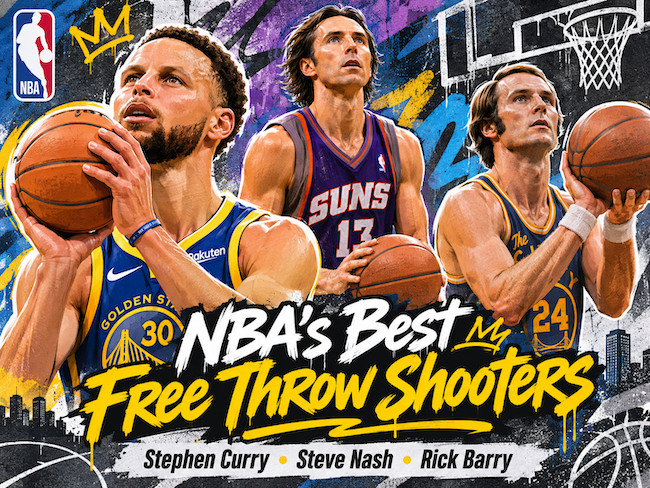
Stephen Curry: The Free Throw King
Career free throw percentage: Approximately 91.3%
Curry has revolutionized basketball with his extraordinary three-point shooting. Yet his accuracy from the free-throw line might be equally impressive.
The Golden State Warriors superstar leads the NBA’s all-time career free throw percentage rankings.
Curry’s technique is a model of economy. His feet are balanced, his movements are compact, and his release is smooth and repeatable.
Most importantly, his mechanics don’t change dramatically when the game becomes tense.
He approaches the free throw line with the casual confidence of someone tossing his car keys onto the kitchen counter.
The difference is that his keys almost always land exactly where he intended.
Steve Nash: Poetry in Motion
Career free throw percentage: 90.4%
Nash combined extraordinary shooting touch with an almost obsessive dedication to preparation.
The two-time NBA MVP was renowned for his precise mechanics and consistent routines.
Nash also provided a fascinating glimpse into shooting psychology. He often practiced his shooting motion without the ball, reinforcing the feel of a successful release.
His greatest lesson? Good shooting isn’t necessarily about having the prettiest form.
It’s about making your form remarkably consistent.
Explore our Basketball Roles and Responsibilities of Each Position for a deeper understanding of the game.
Mark Price: The Cleveland Marksman
Career free throw percentage: 90.4%
Before Curry, Nash, and many other modern shooting specialists, Mark Price was demonstrating just how valuable exceptional free throw shooting could be.
The Cleveland Cavaliers guard possessed beautiful shooting mechanics and extraordinary touch.
Price’s success also helped challenge the notion that smaller guards needed overwhelming athleticism to dominate offensively.
Sometimes, precision is its own superpower.
Rick Barry: The Underhand Genius
NBA career free throw percentage: 90.0%
Barry was an eight-time NBA All-Star, a scoring champion, and one of basketball’s fiercest competitors.
He also shot his free throws underhand.
Yes, underhand.
While most players raised the ball above their heads, Barry swung it upward from below his waist with both hands.
The technique was sometimes called the “granny shot.”
Barry didn’t care.
He made nearly 90% of his NBA free throws and became one of the greatest practitioners of an unconventional technique.
We’ll examine his shooting style shortly, because Barry offers an important lesson: Results matter more than appearances.
Other Legendary Free Throw Shooters
Several other players deserve recognition:
- Damian Lillard: Approximately 89.9% for his career, combining deep-range shooting with excellent foul-line accuracy.
- Ray Allen: 89.4%, with a famously disciplined shooting motion.
- Reggie Miller: 88.8%, a clutch performer who rarely seemed rattled by hostile crowds.
- Larry Bird: 88.6%, combining exceptional touch with legendary competitive confidence.
- Dirk Nowitzki: 87.9%, remarkable accuracy for a seven-footer who frequently drew fouls.
These percentages are regular-season career figures, rounded, with active-player numbers subject to change.
Browse our Basketball Captions for ways to liven up your photos on Instagram and Facebook.
Worst Free Throw Shooters in NBA History
For every player who treats the foul line like a personal ATM, there’s another who approaches it like an appointment with the dentist.
Several NBA stars were brilliant at virtually everything except free throws.
Ben Wallace: The Unfortunate Record Holder
Career free throw percentage: 41.4%
Ben Wallace was an extraordinary defender, a four-time NBA Defensive Player of the Year, and an essential part of Detroit’s 2004 championship team.
Unfortunately, free-throw shooting was not among his strengths.
Wallace made fewer than 42% of his career attempts, placing him at the bottom of prominent career rankings for players with substantial free throw volume.
Imagine being one of the toughest defenders in basketball history but struggling against a basket that wasn’t defending itself.
Chris Dudley: A Difficult Assignment
Career free throw percentage: 45.8%
Dudley played 16 NBA seasons as a hardworking center known for rebounding and defense.
His free throw shooting, however, was a persistent adventure.
He endured one particularly unforgettable trip to the line in 1990, missing five consecutive free throws during a single possession after repeated lane violations.
Even the basket probably felt uncomfortable.
Shaquille O’Neal: Dominant Everywhere Else
Career free throw percentage: 52.7%
Shaq was nearly unstoppable near the basket.
At 7-foot-1 and more than 300 pounds during much of his career, he overwhelmed defenders with strength, agility, and astonishing coordination.
But the free-throw line was another matter.
O’Neal worked with shooting coaches, adjusted techniques, and practiced extensively. Nevertheless, his career percentage remained below 53%.
His difficulties became so famous that opposing teams developed an entire strategy around them.
More on that shortly.
Wilt Chamberlain: The Greatest Contradiction
Career free throw percentage: 51.1%
Wilt averaged 30.1 points over his remarkable NBA career and remains the only player to score 100 points in a game.
Yet nearly half of his career free throws were missed.
That brings us to one of basketball history’s most fascinating stories.
The Wilt Chamberlain Paradox: How a Terrible Free Throw Shooter Scored 100 Points
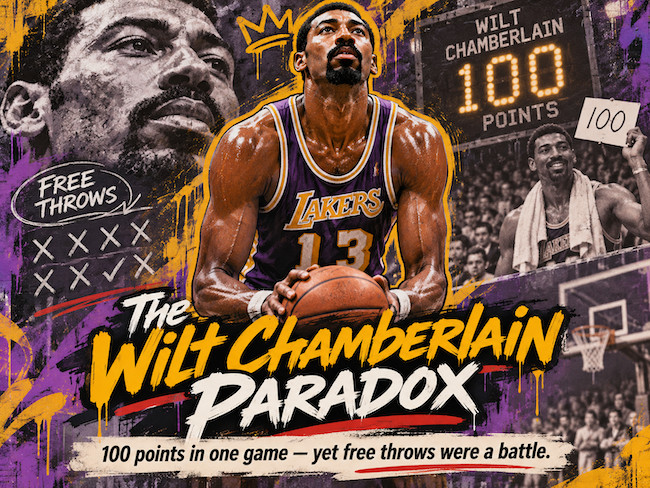
On March 2, 1962, Wilt Chamberlain delivered arguably the most extraordinary individual performance in professional basketball history.
Playing for the Philadelphia Warriors against the New York Knicks in Hershey, Pennsylvania, Chamberlain scored 100 points. Learn more about Chamberlain’s 100-point game.
He made 36 field goals. He dominated the boards. And he overwhelmed defenders.
And, perhaps most surprisingly, he made 28 of 32 free throws. That’s 87.5%.
For perspective, Chamberlain entered that game as a notoriously unreliable foul shooter. Over his career, he would make just 51.1% of his attempts. So what happened?
Wilt’s Experiment With Underhand Shooting
During the 1961–62 season, Chamberlain experimented with shooting free throws underhand, following advice from coach Frank McGuire.
The technique produced the best free-throw season of his career.
He shot 61.3%, the only time in his 14 NBA seasons he exceeded 60%.
That might not impress Stephen Curry, but for Chamberlain, it represented meaningful progress.
Then came his historic 100-point performance.
Using the underhand technique, Wilt made those astonishing 28 free throws. They remain tied for the most successful free throws in an NBA game.
And here’s the paradox.
Despite his improved results, Chamberlain eventually abandoned underhand shooting.
Why?
Part of the explanation involved how uncomfortable he felt using the unconventional style. Chamberlain also struggled with confidence, technique changes, and the mental challenge of shooting free throws.
He later acknowledged that his difficulties had become a psychological problem.
In a 1999 Los Angeles Times retrospective, Chamberlain described how repeatedly changing his shooting motion and listening to conflicting advice undermined his confidence.
His problem was no longer simply physical.
He had begun expecting to miss.
What Wilt Chamberlain Teaches Us
Chamberlain’s experience offers three valuable lessons:
- The most effective technique isn’t necessarily the most fashionable.
- Changing shooting mechanics constantly can destroy consistency.
- Confidence and repetition matter as much as physical talent.
There’s something wonderfully ironic about basketball’s most physically imposing superstar being defeated by a shot requiring almost no physical resistance.
Wilt could overpower defenders, outjump opponents, and score 100 points.
But the foul line often got the better of him.
Different Free Throw Shooting Styles
Most basketball players use a conventional one-handed shooting technique, but variations have existed throughout the game’s history.
The Traditional One-Handed Free Throw
This is the standard approach taught by most basketball coaches.
The shooting hand rests underneath and slightly behind the basketball, while the guide hand stabilizes it.
The shooter bends the knees, extends upward, and releases the ball with a smooth wrist motion.
The guide hand should contribute little or no force.
A successful shot usually features a comfortable arc, soft backspin, and a relaxed follow-through.
The Underhand Free Throw
Underhand shooting involves holding the basketball with both hands below the waist and swinging it upward toward the basket.
The ball leaves both hands during an upward motion.
Advantages may include:
- A relatively simple, repeatable motion.
- Less dependence on a high overhead release.
- A comfortable option for some players struggling with conventional mechanics.
Disadvantages include unfamiliarity and the difficulty some athletes experience developing the necessary touch.
And, of course, there’s the social pressure associated with the technique.
Rick Barry demonstrated that underhand shooting can be extraordinarily effective. Wilt Chamberlain demonstrated that knowing something works doesn’t always mean you’ll continue doing it.
One-Motion Versus Two-Motion Shooting
Some players favor a continuous movement from their initial knee bend through the release.
Others briefly bring the basketball into a set position before extending upward.
Neither approach guarantees success.
For free throws, the more important consideration is that the motion feels natural and can be repeated without unnecessary adjustments.
The Jumping Free Throw
Some younger players develop the habit of jumping when shooting free throws.
A small rise onto the toes is perfectly normal. A dramatic jump, however, can introduce unnecessary movement and make consistency more difficult.
Most experienced shooters keep their feet grounded or use only a subtle upward extension.
The goal is control, not altitude.
How to Shoot Free Throws: Seven Fundamentals of Great Technique
Free throw shooting improves when players simplify their movements and practice them consistently.
Here’s a practical breakdown.
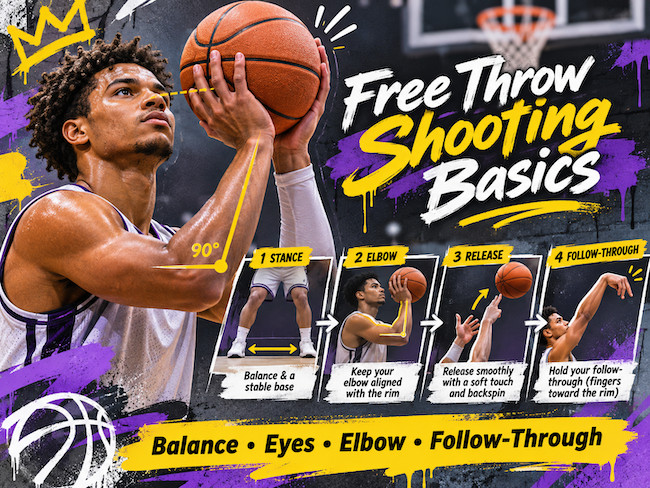
Establish a Comfortable Stance
Position your feet approximately shoulder-width apart.
Many right-handed shooters place their right foot slightly ahead of the left, while left-handed shooters may reverse the alignment.
A slight angle is fine if it allows your shooting arm to move comfortably toward the basket.
Avoid exaggerated foot positions that make you feel twisted or unbalanced.
Bend Your Knees Naturally
Your legs provide rhythm and help generate the shot’s upward motion.
Bend your knees slightly, keeping your weight balanced.
You shouldn’t need to perform a deep squat.
This is a basketball shot, not a powerlifting competition.
Position Your Shooting Hand Properly
Place your shooting hand underneath and slightly behind the basketball, with your fingers comfortably spread.
The guide hand rests on the side.
Avoid squeezing the ball tightly.
Excessive tension in the hands and wrists makes a soft release more difficult.
Align Your Shooting Arm
Your shooting elbow should move in a comfortable path toward the basket.
A common coaching mistake is forcing every athlete into an identical elbow position.
Bodies differ.
Focus on eliminating unnecessary sideways movement rather than creating a mechanically rigid pose.
Focus on a Small Target
Choose a consistent aiming point, such as the back portion of the rim or the center of the basket.
Don’t switch targets from shot to shot.
Some players prefer the front rim. Others focus deeper into the hoop.
The key is maintaining a clear, familiar visual reference.
Release With Arc and Backspin
Extend your legs and shooting arm in a connected, controlled motion.
Finish with a relaxed wrist snap that produces gentle backspin.
A shot with an appropriate arc has a better chance of entering the basket than a flat, hard throw.
You want the basketball dropping softly toward the rim, not arriving like an express delivery.
Hold Your Follow-Through
After releasing the ball, leave your shooting arm extended briefly, with your wrist relaxed and fingers pointing downward.
Holding the follow-through reinforces a consistent release.
A simple coaching reminder is:
Finish high. Relax your wrist. Hold your pose.
These principles build on the familiar BEEF shooting framework: Balance, Eyes, Elbow, and Follow-Through.
The Psychology of Free Throw Shooting: Why Pressure Changes Everything
Here’s a basketball mystery.
A player makes 19 of 20 free throws during practice.
Ten minutes later, with a game tied and five seconds remaining, the same player misses two consecutive attempts.
Did the basket shrink? Did the basketball suddenly gain weight? Of course not. The circumstances changed.
Free-throw shooting is vulnerable to psychological pressure because the player has time to think.
During ordinary gameplay, athletes react almost instinctively. At the free throw line, they can become painfully aware of the consequences of missing.
The Danger of Overthinking
Highly practiced shooting motions should become automatic.
When players consciously analyze every movement during a pressure situation, they may interfere with those automatic skills.
Instead of shooting naturally, they start supervising themselves.
Is my elbow straight?
Are my knees bent enough?
Am I holding the ball correctly?
Will my coach bench me if I miss?
By the time the ball leaves their hands, they’re trying to solve six problems instead of completing one familiar movement.
Three Ways to Handle Free Throw Pressure
- Develop a consistent routine. Repeating familiar movements helps create a sense of control.
- Use one simple mental cue. Think “smooth,” “finish,” or “follow through,” rather than juggling several mechanical instructions.
- Practice with consequences. Incorporate competitive challenges that simulate the discomfort of shooting under pressure.
A good free throw routine doesn’t eliminate nerves.
It gives the player something constructive to do with them.
The Most Interesting Free Throw Routines in NBA History
Basketball players can be wonderfully superstitious.
Some bounce the basketball exactly three times. Others spin it, take a deep breath, or whisper something before shooting.
A few routines have become practically legendary.
Jason Kidd’s Kiss
Early in his career, Jason Kidd famously blew a kiss toward the basket before shooting free throws.
The gesture became one of the NBA’s most recognizable shooting rituals.
It also demonstrated how players can attach personal meaning to a repetitive physical routine.
Karl Malone’s Conversation
Karl Malone often appeared to mutter or speak quietly to himself while preparing to shoot.
Whatever he was saying, the process was familiar enough to become part of his basketball identity.
Opposing fans sometimes tried to distract him by counting during his elaborate routine.
Richard Hamilton’s Rhythm
Detroit Pistons guard Richard “Rip” Hamilton was known for his consistent preparation at the line.
He used a distinctive dribbling pattern before shooting, illustrating the importance many players place on establishing a personal rhythm.
The lesson isn’t to copy these exact rituals.
It’s to develop one that works for you.
Incredible NBA Free Throw Records and Facts
Free throw shooting has produced some of basketball’s most remarkable statistical achievements.
| Record | Player | Achievement |
|---|---|---|
| Highest qualified career NBA percentage | Stephen Curry | Approximately 91.3%, as of November 2026 |
| Highest qualified single-season percentage | José Calderón | 98.1% in 2008–09 |
| Most consecutive free throws made | Micheal Williams | 97 |
| Most free throws made in one NBA game | Wilt Chamberlain and Adrian Dantley | 28 each |
| Lowest prominent career percentage among high-volume shooters | Ben Wallace | 41.4% |
José Calderón’s Nearly Perfect Season
During the 2008–09 season with the Toronto Raptors, José Calderón made 151 of 154 free throw attempts.
That’s 98.1%.
He missed three free throws across an entire NBA season.
Most recreational players can accomplish that during warmups.
Micheal Williams: 97 in a Row
Micheal Williams made 97 consecutive free throws while playing for the Minnesota Timberwolves.
The remarkable streak began during the 1992–93 season and continued into the following campaign.
Ninety-seven consecutive makes.
Imagine getting to number 96 and knowing the next shot might extend an NBA record.
No pressure, right?
Wilt Chamberlain’s Unlikely Record
During his 100-point performance, Chamberlain made 28 free throws, establishing a single-game NBA record.
Adrian Dantley tied that mark in 1984.
It’s an especially delicious historical detail that one of basketball’s worst famous free throw shooters shares the record for most made in one game.
Basketball history has a sense of humor.
Hack-a-Shaq: When Bad Free Throw Shooting Becomes a Strategy
During Shaquille O’Neal’s prime, opposing coaches sometimes intentionally fouled him to force him to shoot free throws.
The strategy became known as Hack-a-Shaq.
The logic was simple.
If Shaq was nearly unstoppable near the basket but made only about half his free throws, sending him to the line could be preferable to allowing him an easy dunk.
The approach spread to other poor free throw shooters.
It was effective enough in certain circumstances that the NBA adjusted rules to discourage deliberate away-from-the-play fouling, particularly late in periods and before inbound passes were released.
Still, intentional fouling remains a tactical consideration.
The strategy creates an unusual situation: The better a player is near the basket, the more attractive it can become to foul him before he shoots.
It’s basketball’s version of paying somebody a compliment with a technical insult.
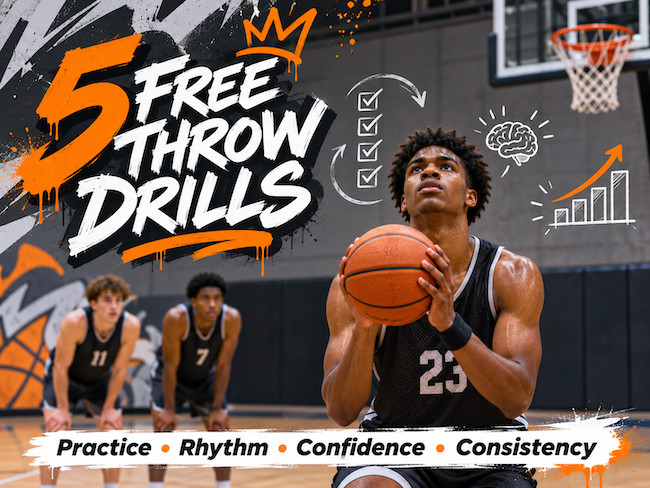
Five Free Throw Shooting Drills That Actually Help
Great free throw shooting requires more than standing at the line and launching 100 basketballs.
Players need deliberate practice, feedback, and some simulated pressure.
These five drills work well for youth players, high school athletes, and recreational basketball enthusiasts.
The 10-in-a-Row Challenge
Purpose: Develop consistency and concentration.
Instructions:
- Shoot 10 free throws, recording your makes.
- Concentrate on using the same stance and routine for every attempt.
- When you achieve 10 consecutive makes, raise the challenge to 15.
- For beginners, start with three or five consecutive makes.
Coaching tip: Don’t change your shooting technique after every miss. Identify a consistent mechanical problem before making adjustments.
Explore our Fun Basketball Games For Kids To Improve Shooting for more ideas.
The Pressure Pair
Purpose: Simulate late-game pressure.
Instructions:
- Imagine your team trails by one point with two seconds remaining.
- Shoot two free throws.
- Make both, and your imaginary team wins.
- Make one, and the game goes into overtime.
- Miss both, and your team loses.
- Repeat for 10 rounds.
Keep a record of your results over several practices.
Coaching tip: Make the scenario feel important without embarrassing players who miss.
The Fatigue Free Throw Drill
Purpose: Develop shooting consistency while tired.
Instructions:
- Perform a short, moderate basketball movement activity, such as defensive slides or a controlled jog.
- Step to the free throw line.
- Take two shots using your regular routine.
- Repeat for five rounds.
The objective is to stabilize your breathing, regain balance, and shoot with control.
Coaching tip: Avoid turning this into an exhausting conditioning punishment. The goal is quality shooting under realistic fatigue.
The Partner Competition
Purpose: Improve concentration through friendly competition.
Instructions:
- Pair players with similar skill levels.
- Each player takes five free throws.
- Award one point per make.
- Play five rounds.
- The player with the higher total wins.
For additional difficulty, award a bonus point when a player makes all five.
Coaching tip: Encourage positive feedback. One player’s success should motivate the other, not create frustration.
The Swish Challenge
Purpose: Improve touch, arc, and accuracy.
Instructions:
- Take 20 free throws.
- Award two points for a clean swish.
- Award one point for a made basket that touches the rim.
- Award zero points for a miss.
- Try to beat your previous score.
Coaching tip: Don’t become so obsessed with swishing that players lose confidence when a successful shot touches the rim.
A basket that rattles in still counts.
The scoreboard has never awarded style points.
Free Throw Rules Every Basketball Player Should Know
The NBA’s free throw rules contain several details that surprise casual fans.
How Much Time Does a Shooter Have?
Under NBA rules, players have 10 seconds to attempt a free throw after receiving control of the basketball.
Taking longer can result in a violation.
Can You Jump During a Free Throw?
Yes, provided you follow the applicable positioning rules.
However, jumping adds movement that may make shooting more difficult.
Most coaches recommend a controlled, grounded motion.
Can You Step Over the Free Throw Line?
Under NBA rules, the shooter cannot cross the plane of the free-throw line until the ball touches the rim, backboard, or the free throw ends.
A player who steps too early can be called for a violation.
When Can Players Enter the Lane?
Players occupying rebounding positions must remain in their designated spaces until the ball is released.
The free throw shooter has different restrictions and must remain behind the line until the appropriate point in the shot.
Can Fans Distract Free Throw Shooters?
Fans routinely wave signs, shout, and attempt other distractions.
That’s part of playing in front of a crowd.
Opposing players, however, are subject to rules prohibiting certain forms of deliberate distraction during a free throw.
Specific free throw rules differ across the NBA, NCAA, and high school basketball. Players and coaches should check the rules governing their competition.
Free Throw Shooting FAQs
What is a good free throw percentage?
For recreational and youth players, 70% can be a worthwhile goal, although expectations should reflect age and experience.
For competitive high school players, reaching 75% to 80% is a strong achievement.
At the professional level, 80% or better is generally considered very good, while 90% represents elite shooting.
Why do NBA players miss free throws?
Even professional athletes experience mechanical inconsistencies, fatigue, distraction, and psychological pressure.
Free throw shooting also requires a specific repetitive skill that doesn’t necessarily correlate with height, strength, or overall athleticism.
Should basketball players shoot 100 free throws every day?
Not necessarily.
Focused, technically sound practice is more valuable than careless repetition.
For young players, shorter sessions involving 20 to 50 thoughtful attempts may be more productive than rushing through 100 shots with deteriorating form.
Is underhand shooting more accurate?
Underhand shooting can be effective for certain players, but there is no guarantee it will improve everyone’s accuracy.
Its success depends on individual mechanics, practice, and comfort.
Rick Barry proved that the technique can work exceptionally well at the highest level.
Who is the greatest free throw shooter of all time?
Stephen Curry holds the leading qualified career free throw percentage in NBA history.
However, Steve Nash, Mark Price, Rick Barry, and several other legends deserve consideration when evaluating historical excellence, consistency, and performance under pressure.
Final Thoughts: The Beauty of the Free Throw
Perhaps the most remarkable thing about free throw shooting is its extraordinary simplicity.
Basketball players have become bigger, stronger, faster, and more skilled.
Offenses have evolved. Defensive strategies have changed. Three-point shooting has transformed the sport.
But the free throw remains essentially unchanged.
One player. One basketball. One basket. Fifteen feet.
The world’s greatest shooters still stand at the same line as beginners learning the game. And the lessons remain timeless.
Find a comfortable technique. Develop a dependable routine. Practice with purpose. Trust your preparation.
Above all, don’t let a missed free throw convince you the next one is doomed.
Stephen Curry has missed free throws. Rick Barry missed free throws. Even Wilt Chamberlain, on the night he scored 100 points, missed four.
The difference between a good free throw shooter and a great one isn’t perfection. It’s having enough confidence in your next shot that you don’t spend too much time worrying about your last one.
If all else fails, maybe it’s time to listen to Rick Barry.
Your grandmother might have been onto something.

By Mike O’Halloran
Founder and Editor, Sports Feel Good Stories
Mike O’Halloran founded Sports Feel Good Stories in 2009. He has authored three books on sports jokes, co-authored four trivia books, and authored three books on basketball coaching. Mike has also written a book on sports slogans and captions. He coached youth basketball for 15 seasons, taught tennis, and was a contributing writer for USA Football, the youth arm of the NFL.
Mike is the publisher of the Well-Prepared Coach line of coaches’ practice plans and editable award certificates. He is the founder of the Fantasy Football Team Names Hall of Fame. Mike is married with four children.
You’re on our Free Throw Shooting: Tips, NBA Legends & Amazing Records feature.
You might also like:
25 Youth Basketball Practice Ideas
