
Every pickleball court has its cast of characters. Some make the game more enjoyable. Others make you wonder whether you should take up a less stressful hobby, like wrestling alligators or assembling furniture without instructions.
There’s the guy who hits every ball like it insulted his mother. The woman who treats a questionable line call like a federal investigation. And the player who offers so much unsolicited advice that you’re tempted to ask whether they charge by the hour.
Sound familiar?
One of pickleball’s greatest attractions is its social nature. You can show up at a public court, paddle in hand, and find yourself playing with complete strangers. Within 15 minutes, you’ll know who takes the game seriously, who likes to talk, and who apparently believes the entire court is theirs.
And while pickleball players come from all walks of life, certain personalities seem to appear wherever there’s a net, a plastic ball, and four people with a little competitive spirit.
Some of these characters are lovable. Some are irritating. A few are both.
So grab your paddle, stretch those hamstrings, and meet the 15 types of pickleball players you’ll encounter on the court.
Fair warning: You might recognize your friends. You might recognize your spouse. And somewhere along the way, you might recognize yourself.
- 1. The Banger: Every Shot Is a Missile Launch
- 2. The Unsolicited Coach: Free Advice, Whether You Want It or Not
- 3. The Line-Call Lawyer: Objection, Your Honor!
- 4. The Paddle Snob: It's Definitely the Equipment
- 5. The Poacher: Your Side of the Court Is Also Their Side
- 6. The Olympic Hopeful: Every Game Is for the Gold Medal
- 7. The Social Butterfly: Pickleball Is Just the Opening Act — People You'll Meet on a Pickleball Court
- 8. The Excuse Factory: Never Met a Missed Shot They Couldn't Explain
- 9. The Scoreboard Amnesiac: What's the Score Again?
- 10. The Relentless Encourager: Nobody Ever Hits a Bad Shot — People You'll Meet on a Pickleball Court
- 11. The Kitchen Camper: Prime Real Estate, No Mortgage Required
- 12. The Spin Doctor: Why Hit Straight When You Can Get Fancy?
- 13. The Mad Lobber: The Sky's the Limit — People You'll Meet on a Pickleball Court
- 14. The Fashion Pro: Dressed to Impress, Regardless of the Score
- 15. The Just-Happy-to-Be-Here Player: The Heart and Soul of Pickleball
- How to Get Along With Every Type of Pickleball Player
- Final Thoughts: Pickleball Wouldn't Be the Same Without These Characters
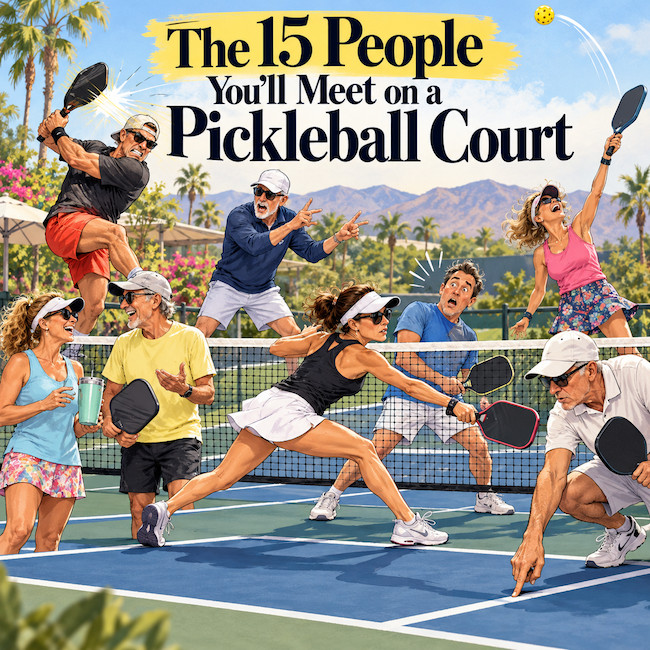
1. The Banger: Every Shot Is a Missile Launch
Signature line: “Sorry! I thought you were ready!”
The Banger approaches pickleball with the subtlety of a wrecking ball.
Dinking? That’s for people who haven’t discovered the joy of hitting something really hard.
Third-shot drop? Never heard of it.
Soft game? Sounds suspiciously like surrender.
The Banger has one strategy: hit the ball so hard that nobody, including the Banger, knows where it’s going. Their favorite shot is a shoulder-high drive aimed directly at the opposing player. Preferably from six feet away.
Some Bangers possess remarkable control. Others hit the back fence so frequently that local wildlife has started wearing helmets. And don’t bother explaining that pickleball rewards patience, positioning, and touch.
The Banger already has a philosophy. Why win a point with six carefully placed shots when you can attempt to end civilization with one?
Of course, experienced players know that controlled power is a legitimate weapon. It’s the reckless, every-ball-is-an-emergency variety that gives Bangers their reputation.
Discover our Pickleball Slogans, Sayings, and Captions feature.

How to Survive the Banger
Keep your paddle up, stay balanced, and let balls heading out of bounds continue their journey.
If you’re playing doubles with a Banger, encourage patience without lecturing.
And remember: Sometimes the best defense against excessive firepower is simply getting out of the way.
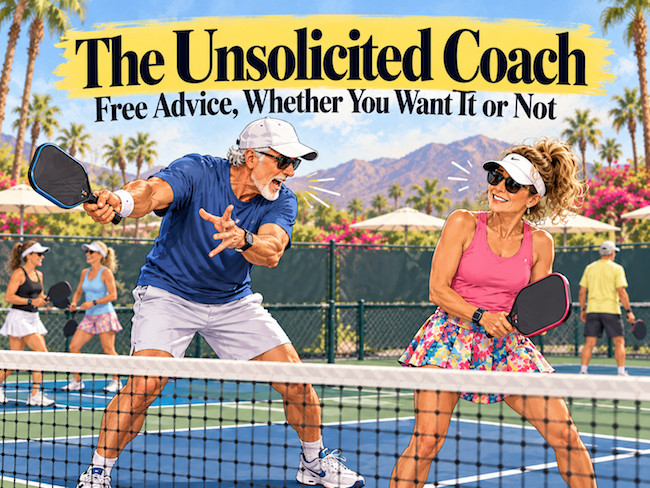
2. The Unsolicited Coach: Free Advice, Whether You Want It or Not
Signature line: “Can I give you one little tip?”
The Unsolicited Coach has never met a player who couldn’t benefit from their wisdom.
Your grip is wrong. Your feet are too close together. Did you know that your paddle is too low? Your positioning needs work.
And apparently, your entire understanding of pickleball is fundamentally flawed.
The remarkable thing is that the Unsolicited Coach doesn’t necessarily play particularly well.
They might miss four consecutive serves, then explain why your backhand technique is costing the team points.
Their advice usually begins with a friendly phrase.
“Just one little suggestion.”
Twenty minutes later, you’re receiving a detailed analysis of your wrist angle, shoulder rotation, and possible childhood influences.
The Unsolicited Coach is especially active after losing a point.
“You needed to move up.”
Helpful information, considering you’ve already watched the ball bounce twice.
To be fair, good coaching can dramatically improve your pickleball game.
But good coaching generally starts when someone requests it.
How to Survive the Unsolicited Coach
Smile and say, “Thanks! I’m working on a few things already.”
If the advice keeps coming, explain that you’d rather concentrate on enjoying the game.
Should that fail, tell them you’re considering charging admission to their next instructional clinic.
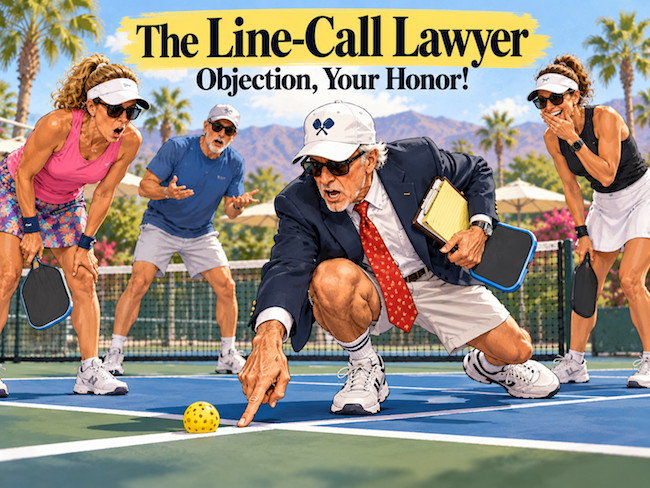
3. The Line-Call Lawyer: Objection, Your Honor!
Signature line: “From my angle, that was definitely out.”
The Line-Call Lawyer considers every close ball a potential Supreme Court case.
Was it in? Was it out? Did the ball touch the line by two millimeters?
Forget playing the next point. We have litigation to conduct.
The Line-Call Lawyer squints, examines imaginary evidence, reconstructs the trajectory, and occasionally consults spectators who weren’t paying attention.
“I saw daylight between the ball and the line.”
Interesting. From 25 feet away, with the sun in your eyes?
There are two particularly interesting things about the Line-Call Lawyer.
First, their eyesight becomes astonishingly precise whenever a close call benefits their team.
Second, that same eyesight mysteriously deteriorates when the call favors an opponent.
Under standard pickleball rules, a ball touching a boundary line is in, except when the serve contacts the non-volley zone line.
And if you can’t clearly see a ball out on your side, the opponent gets the benefit of the doubt.
Unfortunately, the Line-Call Lawyer sometimes treats those principles as optional.
Explore our article on Pickleball court dimensions and rules of play.
How to Survive the Line-Call Lawyer
Make your calls clearly, promptly, and respectfully.
Don’t turn a recreational game into a courtroom drama.
If disagreement persists, remind everyone that the prize for winning is usually the exact same thing as the prize for losing: another game of pickleball.
4. The Paddle Snob: It’s Definitely the Equipment
Signature line: “You really need to try this paddle.”
The Paddle Snob doesn’t just own pickleball equipment. They maintain an investment portfolio of it.
Their collection includes thermoformed paddles, raw carbon fiber paddles, elongated paddles, widebody paddles, and paddles with technology apparently developed by NASA.
Each has a specific purpose. One produces more spin. Another provides exceptional control. A third has an enlarged sweet spot roughly the size of Rhode Island. Unfortunately, none of them prevent the occasional double fault.
The Paddle Snob loves explaining technical specifications. Swing weight. Twist weight. Core thickness. Surface texture.
Ask what time it is, and you might receive a presentation on polymer honeycomb construction.
Their favorite activity is encouraging other players to try a different paddle.
“You’d be amazed what this can do for your game.”
Maybe.
But some of us suspect our primary problem isn’t paddle technology.
It’s the person holding the paddle.
How to Survive the Paddle Snob
Enjoy the demonstration, test the paddle if you’d like, and remember that technique generally matters more than price.
If they start describing their latest purchase in excessive detail, casually ask whether it comes with a professional player attached.
5. The Poacher: Your Side of the Court Is Also Their Side
Signature line: “I had that!”
The Poacher has a simple understanding of doubles pickleball.
There are two players on the team.
One hits the ball.
The other watches.
Guess which role the Poacher prefers?
The Poacher takes your forehand, your backhand, and occasionally balls that appear headed toward an adjoining court.
They spring across the middle like a golden retriever chasing a tennis ball.
Sometimes the result is spectacular.
A lightning-fast volley. A perfectly angled winner. A point-ending smash.
Other times, the Poacher lunges across your body, sends the ball into the net, and looks disappointed that you didn’t provide better support.
“Why weren’t you covering the other side?”
Because, apparently, I was supposed to anticipate your unexpected migration.
Of course, smart poaching can be an excellent doubles strategy. A well-timed interception puts pressure on opponents and creates winning opportunities.
The problem arises when the Poacher believes communication is unnecessary because their instincts are infallible.
Take a deep dive into Winning the First Five Minutes of a Pickleball Game.

How to Survive the Poacher
Establish who takes middle balls before the game begins.
Talk during points and clarify responsibilities between games.
And if your partner insists on covering 90% of the court, consider asking whether they’d like you to hold their water bottle.
6. The Olympic Hopeful: Every Game Is for the Gold Medal
Signature line: “COME ONNNNN!”
It’s 9:15 on a Tuesday morning.
You’re playing recreational pickleball at the community center.
The score is 4–3.
But according to the Olympic Hopeful, this is the most important athletic contest since the Miracle on Ice.
Every point demands maximum emotional investment.
A successful dink earns a fist pump.
A putaway produces a primal scream.
An opponent’s unforced error apparently requires a celebration normally reserved for winning the Super Bowl.
The Olympic Hopeful also takes losses personally.
A missed return might produce a dramatic stare toward the heavens, followed by a speech about focus, execution, and mental toughness.
Meanwhile, you’re just hoping to finish before lunch.
The funniest part?
This player often announces, “I’m just here to have fun.”
Absolutely.
And a tornado is just a little breeze.
How to Survive the Olympic Hopeful
Play your game and don’t let their intensity infect your mood.
A little competitive fire makes pickleball exciting. But if your partner starts treating match point like a matter of national security, remind them that nobody is handing out medals afterward.
7. The Social Butterfly: Pickleball Is Just the Opening Act — People You’ll Meet on a Pickleball Court
Signature line: “Oh, that reminds me of something!”
The Social Butterfly loves pickleball.
But pickleball ranks somewhere below conversation, friendship, community gossip, and learning about your grandchildren.
This player knows everybody.
First names, birthdays, occupations, favorite restaurants, vacation plans, and which couple recently bought a condo in Florida.
Between points, they tell stories.
During breaks, they tell longer stories.
Occasionally, they interrupt a rally to finish one.
The Social Butterfly can transform a simple question like “Who’s serving?” into a discussion of a recent cruise, a knee replacement, and the best place to buy fresh tomatoes.
Their matches take longer than most.
But everyone leaves feeling like they’ve attended a neighborhood reunion.
And here’s the wonderful thing: The Social Butterfly reminds us that pickleball is about much more than winning.
It’s about belonging.
Looking for a laugh? Browse our Funny Pickleball Jokes, Puns, and One-Liners.
How to Survive the Social Butterfly
Enjoy the conversation, but gently keep the game moving.
And if you have somewhere to be afterward, avoid asking, “So how was your weekend?”
That could cost you 45 minutes.
8. The Excuse Factory: Never Met a Missed Shot They Couldn’t Explain
Signature line: “Normally, I make that shot.”
The Excuse Factory has never missed a shot because of poor execution.
There is always another explanation.
The sun was too bright.
The wind changed direction.
The ball bounced funny.
The paddle slipped.
The court surface was strange.
Their shoes weren’t gripping.
Their shoulder felt tight.
Or, in particularly desperate circumstances, Mercury was in retrograde.
After hitting an easy overhead into the net, the Excuse Factory looks at their paddle with genuine suspicion.
“Something’s wrong with this thing.”
After missing a routine return, they explain that the previous night’s sleep was disappointing.
And when their serve lands six feet long?
“Wow. That ball really took off.”
It’s almost admirable.
The Excuse Factory possesses an unshakable confidence in their abilities, supported by an equally unshakable refusal to accept responsibility.
If excuses earned points, they’d never lose.
How to Survive the Excuse Factory
Don’t argue. Just keep playing.
If you’re feeling mischievous, offer a new explanation.
“Maybe the Earth’s rotation was slightly faster on that one.”
Then prepare to hear why that might actually be possible.
9. The Scoreboard Amnesiac: What’s the Score Again?
Signature line: “Wait. Is it 7–5–2 or 5–7–1?”
The Scoreboard Amnesiac has played pickleball for years.
They understand the rules, know the difference between a dink and a drive, and can execute a respectable third-shot drop.
But remembering the score?
Impossible.
You announce it before serving.
Three seconds later, they ask for it again.
The Scoreboard Amnesiac struggles especially with traditional doubles scoring, where the serving team’s score, receiving team’s score, and server number must be called.
“Six-four-two.”
“Wait. We’re winning?”
“No, we’re losing.”
“Then why did you say six first?”
“Because we’re serving.”
“Oh. Right.”
Two points later, the entire conversation repeats.
The Scoreboard Amnesiac isn’t necessarily distracted.
Their brain simply refuses to reserve storage space for three small numbers.
And strangely enough, this condition appears contagious.
After 20 minutes, nobody on the court remembers the score.
How to Survive the Scoreboard Amnesiac
Announce the score clearly before every serve.
Keep track of the server and your team’s position.
And when all four players lose count, negotiate a reasonable score and continue.
Nobody wants to summon an accountant to settle a friendly game.
10. The Relentless Encourager: Nobody Ever Hits a Bad Shot — People You’ll Meet on a Pickleball Court
Signature line: “Great idea! Just missed!”
The Relentless Encourager is the human equivalent of a motivational poster.
Miss an easy dink?
“Good try!”
Send a serve into the parking lot?
“You’ve got the right idea!”
Swing and miss entirely?
“Love the aggression!”
This player can turn an 11–0 defeat into an inspirational experience.
“We did some really good things out there!”
Really?
Because according to the scoreboard, we did absolutely nothing.
But here’s the secret: The Relentless Encourager is often a terrific doubles partner.
They don’t sulk, criticize, or assign blame.
They keep your spirits up and help you recover from mistakes.
And they’re remarkably good at reminding everyone that recreational sports should be enjoyable.
Sure, their optimism sometimes stretches the boundaries of reality.
But in a world full of Unsolicited Coaches and Excuse Factories, isn’t it nice to play with someone who thinks you’re doing great?
How to Survive the Relentless Encourager
You don’t need to survive them.
You need to appreciate them.
Although if you miss 14 consecutive shots, you might gently suggest that a little honest feedback wouldn’t hurt.
11. The Kitchen Camper: Prime Real Estate, No Mortgage Required
Signature line: “Come on up! Don’t stay back!”
The Kitchen Camper has one preferred destination on the pickleball court.
The non-volley-zone line.
Once there, they intend to remain indefinitely.
If zoning regulations permitted, they’d install a mailbox, patio furniture, and a small refrigerator.
The Kitchen Camper knows that controlling the area near the kitchen line is fundamental to successful doubles pickleball.
And they’re not wrong.
They love exchanging dinks, cutting off angles, and pressuring opponents who remain near the baseline.
Their problem is occasionally forgetting that successful positioning also requires movement.
A well-placed lob sends them retreating awkwardly.
A hard drive at their feet produces frantic paddle work.
And a short ball might leave them leaning so far forward that their shoes threaten to cross the kitchen line.
The Kitchen Camper also enjoys instructing partners to move forward.
Repeatedly.
Sometimes while the partner is desperately defending a shot from the backcourt.
How to Survive the Kitchen Camper
Recognize that moving toward the kitchen line is generally a good strategy, but do it when the ball and circumstances allow.
And if your partner insists on living there permanently, remind them that the rest of the court isn’t merely decorative.
12. The Spin Doctor: Why Hit Straight When You Can Get Fancy?
Signature line: “Did you see how much spin I put on that?”
The Spin Doctor believes ordinary pickleball shots are boring.
Why hit a straightforward serve when you can produce a wicked topspin drive?
Why return a ball safely when you can attempt a delicate slice that curves like a boomerang?
And why execute a routine dink when you can add so much spin that even the ball seems confused?
The Spin Doctor spends considerable time experimenting.
Their paddle moves through strange angles and elaborate follow-throughs.
Occasionally, the result is magnificent.
The ball dips sharply, skids unexpectedly, or causes an opponent to swing at thin air.
Other times, the ball sails into the next county.
No matter.
The Spin Doctor is already analyzing the mechanics.
“Too much wrist that time.”
Their greatest joy isn’t necessarily winning a point.
It’s watching an opponent unsuccessfully deal with something unusual.
How to Survive the Spin Doctor
Watch the paddle face, observe the ball’s flight, and prepare for unusual bounces.
Don’t assume every heavily spinning shot will land in.
And if you’re partnering with a Spin Doctor, remember that creativity occasionally comes with a price tag.
Usually paid in unforced errors.
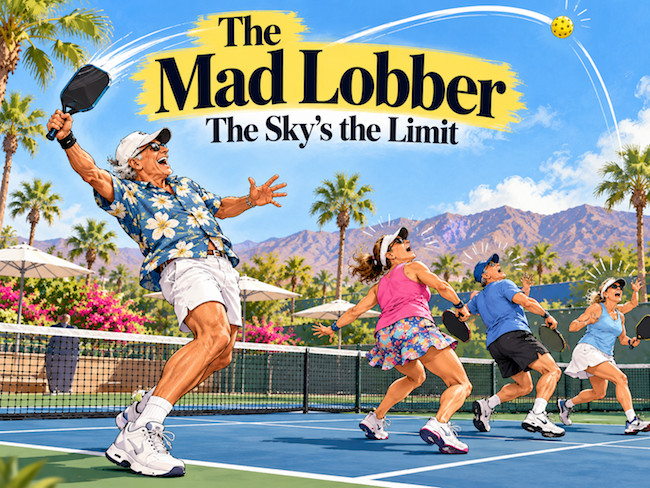
13. The Mad Lobber: The Sky’s the Limit — People You’ll Meet on a Pickleball Court
Signature line: “They can’t smash it if they can’t reach it!”
The Mad Lobber has never met a pickleball that couldn’t benefit from additional altitude.
Corner dink?
Lob.
Easy midcourt ball?
Lob.
Opponents standing 30 feet behind the baseline?
Believe it or not, another lob.
The Mad Lobber’s philosophy is simple: Why compete on the ground when there’s so much unused airspace?
Their favorite shot launches the ball toward the heavens, where it briefly threatens commercial aviation before returning to Earth.
Sometimes the strategy works beautifully.
A well-placed lob sails over opponents positioned too close to the kitchen line and lands near the baseline.
Other times, the lob hangs in the air like a birthday balloon.
The opposing player has enough time to retreat, set their feet, check their retirement account, and deliver an overhead smash.
The Mad Lobber remains undeterred.
“Just needed a little more height.”
This player is particularly dangerous indoors, where low ceilings create an additional opponent.
How to Survive the Mad Lobber
When facing one, communicate with your partner and prepare to move backward safely.
When partnering with one, anticipate the overhead smash that might follow a short lob.
And if every shot goes skyward, gently suggest that horizontal pickleball is also an option.
14. The Fashion Pro: Dressed to Impress, Regardless of the Score
Signature line: “Do these shoes match my paddle?”
The Fashion Pro arrives looking like the centerpiece of a sporting goods advertisement.
Matching shoes.
Matching visor.
Perfectly coordinated shirt, shorts, and accessories.
Even the paddle cover complements the outfit.
Their wardrobe says, professional athlete.
Their game occasionally says, introductory recreation class.
But that’s beside the point.
The Fashion Pro understands something the rest of us have overlooked: You can lose a match and still win the fashion competition.
They know which athletic brands are trending and can identify the newest pickleball clothing lines.
They own specialized court shoes, moisture-wicking shirts, premium sunglasses, and enough accessories to outfit a small national team.
Meanwhile, you’re wearing a faded charity 5K T-shirt from 2014.
The Fashion Pro’s equipment always looks brand-new.
And somehow, they never seem quite as sweaty as everybody else.
How to Survive the Fashion Pro
Compliment the outfit.
Then play your normal game.
The ball doesn’t care how much anyone spent on their clothing.
If they show up with shoes that match the court surface, you should probably acknowledge the effort.
15. The Just-Happy-to-Be-Here Player: The Heart and Soul of Pickleball
Signature line: “Great game! Who’s next?”
Every pickleball group needs this player.
They’re friendly, enthusiastic, and genuinely happy to be on the court.
They don’t obsess over ratings, rankings, paddle technology, or whether someone made a questionable line call three games ago.
These players celebrate good shots.
They laugh at mistakes.
They willingly partner with beginners.
And they remember that a beautiful morning spent playing pickleball is already a pretty good day.
The Just-Happy-to-Be-Here Player can be competitive, too.
They like winning as much as anybody.
But losing doesn’t spoil their mood.
They don’t need an excuse for every mistake or a lecture for every teammate.
They understand that one of pickleball’s greatest gifts is bringing people together.
Sometimes those people are lifelong friends.
Sometimes they’re complete strangers who become friends after a few games.
And sometimes they’re Bangers, Poachers, Spin Doctors, and Line-Call Lawyers.
The Just-Happy-to-Be-Here Player welcomes them all.
How to Survive the Just-Happy-to-Be-Here Player
Don’t.
Join them.
Because if you’re fortunate enough to play with someone who makes everybody feel welcome, you’ve found one of the best partners in the game.
And if you can become that person yourself, even better.
How to Get Along With Every Type of Pickleball Player
One of the remarkable things about pickleball is how many different personalities can share a small playing surface.
Four people can approach the same recreational game with completely different motivations.
One wants exercise. Another wants competition. A third wants social interaction. And the fourth wants to demonstrate the devastating power of a $275 paddle.
Yet somehow, most of the time, everybody manages to have fun.
A few basic principles can make those games even better.
Remember Why People Play
Not everyone has the same goals.
Some players want to improve their DUPR ratings and compete in tournaments. Others simply want to enjoy an hour of exercise with friends.
Neither approach is wrong.
Problems develop when players expect everyone else to share their priorities.
Read the Room
A competitive tournament isn’t the same as a beginner-friendly open-play session.
Hard drives, aggressive poaching, and tactical targeting might be appropriate in one setting but unpleasant in another.
Good players adjust to the situation without making others feel uncomfortable.
Be the Partner You’d Want to Have
Communicate. Encourage. Accept responsibility for mistakes.
And remember that blaming your partner for every lost point is a remarkably effective way to find yourself looking for a new partner.
Keep Your Sense of Humor
Pickleball is full of ridiculous moments.
Balls hit paddle frames.
Players swing at shots that bounce three feet away.
Perfectly executed strategies occasionally produce spectacular failures.
Laugh at yourself.
The game becomes much more enjoyable when every mistake isn’t treated like a personal tragedy.
Final Thoughts: Pickleball Wouldn’t Be the Same Without These Characters
The beauty of pickleball isn’t simply the competition, the exercise, or the satisfaction of hitting a perfect shot.
It’s the people.
The familiar faces. The friendly rivalries. The laughter between games. The unexpected friendships that begin with four strangers and a plastic ball.
Sure, the Banger might occasionally frighten you.
The Line-Call Lawyer might test your patience.
And the Mad Lobber might inspire you to wear a hard hat.
But together, these characters make pickleball one of the most entertaining recreational sports around.
A good pickleball community has room for different personalities, skill levels, and playing styles.
And while we can all appreciate a perfectly executed third-shot drop, sometimes the best moments have nothing to do with the score.
They’re the moments that leave everybody laughing.
So which of these 15 pickleball personalities sounds most like you? And which one describes your favorite—or least favorite—playing partner?
Share this article with your pickleball group and see how many of these characters your friends recognize.
Just remember: If you tag somebody as the Unsolicited Coach, the Line-Call Lawyer, or the Excuse Factory, you might want to find a different doubles partner for tomorrow.
And one final piece of advice.
If you can’t identify the Banger, the Poacher, or the Unsolicited Coach in your pickleball group, there’s a chance you’re one of them.
See you on the court!

By Mike O’Halloran
Founder and Editor, Sports Feel Good Stories
Mike O’Halloran founded Sports Feel Good Stories in 2009. He has authored three books on sports jokes, co-authored four trivia books, and authored three books on basketball coaching. Mike has also written a book on sports slogans and captions. He coached youth basketball for 15 seasons, taught tennis, and was a contributing writer for USA Football, the youth arm of the NFL.
Mike is the publisher of the Well-Prepared Coach line of coaches’ practice plans and editable award certificates. He is the founder of the Fantasy Football Team Names Hall of Fame. Mike is married with four children.
Mike has been playing pickleball for five years.
You are on our The 15 People You’ll Meet on a Pickleball Court (& How to Survive) feature.
You might also like:
Is Serving First in Pickleball an Advantage?
