
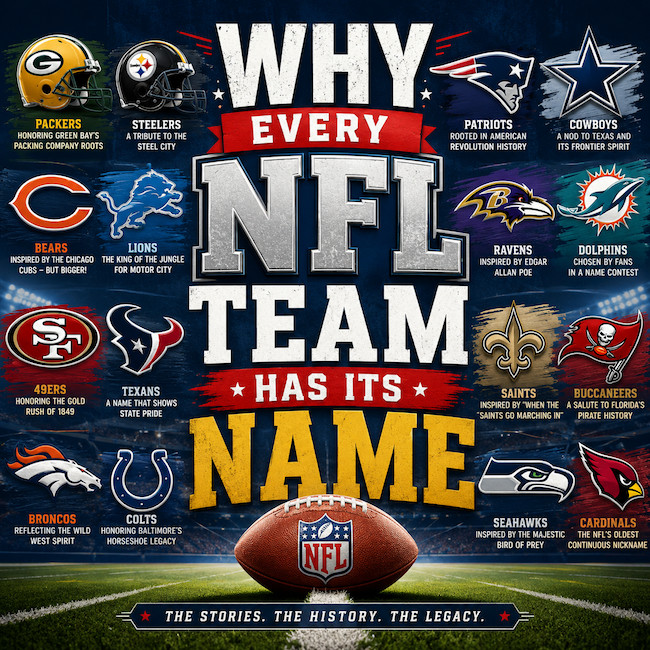
Did you ever wonder how NFL team names came about? Football fans love debating quarterbacks, arguing about dynasties, and insisting their team’s throwback uniforms are vastly superior to everyone else’s. But every Sunday, millions of fans cheer for names they rarely stop to think about.
Why are Green Bay’s players called the Packers? What exactly is a Brown? Why did Tennessee become the Titans? And how did a bird as intimidating as a cardinal become the mascot of one of the NFL’s oldest franchises?
The answers are far more interesting than you might expect.
Some NFL team names celebrate local industries. Others honor military history, regional wildlife, or civic pride. A few were borrowed from earlier professional teams. Several survived cross-country relocations despite making almost no geographical sense anymore. (Looking at you, Lakers…wait, wrong league.)
In this guide, we’ll explore the origin story behind every NFL franchise name, uncover fascinating historical tidbits, and explain why these identities have endured for generations.
Let’s begin in the American Football Conference.
AFC East – NFL Team Names
Buffalo Bills
The Story Behind the Name
At first glance, you might assume the Buffalo Bills are named after the city’s most famous animal. Surprisingly, they aren’t.
The franchise was founded in 1960 as one of the original members of the American Football League. During a public naming contest, fans overwhelmingly selected “Bills.”
The nickname actually traces back to the legendary American frontiersman William Frederick Cody, better known as Buffalo Bill. Cody became one of the most recognizable figures of the American West thanks to his wildly popular “Buffalo Bill’s Wild West Show,” which toured the United States and Europe during the late 1800s.
Even more interesting, Buffalo already had a successful All-America Football Conference team during the 1940s called the Bills. The AFL franchise revived that familiar name, giving the city a sense of continuity while paying tribute to one of America’s greatest folk heroes.
Why It Fits Buffalo
Although Cody had no meaningful connection to Western New York, the name had already become woven into Buffalo’s sporting history.
Today, “Bills Mafia” has become one of the NFL’s most recognizable fan cultures. The team didn’t officially create the nickname—it grew organically on social media—but it perfectly complements a franchise known for passionate supporters, snow-covered games, and unforgettable tailgates.
It’s safe to say Buffalo Bill probably never envisioned fans jumping through folding tables, but history occasionally takes delightful detours.
Miami Dolphins
The Story Behind the Name
When Miami joined the AFL in 1966, ownership held a public contest to name the expansion franchise.
More than 19,000 entries poured in, with “Dolphins” emerging as the clear favorite.
The choice reflected South Florida’s close relationship with the Atlantic Ocean, where dolphins are commonly found. Known for intelligence, speed, teamwork, and playful energy, dolphins projected exactly the kind of image the young franchise wanted.
Unlike intimidating names such as the Raiders or the Vikings, the Dolphins had a lighter personality while still representing athletic excellence.
A Perfect Match for South Florida
Few professional sports names fit their location as naturally as the Miami Dolphins.
The team’s aqua and orange colors echo the ocean and sunshine that define South Florida. Even the iconic leaping dolphin logo became one of the NFL’s most recognizable visual identities.
Of course, the franchise quickly gave opponents something else to fear besides marine mammals.
During the early 1970s, head coach Don Shula guided Miami to one of football’s greatest dynasties, highlighted by the undefeated 1972 season—the only perfect season in NFL history.
Not bad for a mascot that usually spends its day entertaining tourists.
New England Patriots
The Story Behind the Name
The franchise began life in 1960 as the Boston Patriots.
The name celebrated the American colonists who fought for independence during the Revolutionary War. Few regions of the United States are as closely associated with the nation’s founding as New England, making the Patriots an obvious choice.
When the franchise moved to Foxborough in 1971, ownership considered changing the team’s identity.
One proposal was the Bay State Patriots. Fortunately, cooler heads prevailed.
The broader “New England Patriots” better represented the six-state region and helped the team cultivate one of the largest fan bases in professional sports.
Why the Name Endures
Unlike many NFL names rooted in geography or wildlife, the Patriots celebrate an ideal.
The team’s famous “Pat Patriot” mascot, Revolutionary War imagery, and tri-corner hats reinforce that colonial heritage. Ironically, the Patriots didn’t become football royalty until centuries after the Revolution.
Under Bill Belichick and Tom Brady, New England built one of the greatest dynasties in sports history, winning six Super Bowls together and redefining sustained excellence.
Apparently, liberty isn’t the only thing worth defending.
New York Jets
The Story Behind the Name
The franchise entered the AFL in 1960 as the New York Titans. The name sounded powerful, but the team struggled financially and competitively during its early years.
Everything changed after new ownership purchased the club in 1963. The organization moved into Shea Stadium, located near LaGuardia Airport, one of the world’s busiest airports.
Seeking a fresh identity, ownership chose “Jets.”
The new name reflected America’s fascination with the Jet Age, symbolizing speed, modern technology, and the nation’s growing aerospace industry.
The alliteration with the Mets, another Shea Stadium tenant, certainly didn’t hurt either.
More Than Just Airplanes
The Jets embraced aviation from the start.
Their logo, uniforms, and branding consistently incorporated flight themes, helping establish one of the league’s cleaner visual identities.
Of course, no discussion of the Jets can ignore Joe Namath.
“Broadway Joe” famously guaranteed victory before Super Bowl III, then delivered one of the greatest upsets in football history by defeating the heavily favored Baltimore Colts.
The Jets have spent decades chasing another championship, but their name remains one of the NFL’s sleekest and most forward-looking identities.
Browse our Football Terms and Definitions to learn more about the game.
AFC North – NFL Team Names
Baltimore Ravens
The Story Behind the Name
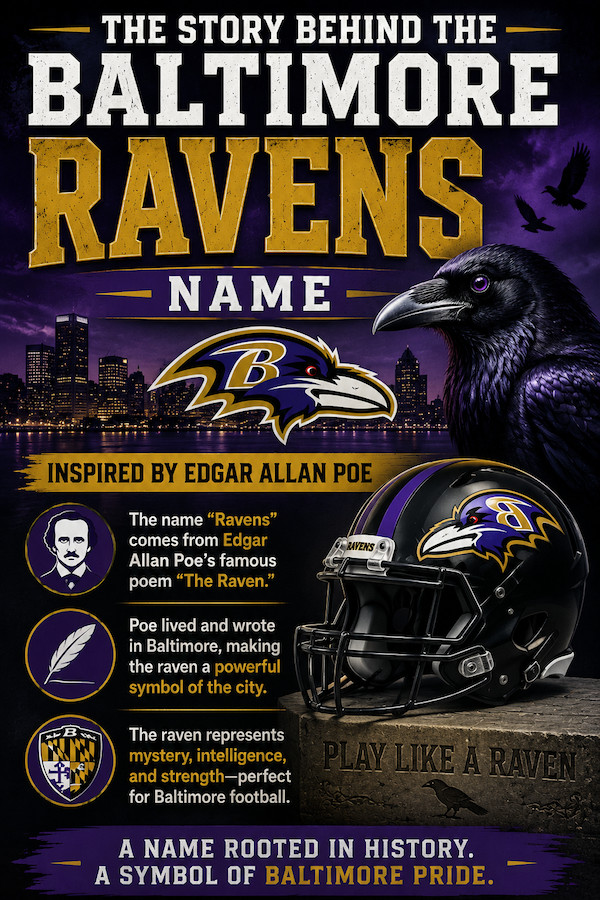
Few NFL names carry as much literary significance as the Ravens. When Baltimore received a new franchise in 1996 following the relocation of the Cleveland Browns organization, fans participated in another naming contest.
The overwhelming winner was the Ravens.
The inspiration came from Edgar Allan Poe’s famous poem, The Raven. Poe spent the final years of his life in Baltimore and is buried there, making him one of the city’s most celebrated historical figures.
Rather than choosing a generic bird mascot, Baltimore embraced one of literature’s most enduring symbols.
A Name with Personality
The raven represents intelligence, mystery, and resilience.
Those qualities have fit the franchise remarkably well.
From Ray Lewis and Ed Reed to Lamar Jackson, Baltimore has consistently fielded teams known for intelligence, toughness, and creativity.
And unlike some sports names that require lengthy explanations, Ravens immediately evoke a memorable image—even if opposing quarterbacks probably hear something closer to “Nevermore” after another Baltimore interception.
Cincinnati Bengals
The Story Behind the Name
The Bengals’ name predates the NFL franchise.
During the 1930s, Cincinnati featured a professional football team called the Bengals.
When Paul Brown founded the modern franchise in 1968, he revived the historic nickname.
There was another reason for the selection.
The Cincinnati Zoo was famous for its rare Bengal tigers, giving the name a natural local connection.
Brown wanted a fierce, recognizable identity that also honored the city’s football past.
Mission accomplished.
Orange, Black, and Instantly Recognizable
Few NFL uniforms stand out like Cincinnati’s tiger stripes.
The Bengals fully embraced their identity, creating one of football’s boldest visual brands.
The team’s helmets—introduced in 1981—remain among the most distinctive in professional sports.
Sometimes the simplest ideas are the best ones.
If you’re going to call yourself the Bengals, you might as well look like one.
Cleveland Browns
The Story Behind the Name
No NFL name sparks more curiosity than the Browns. Were they named after the color? A family?
The answer is simpler.
The franchise is named after its legendary first coach and co-founder, Paul Brown.
When the team was established in 1945, a fan contest produced “Panthers” as the leading choice. Unfortunately, another football team already owned the rights. Eventually, ownership settled on Browns to honor the coach who would become one of football’s greatest innovators.
Brown revolutionized professional football through advanced scouting, classroom instruction, detailed playbooks, and rigorous organizational structure. Many of today’s coaching practices can be traced directly to his influence.
One of Football’s Most Historic Names
Unlike nearly every other NFL team, the Browns aren’t represented by an animal, occupation, or mythical figure.
They’re named after a man. That uniqueness has become part of Cleveland’s identity. Their simple orange helmets—remarkably logo-free—are equally distinctive.
In a league filled with soaring birds and fearsome predators, Cleveland proudly says, “We’ll just be the Browns.”
Sometimes confidence doesn’t need decoration.
Pittsburgh Steelers
The Story Behind the Name
Originally founded in 1933, Pittsburgh’s franchise was known as the Pirates, borrowing the name from the city’s successful Major League Baseball club.
In 1940, owner Art Rooney decided the football team deserved its own identity.
A contest produced the winning entry: Steelers.
The name honored the steel industry that transformed Pittsburgh into one of America’s great industrial powerhouses.
At one time, nearly half of America’s steel was produced in and around the city.
The football team became a tribute to the workers whose labor helped build bridges, skyscrapers, railroads, ships, and countless pieces of American infrastructure.
Built Like Steel
Few names have aged as gracefully.
The Steelers became synonymous with toughness, physical football, and blue-collar excellence.
The famous Steelmark logo on one side of the helmet originally belonged to the American Iron and Steel Institute before the franchise adapted it for football.
Combined with six Super Bowl championships, the identity has become one of the strongest brands in all of sports.
If ever a city and football team were forged from the same material, it’s Pittsburgh.
Discover our fun Football Captions to bring your pigskin photos to life.
AFC South – NFL Team Names
Houston Texans
The Story Behind the Name
When Houston received an expansion franchise in 2002 following the Oilers’ departure to Tennessee, ownership faced an enormous challenge.
How do you replace one of football’s most beloved names?
After considering several options—including Stallions, Bobcats, and Apollos—the franchise selected Texans. The choice celebrated the state’s unique identity and fierce pride.
If there’s one thing Texans generally enjoy, it’s being Texan.
The name immediately resonated with fans, creating a broad identity that represented the entire state rather than any one city or industry.
A Symbol of State Pride
Unlike many NFL teams named after animals or occupations, the Texans represent people.
The logo, featuring a stylized bull’s head in the colors of the Texas flag, reinforces themes of independence, strength, and heritage.
It may not possess the romance of the Oilers, but the Texans capture something equally authentic: the larger-than-life personality of the Lone Star State.
Few places wear regional pride quite as confidently as Texas.
The football team followed suit.
Indianapolis Colts
The Story Behind the Name
The Colts began life in Baltimore in 1953.
The name honored Maryland’s rich horse-breeding tradition.
The state had long been known for raising championship thoroughbreds, making Colts an appropriate symbol of youth, speed, and athleticism.
When owner Robert Irsay controversially relocated the franchise to Indianapolis in 1984, the nickname surprisingly remained a perfect fit.
Indiana also boasts a deep equestrian tradition, and the name transitioned more naturally than many relocated franchises.
Galloping Into a New Era
The Colts found new life in Indianapolis.
From Johnny Unitas in Baltimore to Peyton Manning in Indianapolis, the franchise has consistently been associated with elite quarterback play.
The horseshoe logo remains one of the NFL’s simplest and most recognizable symbols.
Sometimes relocation creates awkward branding.
This wasn’t one of those times.
Jacksonville Jaguars
The Story Behind the Name
When Jacksonville earned an expansion franchise in 1995, ownership wanted a nickname that projected speed, power, and excitement.
A fan contest helped identify several finalists before the Jaguars emerged as the winner.
Although jaguars aren’t native to Florida, they are among the world’s most athletic predators, capable of explosive acceleration, incredible agility, and remarkable strength.
There was also a local connection.
Jacksonville Zoo had recently featured a popular jaguar exhibit, helping familiarize residents with the majestic cats.
One of the NFL’s Newest Identities
The Jaguars quickly established a distinctive visual identity with teal uniforms, a fierce cat logo, and an aggressive style that reflected their mascot.
Remarkably, the expansion team reached the AFC Championship Game during just its second season, proving the Jaguars weren’t content to spend years learning how to hunt.
They preferred to pounce immediately.
Tennessee Titans
The Story Behind the Name
Few NFL franchises have undergone a more dramatic identity makeover than the Tennessee Titans.
The organization began life in 1960 as the Houston Oilers, one of the charter members of the American Football League. The name perfectly reflected Houston’s booming petroleum industry, and the Oilers became one of professional football’s most beloved brands, complete with their unforgettable Columbia blue uniforms and iconic derrick logo.
Then came the move.
Owner Bud Adams relocated the franchise to Tennessee following the 1996 season. During its first year in its new home, the team remained the Houston Oilers despite playing in Memphis—a geographical mismatch that confused just about everyone.
In 1998, the club became the Tennessee Oilers, but the name still didn’t feel right. Tennessee wasn’t exactly known for offshore drilling or sprawling oil fields.
A fresh start was needed.
Before the 1999 season, the organization unveiled its new identity: the Titans.
Why “Titans”?
The name draws inspiration from Greek mythology, where the Titans were powerful giants who ruled before the Olympian gods. More broadly, the word has come to represent greatness, strength, leadership, and larger-than-life figures.
It also happened to fit Nashville surprisingly well.
The city’s skyline was growing, its economy was booming, and Tennessee wanted a franchise that represented the entire state rather than a single industry left behind in Texas.
The timing couldn’t have been better.
In their very first season as the Titans, the franchise reached Super Bowl XXXIV, producing one of the most memorable finishes in NFL history. Kevin Dyson was tackled just one yard short of the tying touchdown as time expired against the St. Louis Rams.
One yard.
It remains perhaps the most famous yard in franchise history.
Explore our Football Positions Explained Guide feature for a deeper understanding of the game.
AFC West – NFL Team Names
The AFC West might be the NFL’s most colorful division. Cowboys, pirates, horses, and lightning bolts all call this corner of the league home. The names reflect the American West’s adventurous spirit, and each franchise has built an identity that extends far beyond its logo.
Denver Broncos
The Story Behind the Name
When Denver joined the AFL in 1960, the city held a public naming contest.
The winning entry?
Broncos.
The choice couldn’t have been more fitting.
A bronco is an untamed horse, famous for its speed, endurance, and unwillingness to be broken. Throughout the American West, broncos symbolize independence, resilience, and frontier life.
Colorado’s history is deeply tied to ranching, rodeos, and horseback travel, making the Broncos an obvious winner.
The name instantly connected the franchise with the Rocky Mountain West.
More Than Just a Horse
The Broncos have embraced their Western identity for decades.
The team’s famous white horse mascot, Thunder, gallops across the field before games, while the orange-and-blue uniforms have become among the NFL’s most recognizable color combinations.
Success certainly helped.
John Elway’s heroics, Terrell Davis’ powerful running, Peyton Manning’s record-breaking offense, and a trio of Super Bowl championships transformed the Broncos into one of football’s flagship franchises.
Much like the horses that inspired the name, Denver has built a reputation for speed, toughness, and refusing to stay down for long.
Kansas City Chiefs
The Story Behind the Name
Contrary to popular belief, the Chiefs weren’t originally born in Kansas City. The franchise began in Dallas in 1960 as the Texans, founded by AFL visionary Lamar Hunt.
When Hunt moved the team to Kansas City in 1963, he wanted a new identity that reflected the city’s unique character. The inspiration came from Kansas City Mayor Harold Roe Bartle.
Bartle was affectionately known as “The Chief” because of his leadership role in a youth organization that incorporated Native American-inspired traditions.
Rather than naming the team directly after Bartle, Hunt selected Chiefs as a tribute to the mayor’s leadership and influence in bringing professional football to Kansas City.
A Name That Has Evolved
Over the decades, the franchise has adjusted various game-day traditions to be more respectful and mindful of Native American cultures while retaining its historic name.
Meanwhile, the football has been spectacular.
The Chiefs won Super Bowl IV under Hank Stram, then returned to the NFL’s mountaintop more than 50 years later behind Andy Reid and Patrick Mahomes.
Arrowhead Stadium has become one of the loudest venues in sports, routinely setting records for crowd noise.
Apparently, winning has a way of amplifying the volume.
Las Vegas Raiders
The Story Behind the Name
If ever there were a perfect marriage between a nickname and a team’s personality, it’s the Raiders.
The franchise entered the AFL in 1960 after an unusual beginning.
Initially, a public contest selected the nickname “Señors.”
Fans hated it.
Within weeks, ownership wisely changed course and adopted the Raiders.
It was a brilliant decision.
Raiders evoked images of fearless adventurers, daring risk-takers, and relentless competitors—qualities that eventually became synonymous with the franchise itself.
Building the Raider Mystique
No discussion of the Raiders can ignore Al Davis. His famous motto, “Just Win, Baby,” became one of the defining slogans in professional sports.
Under Davis, the Raiders cultivated an image unlike any other team. The silver-and-black uniforms, pirate logo, eye patch, and intimidating fan culture created one of football’s strongest brands.
The franchise has relocated from Oakland to Los Angeles, back to Oakland, and finally to Las Vegas. Remarkably, the Raiders’ identity survived every move. That’s the sign of a truly iconic name.
The address changed. The attitude never did.
Los Angeles Chargers
The Story Behind the Name
The Chargers have one of the NFL’s more unusual naming stories.
When the franchise was founded in Los Angeles in 1960, owner Barron Hilton reportedly chose the nickname after becoming captivated by the bugle charge commonly heard at the Los Angeles Memorial Coliseum during sporting events.
Each triumphant blast of the trumpet was known as a “charge.”
Hilton loved both the sound and the energy.
Thus, the Chargers were born.
The name also conveniently aligned with the era’s growing fascination with electricity, speed, and modern technology.
A Bolt That Has Lasted
The lightning bolt quickly became one of the most recognizable logos in professional sports.
Even after moving to San Diego for more than five decades—and eventually returning to Los Angeles—the Chargers retained their identity.
Unlike many relocated franchises, the name traveled effortlessly. Lightning doesn’t really care about city limits.
From Lance Alworth and Dan Fouts to LaDainian Tomlinson, Philip Rivers, Justin Herbert, and beyond, explosive offense has often defined the franchise.
The bolt remains an appropriate symbol.
NFC East – NFL Team Names
No division carries more history, championships, and passionate fan bases than the NFC East.
Its names range from giants and eagles to cowboys and commanders, each telling a unique story rooted in American history and culture.
Dallas Cowboys
The Story Behind the Name
America’s Team wasn’t always going to be the Cowboys.
When Dallas received an expansion franchise in 1960, owner Clint Murchison Jr. initially favored the name Steers.
There was one obvious problem.
Opposing fans quickly pointed out that steers are castrated cattle.
Not exactly the intimidating image you’d want before kickoff.
The organization wisely pivoted to the Cowboys.
Capturing the Spirit of Texas
Few names better represent Texas.
Cowboys symbolize independence, courage, grit, and the ranching traditions that helped shape the state’s identity.
The nickname also fit the larger-than-life personality the franchise hoped to build.
Mission accomplished.
The Cowboys became one of the NFL’s premier brands, fueled by stars like Roger Staubach, Emmitt Smith, Troy Aikman, Michael Irvin, and countless others.
Whether you love them or love rooting against them, the star on the helmet remains one of sports’ most recognizable symbols.
As for “America’s Team,” that’s still debated every Sunday.
New York Giants
The Story Behind the Name
The Giants are one of the NFL’s oldest franchises, joining the league in 1925.
Owner Tim Mara borrowed the name from the New York Giants baseball club, a common practice during the early days of professional sports.
At the time, baseball dominated America’s sporting landscape.
Using a familiar nickname helped football gain immediate credibility.
A Giant Legacy
Fortunately, the name also worked symbolically.
Giants suggest strength, power, and imposing size.
Over the past century, the franchise has lived up to that reputation.
From Lawrence Taylor terrorizing quarterbacks to Eli Manning twice spoiling the Patriots’ perfect-championship dreams, the Giants have produced some of football’s most memorable moments.
One hundred years later, the nickname still feels timeless.
Philadelphia Eagles
The Story Behind the Name
The Eagles entered the NFL in 1933 under difficult circumstances.
Philadelphia had recently lost another franchise called the Frankford Yellow Jackets.
New owner Bert Bell wanted a fresh identity while honoring a symbol of hope during one of America’s darkest economic periods.
He found inspiration in the National Recovery Administration.
One of the New Deal agencies’ symbols was the Blue Eagle, representing economic recovery during the Great Depression.
Bell shortened the idea to the Eagles.
A Symbol Worth Soaring Behind
The bald eagle has long represented the United States, symbolizing freedom, resilience, and strength.
The nickname quickly resonated with Philadelphia fans.
Over the decades, the Eagles developed one of the league’s most passionate followings.
Whether it’s the “Fly, Eagles, Fly” fight song echoing through the stadium or generations of devoted fans cheering through snowstorms and sunshine alike, the eagle has become inseparable from Philadelphia’s sporting identity.
Fortunately for opposing mascots, bald eagles don’t actually carry batteries.
Washington Commanders
The Story Behind the Name
Washington’s franchise has experienced one of the most complex naming journeys in professional sports.
Founded in 1932 as the Boston Braves, the team changed its name to the Boston Redskins just one year later before relocating to Washington in 1937.
After decades of debate surrounding the appropriateness of that nickname, the organization retired it following the 2019 season.
For two years, the franchise competed simply as the Washington Football Team.
It was temporary—but surprisingly popular with many fans who appreciated its clean, traditional feel.
In 2022, the organization officially introduced its permanent name: the Commanders.
Looking Toward the Future
The new identity reflects Washington, D.C.’s longstanding association with military leadership, public service, and national command.
The name emphasizes teamwork, leadership, discipline, and responsibility rather than focusing on a specific individual or mascot.
Like any major rebrand, the Commanders’ name generated spirited debate.
Time will ultimately determine whether it becomes as deeply rooted in football culture as many of the league’s century-old nicknames.
History suggests one thing, however.
Winning has a remarkable way of helping fans embrace almost any name.
NFC North – NFL Team Names
If one division best captures the NFL’s old-school spirit, it’s the NFC North.
Home to four of the league’s oldest franchises, the division features names inspired by wildlife, history, industry, and Scandinavian explorers. These aren’t just football teams—they’re institutions.
Chicago Bears
The Story Behind the Name
The Chicago Bears weren’t always the Bears.
When George Halas founded the franchise in 1920, it was known as the Decatur Staleys, named after the A.E. Staley Manufacturing Company that sponsored the team.
A year later, Halas moved the franchise to Chicago. Initially, the club became the Chicago Staleys before Halas sought a nickname that better fit its new home.
Since the team shared Wrigley Field with baseball’s Chicago Cubs, Halas reasoned that if baseball players were “cubs,” then football players—being larger and tougher—should naturally be “bears.”
Simple. Logical. Perfect.
A Name That Grew Into a Legend
The nickname quickly became one of the NFL’s defining identities.
Bears symbolize strength, toughness, and resilience—qualities Halas wanted his football team to embody.
Few franchises have lived up to their name more consistently.
From the “Monsters of the Midway” defenses to Hall of Famers like Dick Butkus, Walter Payton, Mike Singletary, and Brian Urlacher, the Bears have built their reputation on physical football.
Even today, when Chicago wins, it often feels like a bear has wandered onto the field and decided the line of scrimmage belongs to it.
Detroit Lions
The Story Behind the Name
Detroit’s NFL franchise began in Portsmouth, Ohio, where it was known as the Spartans.
In 1934, owner George Richards moved the team to Detroit and decided a new city deserved a new identity. Richards admired the city’s successful baseball club, the Tigers.
Rather than copying another animal outright, he wanted something even grander. His reasoning was memorable. If the baseball team represented the king of the jungle’s closest rival, then the football team should represent the king itself.
Thus, the Lions were born.
Royal Ambitions
The lion has long symbolized courage, leadership, and power.
Those traits perfectly matched Richards’ vision for Detroit football.
For decades, the Lions experienced more rebuilding projects than championship parades.
Yet one thing never wavered.
Detroit fans remained among the NFL’s most loyal supporters.
Recent seasons have breathed new life into the franchise, rekindling excitement throughout Motor City and proving that even sleeping lions eventually wake up.
Green Bay Packers
The Story Behind the Name
No NFL nickname has a more charming—or more authentic—origin story than the Packers.
Unlike names inspired by mythology, fierce animals, or military heroes, Green Bay’s identity began with a business transaction.
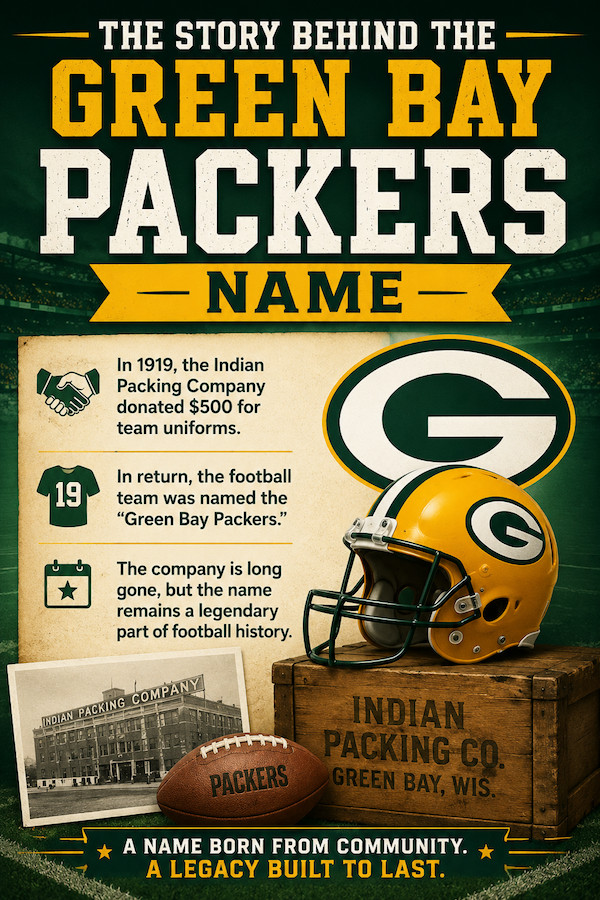
In 1919, Earl “Curly” Lambeau wanted to organize a football team in Green Bay. There was one problem. He needed money for uniforms.
Lambeau worked for the Indian Packing Company and convinced his employer to sponsor the team with a $500 contribution. In return, the new club would carry the company’s name.
The Green Bay Packers were born. The sponsor itself disappeared years later.
The football team never did.
From Small-Town Club to NFL Royalty
What started as a practical sponsorship became one of the greatest brands in sports.
The name honors the city’s meatpacking industry, which played an important role in Green Bay’s early economy. Unlike many professional teams that eventually abandoned industrial nicknames, the Packers embraced theirs.
Today, it’s impossible to imagine football without Green Bay. The franchise owns more NFL championships than any other team, has produced legends from Don Hutson and Bart Starr to Brett Favre and Aaron Rodgers, and remains the league’s only community-owned franchise.
Then there’s Lambeau Field. Nicknamed the Frozen Tundra, it’s one of the sport’s most sacred venues.
Snow falls. Fans shovel. Cheeseheads cheer. History repeats itself.
In an era when many sports franchises chase flashy branding, the Packers remind us that authenticity never goes out of style.
No focus group could have invented a better story.
Minnesota Vikings
The Story Behind the Name
When Minnesota joined the NFL in 1961, the franchise wanted a nickname that reflected the region’s heritage.
The obvious inspiration came from the state’s large Scandinavian population.
Millions of Minnesotans trace their ancestry to Norway, Sweden, Denmark, Finland, and Iceland.
The Vikings—legendary Norse explorers and seafarers—represented courage, adventure, exploration, and determination.
The name immediately resonated throughout the Upper Midwest.
Honoring Scandinavian Heritage
Contrary to popular belief, the Vikings weren’t simply fearsome warriors.
They were also traders, explorers, shipbuilders, and settlers whose influence stretched across Europe and beyond.
The franchise embraced this rich history through its horned helmet logo, Nordic colors, and distinctive branding.
While historians will quickly point out that actual Vikings probably didn’t wear horned helmets into battle, artistic license has produced one of football’s most recognizable logos.
Besides, the real horns belong in the stands.
Few fan traditions rival hearing tens of thousands of Vikings supporters perform the thunderous SKOL Chant before kickoff.
It’s enough to make even opposing teams wonder whether a longship is about to sail into the stadium.
NFC South – NFL Team Names
Compared to many older divisions, the NFC South features younger franchises and team names largely inspired by regional wildlife and local culture.
Each tells a uniquely Southern story.
Atlanta Falcons
The Story Behind the Name
When Atlanta received an expansion franchise in 1965, team officials held a public naming contest.
Schoolteacher Julia Elliott submitted the winning entry, “Falcons.”
Her explanation impressed the judges.
She described the falcon as proud, courageous, graceful, swift, and fierce—everything a football team should aspire to become.
Built for Speed
Falcons are among the fastest birds on Earth.
The peregrine falcon can dive at speeds exceeding 200 miles per hour.
While NFL receivers don’t quite reach those numbers, Atlanta has certainly featured its share of explosive athletes over the years.
The sleek black, red, and white uniforms reinforce the bird’s aggressive appearance, giving the Falcons one of the league’s cleanest visual identities.
Carolina Panthers
The Story Behind the Name
The Panthers entered the NFL as an expansion franchise in 1995.
Owner Jerry Richardson wanted a nickname that represented both North and South Carolina while projecting strength and elegance.
After evaluating numerous possibilities, the Panthers emerged as the clear favorite.
Although black panthers aren’t technically a separate species—they’re melanistic leopards or jaguars—the name evokes stealth, speed, intelligence, and raw power.
Everything a football franchise hopes to embody.
A Modern Classic
Few expansion teams have established their identity as quickly.
The Panthers’ black, blue, and silver color scheme remains among the NFL’s sharpest uniform combinations.
Within just their second season, Carolina reached the NFC Championship Game, proving expansion franchises didn’t necessarily need years of growing pains.
Sometimes they simply pounce.
New Orleans Saints
The Story Behind the Name
The Saints owe their name to both music and timing.
The franchise officially became the NFL’s newest team on November 1, 1966.
That date carries special significance.
November 1 is All Saints’ Day in the Christian calendar.
The connection inspired the nickname.
It also aligned perfectly with one of New Orleans’ most beloved songs: “When the Saints Go Marching In.”
Already deeply woven into the city’s culture through jazz and local celebrations, the song became the team’s unofficial anthem almost immediately.
More Than a Football Name
Few NFL identities are tied so closely to their community.
Gold, black, fleur-de-lis logos, jazz traditions, and the famous anthem create one of football’s richest cultural identities.
Following Hurricane Katrina, the Saints became a symbol of hope and resilience throughout New Orleans.
Their emotional Super Bowl victory in the 2009 season represented far more than a championship.
It became part of the city’s recovery story.
Sometimes a nickname becomes bigger than sports.
This is one of those times.
Tampa Bay Buccaneers
The Story Behind the Name
Pirates have long been part of Florida’s Gulf Coast history.
During the 17th and 18th centuries, buccaneers sailed the Caribbean and Gulf of Mexico seeking fortune—and occasionally someone else’s treasure.
When Tampa received an expansion team in 1976, the Buccaneers became the natural choice.
The city already celebrated pirate history through the annual Gasparilla Festival, named after the legendary pirate José Gaspar.
Sailing Into NFL History
The original “Bucco Bruce” logo eventually gave way to the modern skull-and-crossbones flag that flies today.
The pirate ship inside Raymond James Stadium further reinforces the team’s adventurous identity.
The Buccaneers have experienced dramatic highs and lows throughout their history, but one thing has remained constant.
No touchdown celebration is complete without firing the cannons.
It’s one of the few places where making loud explosions is considered excellent customer service.
NFC West – NFL Team Names
The NFC West is proof that NFL team names don’t always stay rooted in the city where they originated.
Four franchises have relocated multiple times, yet each has managed to preserve an identity that remains instantly recognizable. Their names connect fans to history, geography, and the adventurous spirit of the American West.
Arizona Cardinals
The Story Behind the Name
The Cardinals hold a unique distinction in NFL history.
Not only are they one of the league’s oldest franchises, but their nickname wasn’t inspired by a bird at all.
The story begins in Chicago in 1898, when founder Chris O’Brien purchased a set of used football jerseys from the University of Chicago.
The faded maroon uniforms had seen better days.
Rather than calling them faded red or worn crimson, O’Brien famously described the color as “cardinal red.”
That simple observation inspired the team’s first nickname: the Cardinals.
Only later did fans begin associating the team with the bright red songbird.
A Name That Traveled Across America
Few franchises have moved as often as the Cardinals.
The team began as the Morgan Athletic Club in Chicago before becoming the Chicago Cardinals. In 1960, the franchise relocated to St. Louis, where it remained for nearly three decades before moving to Arizona in 1988.
Despite changing cities twice, the Cardinals’ name never changed.
It didn’t need to.
By then, the nickname had developed a life of its own.
Today’s logo proudly features the fierce-looking cardinal bird, one of the NFL’s sharpest and most recognizable designs.
Ironically, a nickname born from an old set of faded uniforms eventually became one of professional sports’ brightest brands.
Sometimes history has an excellent sense of humor.
Los Angeles Rams
The Story Behind the Name
The Rams are another franchise whose nickname predates its current home by many decades.
The team was founded in Cleveland in 1936 by attorney Homer Marshman.
A former college football player, Marshman had attended Fordham University, where the athletic teams were known as the Rams.
He admired the nickname and decided it would suit his new professional football team.
The name quickly stuck.
One Name, Four Cities
The Rams have led one of the NFL’s most well-traveled lives.
They’ve called Cleveland, Los Angeles, St. Louis, and once again Los Angeles home.
Through every move, one constant remained.
The ram. The animal symbolizes determination, agility, confidence, and the willingness to charge headfirst into seemingly impossible challenges.
Anyone who has watched two bighorn rams collide on a mountainside understands why the nickname works so well for football.
It’s basically nature’s version of Oklahoma drills.
Horns That Became an Icon
The Rams also changed the aesthetics of football forever.
In 1948, running back Fred Gehrke, who was an accomplished artist, hand-painted horns on the team’s helmets. The design became the NFL’s first permanent helmet logo.
Today, virtually every professional football helmet traces its visual lineage back to that simple but revolutionary idea. The Rams didn’t just pick a memorable nickname.
They helped redefine football branding itself.
San Francisco 49ers
The Story Behind the Name
Few NFL nicknames are as deeply rooted in American history as the 49ers.
The franchise was established in 1946 as part of the All-America Football Conference.
Rather than selecting an animal or intimidating warrior, ownership looked to California’s defining historical event: the Gold Rush.
In 1849, hundreds of thousands of hopeful prospectors flooded California searching for gold.
Those fortune seekers became known simply as the Forty-Niners.
The nickname honored the pioneers whose determination helped transform California into one of America’s fastest-growing states.
More Than Gold
The beauty of the 49ers nickname is that it celebrates far more than precious metal.
It represents ambition.
Optimism.
Risk-taking.
Adventure.
The people who traveled thousands of miles hoping to strike it rich rarely had guarantees.
What they possessed was belief.
That spirit has long defined the football franchise as well.
From Joe Montana and Jerry Rice to Steve Young and modern-day stars, the 49ers have built one of the NFL’s richest winning traditions.
Five Super Bowl championships and decades of excellence have polished the name every bit as effectively as those prospectors once polished nuggets pulled from California rivers.
One of Sports’ Most Distinctive Identities
Unlike many professional teams, the 49ers don’t rely on an animal mascot to establish personality.
Instead, they embrace history.
Their classic red-and-gold uniforms evoke the Gold Rush era, while “Sourdough Sam,” the team’s cheerful prospector mascot, reminds fans of the adventurous pioneers who inspired the franchise.
It’s difficult to imagine another nickname fitting San Francisco so perfectly.
After all, without the Gold Rush, California—and perhaps professional football on the West Coast—might look very different today.
Seattle Seahawks
The Story Behind the Name
When Seattle was awarded an expansion franchise in 1976, team officials launched a public contest to find the perfect nickname.
More than 20,000 entries arrived from fans across the Pacific Northwest. Several names received consideration, including Lumberjacks and Mariners.
Ultimately, the Seahawks emerged as the winner.
Unlike many sports mascots, the seahawk isn’t a single scientific species. Instead, the name refers to a large coastal bird of prey commonly associated with ospreys and other powerful fishing hawks native to the Pacific Northwest.
The nickname reflected the region’s close relationship with forests, mountains, rivers, and the Pacific Ocean.
A Perfect Fit for the Pacific Northwest
Everything about the Seahawks feels local.
The blue and green color scheme mirrors the area’s evergreen forests and surrounding waters.
The original logo was inspired by Indigenous Northwest Coast art, creating one of the NFL’s most distinctive visual identities.
The franchise has worked over the years to honor the artistic traditions that influenced its branding while celebrating the unique culture of the Pacific Northwest.
Flying Into Football History
For many years, Seattle struggled to establish itself among the NFL’s elite.
That changed dramatically during the Pete Carroll era. Behind the famed “Legion of Boom” defense, the Seahawks captured their first Super Bowl championship and turned Lumen Field into one of football’s loudest stadiums.
Appropriately enough, visiting offenses often found themselves unable to hear the snap count. The home-field advantage wasn’t just intimidating.
It was deafening.
Fun Facts About NFL Team Names
Here are a few conversation starters for your next football watch party.
- The Packers are the NFL’s only community-owned franchise.
- The Cardinals are the league’s oldest continuously operating franchise.
- The Browns are the only NFL team named after a person.
- Baseball’s Cubs inspired the Bears.
- The Raiders were almost called the Señors.
- The Chiefs originally played in Dallas as the Texans.
- The Titans reached the Super Bowl during their very first season with their new name.
- The Rams introduced the NFL’s first permanent helmet logo in 1948.
- The Jets embraced America’s fascination with the Jet Age during the 1960s.
- The Dolphins were selected through a fan contest that drew nearly 20,000 entries.
As football trivia goes, those are considerably more useful than memorizing every backup long snapper since 1978.
FAQs: NFL Team Names
Here are some frequently asked questions about NFL teams’ names.
Which NFL team has the oldest nickname?
The Arizona Cardinals trace their nickname back to 1898, making it the oldest continuously used team name in the NFL.
Which NFL team is named after a real person?
The Cleveland Browns are named in honor of legendary coach and football innovator Paul Brown.
Why are the Green Bay Packers called the Packers?
The team received its name in 1919 after the Indian Packing Company contributed $500 toward the purchase of uniforms. The sponsorship lasted only a short time, but the nickname became permanent.
Which NFL team changed its name most recently?
The Washington Commanders adopted their current name in 2022 after competing as the Washington Football Team for two seasons.
Which NFL name has changed the most?
The franchise now known as the Arizona Cardinals has undergone several geographic changes—from the Morgan Athletic Club to the Chicago Cardinals, St. Louis Cardinals, Phoenix Cardinals, and finally Arizona Cardinals—while retaining its famous nickname.
Final Whistle
One of the NFL’s greatest strengths is that no two franchises feel exactly alike. Each team has developed a distinct personality rooted in the place it calls home—or once called home.
Some names were born from fan contests. Others emerged from history books, local businesses, mythology, literature, or even faded football jerseys. Yet everyone has become part of the league’s rich tapestry.
The next time you settle in for a Sunday afternoon game, take a moment to appreciate what’s painted across each helmet. Those aren’t just logos. They’re living pieces of American history.
And while championships may come and go, these remarkable names continue to connect the NFL’s past, present, and future—one kickoff at a time.

By Mike O’Halloran
Founder and Editor, Sports Feel Good Stories
Mike O’Halloran founded Sports Feel Good Stories in 2009. He has authored three books on sports jokes, co-authored four trivia books, and authored three books on basketball coaching. Mike has also written a book on sports slogans and captions. He coached youth basketball for 15 seasons, taught tennis, and was a contributing writer for USA Football, the youth arm of the NFL.
Mike is the publisher of the Well-Prepared Coach line of coaches’ practice plans and editable award certificates. He is the founder of the Fantasy Football Team Names Hall of Fame. Mike is married with four children.
You are on our NFL Team Names – The History of all 32 Football Franchises feature.
You might also like:
