
The FIFA World Cup is more than just a soccer tournament—it is the largest and most widely watched sporting event in the world. Every four years, billions of fans tune in to watch national teams compete for a title that carries unmatched global prestige.
But while the excitement is universal, the structure of the tournament is often misunderstood. How do teams qualify? Why are groups drawn the way they are? How does a 32- or 48-team tournament fairly produce a single champion?
This guide breaks everything down in detail, from the earliest qualification matches to the final whistle of the championship game.
- What Is the FIFA World Cup?
- How Teams Qualify for the World Cup
- How the World Cup Group Stage Works
- How the Knockout Stage Works
- World Cup Schedule Structure
- The World Cup Draw Ceremony
- Key Rules That Affect Matches
- Special Scenarios in the World Cup
- Men’s vs Women’s World Cup Structure
- World Cup Strategy: How Teams Approach the Tournament
- Why the World Cup Is Harder Than Club Football
- Common Misunderstandings About the World Cup Format
- How the World Cup Trophy and Awards Work
- FAQ – How the World Cup Works
- World Cup Records, History, and Fun Facts
- How VAR Has Changed the World Cup
- World Cup Expansion and Why It Matters
- Why the World Cup Is So Popular Worldwide
- Summary: How the World Cup Works in Simple Terms
What Is the FIFA World Cup?
The FIFA World Cup is an international soccer tournament organized by FIFA (Fédération Internationale de Football Association), the governing body of world soccer.
It brings together national teams from around the globe to compete for the title of world champion. Unlike club competitions, where players represent professional teams, the World Cup is based entirely on national identity.
Key characteristics include:
- Held every four years
- Features national teams, not club teams
- Includes qualification across all continents
- Culminates in a single championship match
- Is the most widely viewed sporting event in the world
The World Cup is structured to balance two major goals:
- Global representation (every region gets a chance)
- Competitive fairness (strongest teams advance)
The tournament unfolds in three major phases:
- Qualification
- Group Stage
- Knockout Stage
Each phase serves a specific purpose in narrowing down teams from more than 200 eligible nations to a single champion.
Discover our funny Soccer Jokes feature.
How Teams Qualify for the World Cup
Qualification is arguably the most complex part of the entire World Cup system. It takes place over multiple years and involves hundreds of matches across six continents.
Unlike invitational tournaments, no team is guaranteed a place (except the host nation, which qualifies automatically).
The Six FIFA Confederations
FIFA divides global soccer into six regional governing bodies:
UEFA (Europe)
Europe has the most competitive qualification system, with traditional powerhouses like Germany, France, England, Italy, and Spain.
- Typically offers the largest number of qualification spots
- Uses group-based qualification formats
- Extremely competitive due to depth of strong teams
CONMEBOL (South America)
This region includes soccer giants such as Brazil and Argentina.
- Uses a single round-robin league format
- Every team plays home and away matches
- No easy matches due to strong regional parity
CONCACAF (North America, Central America, Caribbean)
Includes the United States, Mexico, and Canada.
- Multi-round qualification system
- Includes group stages and final rounds
- Expanding competitiveness due to rising regional talent
CAF (Africa)
Africa’s qualification is highly competitive and unpredictable.
- Multiple knockout and group phases
- Wide geographic diversity
- Many emerging soccer nations
AFC (Asia)
Asia includes many nations with varying skill levels.
- Several qualification rounds
- Group-based progression system
- Increasing global competitiveness
OFC (Oceania)
The smallest confederation.
- Often receives limited direct qualification spots
- Frequently enters intercontinental playoffs
Discover the Stars of the 2026 World Cup.
How Qualification Works Step by Step
While each region uses a different format, the general process looks like this:
Step 1: Preliminary Rounds
Lower-ranked teams compete first to reduce the field.
Step 2: Group or League Stage
Teams are divided into groups or placed into a league format where they play multiple matches.
Step 3: Final Qualification Round
Top teams enter final rounds where direct World Cup spots are awarded.
Step 4: Intercontinental Playoffs
Remaining spots are decided by cross-continent matches.
For example:
- A team from Asia might play a team from South America for a final berth.
This system ensures both global representation and competitive balance.
Expansion to 48 Teams (2026 and Beyond)
Starting with the 2026 World Cup, the tournament expands from 32 to 48 teams.
This is one of the most significant structural changes in World Cup history.
What changes with 48 teams:
- More qualification spots per continent
- More total matches played
- More debut appearances from smaller nations
- A modified group stage structure
This expansion increases inclusivity but also requires careful restructuring of the group and knockout phases to maintain competitive balance.
How the World Cup Group Stage Works
Once qualification is complete, the tournament begins with the group stage—the first major phase of the finals.
The Group Draw Explained
The group stage begins with a draw ceremony that determines group placement.
How the draw works:
- Teams are placed into seeded pots based on FIFA rankings
- Each group receives one team from each pot
- Geographic restrictions prevent certain matchups
- The host nation is assigned a predetermined group position
This ensures:
- Balanced groups
- Geographic diversityreco
- Fair competition distribution
However, randomness still plays a major role, which is why some groups become significantly harder than others.
Explore our Soccer Field Dimensions (With Diagram) feature.
What Is a “Group”?
A group is a mini-tournament of 3–4 teams.
Each team:
- Plays every other team once
- Earns points based on results
- Is ranked within the group
This structure ensures each team has multiple chances before elimination.
Round-Robin Format Explained
In the group stage:
- Each team plays 3 matches (in a 4-team group)
- Matches are spaced over about 10 days
- Teams earn points per match result
This format reduces randomness compared to single-elimination systems.
A single loss does not eliminate a team, which allows stronger teams to recover from early setbacks.
How Group Stage Scoring Works
Points determine group rankings:
- Win = 3 points
- Draw = 1 point
- Loss = 0 points
At the end of group play, teams are ranked from first to last.
Group Stage Tie-Breakers – How the World Cup Works
If teams finish level on points, FIFA applies tie-breakers in a strict order:
1. Goal Difference
Goals scored minus goals conceded.
2. Goals Scored
Total number of goals a team has scored.
3. Head-to-Head Record
Results between tied teams.
4. Fair Play Points
Disciplinary record:
- Yellow cards = penalty points
- Red cards = heavier penalty
5. Drawing of Lots
A random draw, used only if all other criteria fail.
This system ensures fairness while rewarding attacking play and discipline.
Who Advances From the Group Stage?
Traditionally:
- Top two teams from each group advance
With the expanded 48-team format:
- Additional third-place teams may advance
- A “best third-place” ranking system may be used
This expansion increases knockout participation while maintaining competitive balance.
World Cup Group of Death Explained (With Examples)
The phrase “Group of Death” is one that many casual fans raise during any World Cup draw. It refers to a group that contains multiple top-ranked or historically strong teams, making it extremely difficult for any one team to advance.
In simple terms, a Group of Death is a group where:
- Several strong teams are placed together
- At least one high-profile team is likely to be eliminated early
- The margin for error is very small
Because only the top teams advance from the group stage, even a single poor result can dramatically change the outcome.
Why Group of Death Scenarios Happen
Group of Death situations are not intentional—they result from the draw system. Teams are placed into “pots” based on FIFA rankings, and each group receives one team from each pot.
However, imbalances still occur because:
- Some pots contain multiple strong teams close in ranking
- Emerging national teams outperform expectations
- Historical reputation doesn’t always match current form
- Geographic constraints limit certain matchups
As a result, some groups end up stacked with elite competition while others are more balanced.
Famous World Cup Groups of Death
Over the years, several groups have earned this label due to their extreme difficulty.
2014 World Cup – Group D
- Uruguay
- Italy
- England
- Costa Rica
This group shocked the soccer world when Costa Rica advanced ahead of Italy and England, proving that rankings do not always predict outcomes.
2002 World Cup – Group F
- Argentina
- England
- Sweden
- Nigeria
A group featuring multiple world-class teams, with Argentina surprisingly eliminated early.
2018 World Cup – Group B
- Spain
- Portugal
- Morocco
- Iran
Two European powerhouses, Spain and Portugal, battled tightly, while Morocco and Iran played spoiler roles.
Why Fans Care So Much About Group of Death Matchups
Search interest spikes around the draw because fans immediately begin analyzing:
- “Who has the hardest World Cup group?”
- “Which group is the group of death?”
- “Which top team might get eliminated early?”
The drama comes from the possibility that a championship contender could be eliminated before the knockout stage even begins.
Browse our notable Soccer Quotes to gain insights on the game.
How the Knockout Stage Works
The knockout stage is where the tournament becomes high-stakes and unforgiving.
Every match is:
- Single elimination
- Winner advances
- The loser is eliminated
There are no second chances.
Knockout Bracket Structure – How the World Cup Works
Teams are placed into a predetermined bracket based on:
- Group finishing position
- Tournament rules for match pairing
- Geographic separation rules (in some editions)
This bracket determines the entire path to the final.
Extra Time and Penalty Shootouts – How the World Cup Works
If a knockout match is tied after 90 minutes:
Extra Time:
- Two 15-minute halves are played
Penalty Shootout:
- If still tied, teams take alternating penalty kicks
- First to gain an uncatchable lead wins
Penalty shootouts are among the most dramatic moments in sports history.
Knockout Rounds Breakdown – How the World Cup Works
Typical structure:
- Round of 32 (in expanded format)
- Round of 16
- Quarterfinals
- Semifinals
- Final
Each round halves the number of teams until only two remain.
You might get a kick out of these Top 10 Ted Lasso Moments.
World Cup Schedule Structure
The tournament typically lasts about 5–6 weeks.
Group Stage
- High match frequency
- Multiple games per day
- Rapid standings changes
Knockout Stage – How the World Cup Works
- Fewer matches
- More rest time
- Higher intensity
Final Match
The most watched single sporting event in the world.
The World Cup Draw Ceremony
The draw is one of the most important pre-tournament events.
Step-by-step:
- Teams sorted into pots
- Balls representing teams placed into bowls
- Random selection assigns groups
- Host nation placement confirmed
This process is broadcast globally and often shapes tournament expectations.
Why the Draw Matters So Much – How the World Cup Works
The draw can determine:
- Difficulty of group stage
- Path through knockout rounds
- Potential early elimination of strong teams
Some groups become “groups of death,” where multiple top teams are drawn together.
What Happens After Qualification?
Once a team qualifies, preparation begins immediately.
Squad Selection
Coaches select a final roster, balancing:
- Experience
- Form
- Tactical needs
- Injuries
Training Camps
Teams prepare through:
- Tactical drills
- Conditioning programs
- Team chemistry building
Friendly Matches
Exhibition games help teams prepare for competition conditions.
Learn more about Soccer Positions: Roles and Responsibilities.
Key Rules That Affect Matches
Substitutions
Modern rules allow:
- Up to 5 substitutions per match
- Additional substitutions in extra time (in many formats)
Cards and Suspensions
- Yellow cards accumulate
- Red cards result in immediate suspension
- Some resets occur after the group stage
VAR (Video Assistant Referee)
Used to review:
- Goals
- Penalties
- Red card decisions
- Mistaken identity
VAR ensures higher accuracy in key decisions.
Special Scenarios in the World Cup
Multi-Team Ties
When more than two teams are tied, head-to-head mini-league comparisons are used.
Fair Play Rankings
Discipline becomes a deciding factor when performance metrics are equal.
Drawing of Lots
Used only when all other criteria fail—a rare but official rule.
Men’s vs Women’s World Cup Structure
Both tournaments share the same core format:
- Group stage
- Knockout rounds
- Four-year cycle
Differences include:
- Number of participating teams
- Stage of global competitive development
- Growth trajectory (women’s tournament expanding rapidly)
World Cup Strategy: How Teams Approach the Tournament
While the World Cup appears simple on the surface—win matches and advance—the strategy behind how teams approach the tournament is highly complex. Coaches must balance risk, stamina, and tactical discipline across multiple matches in a short period.
Group Stage Strategy: Play Smart, Not Just Aggressive
Unlike league play, the World Cup group stage rewards consistency more than dominance.
Teams often adjust their approach based on:
- Strength of opponents
- Goal difference importance
- Injury risk
- Scheduling of matches
In many cases, teams do not need to win all three matches. Two strong results can be enough to advance, which changes how aggressively teams play.
Some common strategies include:
- Playing defensively against stronger opponents
- Targeting must-win matches against weaker teams
- Managing energy across three games instead of one
The Importance of Squad Rotation
Because matches are played every few days, player fatigue becomes a major factor. Successful teams often rely on deep squads.
Coaches rotate players to:
- Prevent injuries
- Maintain intensity
- Adapt tactics based on opponents
This is especially important in the group stage, where a fully rested squad can make the difference in tight matches.
Knockout Stage Strategy: Win or Go Home
Once teams reach the knockout stage, strategy shifts dramatically.
There are no draws or second chances, so teams often:
- Play more conservatively early in matches
- Focus on defensive structure first
- Look for counterattack opportunities
- Prepare specifically for penalty shootouts
Some teams even train specifically for penalties, knowing that many knockout matches are decided from the spot.
Tactical Flexibility Is Key
Modern World Cup winners are rarely one-dimensional. Successful teams can switch between:
- High-press attacking systems
- Defensive counterattacks
- Possession-based control
- Set-piece-focused strategies
The ability to adapt during a tournament is often what separates champions from early exits.
Learn What is Offside in Soccer?
Why the World Cup Is Harder Than Club Football
Many fans wonder why World Cup performance is often so unpredictable compared to club competitions like the UEFA Champions League. The answer lies in structure, time, and team composition.
Limited Preparation Time
Club teams train together year-round, building chemistry over months or even years. National teams, however, often have only a few weeks to prepare before the tournament begins.
This creates challenges such as:
- Limited tactical training time
- Less familiarity between players
- Faster need for team cohesion
Even world-class players must quickly adjust to teammates they rarely play with.
Short Tournament Pressure
The World Cup is a compressed tournament. A team can go from group stage success to elimination in just one bad match.
Unlike club leagues:
- There is no long season to recover from mistakes
- Every match carries significant weight
- Momentum shifts quickly and dramatically
This pressure creates a high level of unpredictability.
National Teams vs Club Chemistry
Club teams benefit from:
- Daily training sessions
- Consistent tactical systems
- Stable rosters over time
National teams do not have these advantages. Even elite squads must build chemistry quickly.
This is why some of the most talented national teams do not always win the World Cup.
Travel, Environment, and Conditions
World Cups are hosted in different countries, meaning teams must adapt to:
- Weather differences (heat, humidity, altitude)
- Travel between venues
- Time zone adjustments
- Local playing conditions
These factors can level the playing field between stronger and weaker teams.
Psychological Pressure of National Representation
Playing for a country carries a different emotional weight than playing for a club.
Players often describe:
- Increased pressure from national expectations
- Higher emotional stakes
- Intense media attention
- Long-lasting national consequences of results
This emotional factor is one reason upsets happen so frequently.
Common Misunderstandings About the World Cup Format
Despite being one of the most-watched sporting events in the world, the World Cup format is often misunderstood. Many fans assume it works like a simple elimination bracket from the start, but the structure is more complex.
Myth 1: One Loss Means Elimination
In the group stage, a team is not eliminated after a single loss. Each team plays three matches, and advancement is based on total points.
This means:
- A team can lose one match and still advance
- Consistency matters more than one result
- Final standings depend on all group results combined
Myth 2: The Best Teams Always Advance
While stronger teams are favored, upsets are common. A weaker team can advance by:
- Winning key matches
- Drawing against stronger opponents
- Building a strong goal difference
This unpredictability is part of what makes the tournament so popular.
Myth 3: Goal Difference Doesn’t Matter Much
Goal difference is actually one of the most important tie-breakers. Teams often try to score additional goals late in matches to improve their ranking in case of ties.
This can influence:
- Whether a team advances
- Whether they finish first or second in the group
- Their matchup in the knockout stage
Myth 4: Draws Are Rarely Important
Draws play a major role in the World Cup group stage. A single draw can:
- Secure qualification
- Eliminate a team
- Change group rankings dramatically
Every point matters, even in matches that seem evenly balanced.
Myth 5: The Tournament Is Pure Knockout From the Beginning
The World Cup only becomes single-elimination after the group stage. Before that, teams have multiple chances to earn points and recover from early setbacks.
Why These Misunderstandings Matter
Understanding these rules helps fans better appreciate:
- Why teams sometimes “play for a draw”
- Why goal difference becomes critical late in group play
- Why early matches can decide knockout paths
These details also help explain why the World Cup is both unpredictable and strategically deep.
How the World Cup Trophy and Awards Work
The FIFA World Cup is not only about winning matches—it’s also about earning some of the most prestigious individual and team awards in global sport. From lifting the iconic trophy to winning top scorer honors, these awards recognize both team success and individual brilliance on the world stage.
The FIFA World Cup Trophy (History and Rules)
The FIFA World Cup Trophy is the ultimate prize in international soccer, awarded to the winning national team at the end of the tournament.
The current trophy was introduced in 1974 after the original “Jules Rimet Trophy” was permanently awarded to Brazil in 1970 after their third World Cup win.
Key facts about the modern trophy:
- Made of 18-carat gold
- Weighs approximately 6.1 kg (13.4 lbs)
- Depicts two human figures holding up the Earth
- Designed by Italian artist Silvio Gazzaniga
Only winning nations receive the trophy during celebrations. However, the original is not permanently kept by teams. Instead:
- The winning country receives a temporary version for celebrations
- FIFA retains the official trophy for security and preservation
- Winners are later given a gold-plated replica
A key rule: no country permanently keeps the modern trophy, unlike the original Jules Rimet design.
FIFA World Cup Gold Medal Distribution
Beyond the trophy, FIFA awards medals to players and team staff.
- Gold medals → Winning team (players + coaches)
- Silver medals → Runner-up team
- Bronze medals → Third-place team (if the match is played)
Medals are presented during the official trophy ceremony immediately after the final match. Every registered squad member typically receives a medal, not just starting players, recognizing the team’s effort throughout the tournament.
Golden Boot (Top Scorer Award)
The Golden Boot is awarded to the player who scores the most goals during the World Cup.
If players are tied on goals, FIFA uses tie-breakers in this order:
- Number of assists
- Minutes played (fewer minutes = higher ranking)
- Overall tournament impact (rare cases)
This award is one of the most closely followed because it highlights individual attacking brilliance.
Historically, Golden Boot winners often become global stars, as the award signals elite finishing ability on the biggest stage in soccer.
Golden Ball (Best Player Award)
The Golden Ball is awarded to the best overall player in the tournament.
Unlike the Golden Boot, this award is not based purely on statistics. Instead, it is determined by:
- FIFA technical committee evaluations
- Media and expert voting panels
- Overall influence on matches
The Golden Ball winner is typically:
- A player from the winning or finalist team
- Someone who consistently performs across all stages
- A player who impacts both goals and overall gameplay
There are also:
- Silver Ball (second-best player)
- Bronze Ball (third-best player)
Golden Glove (Best Goalkeeper Award)
The Golden Glove is awarded to the best goalkeeper of the tournament.
Criteria include:
- Clean sheets (games without conceding goals)
- Crucial saves in knockout matches
- Consistency throughout the tournament
- Penalty shootout performance
Goalkeepers often play a decisive role in knockout stages, where matches are frequently decided by narrow margins or penalty shootouts.
Like other awards, this is selected by FIFA’s technical study group rather than purely statistical totals.
FIFA Fair Play Award
The Fair Play Award recognizes the team with the best disciplinary record throughout the tournament.
Points are awarded based on:
- Yellow cards
- Red cards
- Overall sportsmanship
- Respect toward referees and opponents
Teams with fewer fouls and better behavior receive higher rankings.
This award highlights FIFA’s emphasis on sportsmanship and respect, not just winning matches.
Why These Awards Matter
These awards are more than just ceremonial—they help shape football history.
They:
- Highlight individual excellence on a global stage
- Create legacy moments for players
- Influence Ballon d’Or and other global honors
- Become part of long-term football records
For fans searching “World Cup trophy rules” or “Golden Boot winners,” these awards represent some of the most memorable and emotionally significant aspects of the tournament.
FAQ – How the World Cup Works
Here are some frequently asked questions about how the World Cup works.
How many matches does a team play in the World Cup?
- Minimum: 3 (group stage only)
- Maximum: 7 (if reaching the final)
Why is the World Cup every four years?
To allow:
- Qualification cycles
- Player development
- Global scheduling balance
Can teams host the World Cup and play automatically?
Yes, the host nation qualifies automatically.
What is the hardest part of the World Cup?
Many analysts say:
- The qualification phase is the hardest overall due to its length and competitiveness.
World Cup Records, History, and Fun Facts
One of the most powerful ways to increase organic traffic for a World Cup explainer article is to include historical context, records, and “fun fact” style information. These topics generate massive search volume because fans frequently look up stats during and between tournaments.
This section also helps your article rank for related searches like:
- “World Cup records”
- “most World Cup goals”
- “World Cup winners list”
- “World Cup history facts”
- “first World Cup winner”
- “biggest World Cup wins”
The History of the FIFA World Cup
The first FIFA World Cup took place in 1930 in Uruguay. Only 13 teams participated, and the tournament was far smaller and less global than today’s version.
Key early milestones:
- 1930: First World Cup hosted and won by Uruguay
- 1950: World Cup returns after World War II hiatus
- 1970: Brazil wins its third title, establishing global dominance
- 1998: Tournament expands to 32 teams
- 2026: Expansion to 48 teams
Over time, the World Cup has evolved from a regional competition into a truly global sporting event, with nearly every country qualifying.
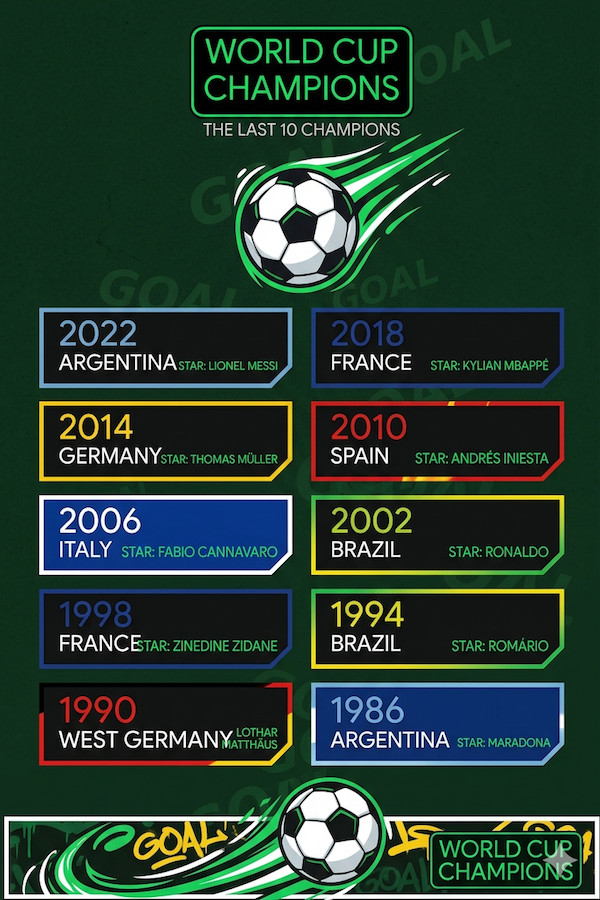
Most Successful World Cup Teams
Certain nations have historically dominated the tournament. These teams are often searched by fans looking for “World Cup winners list” or “most successful World Cup teams.”
Top World Cup Winners:
- Brazil – 5 titles (most in history)
- Germany – 4 titles
- Italy – 4 titles
- Argentina – 3 titles
- France – 2 titles
- Uruguay – 2 titles
- England – 1 title
- Spain – 1 title
Brazil is particularly notable for being the only nation to have qualified for every World Cup since its inception.
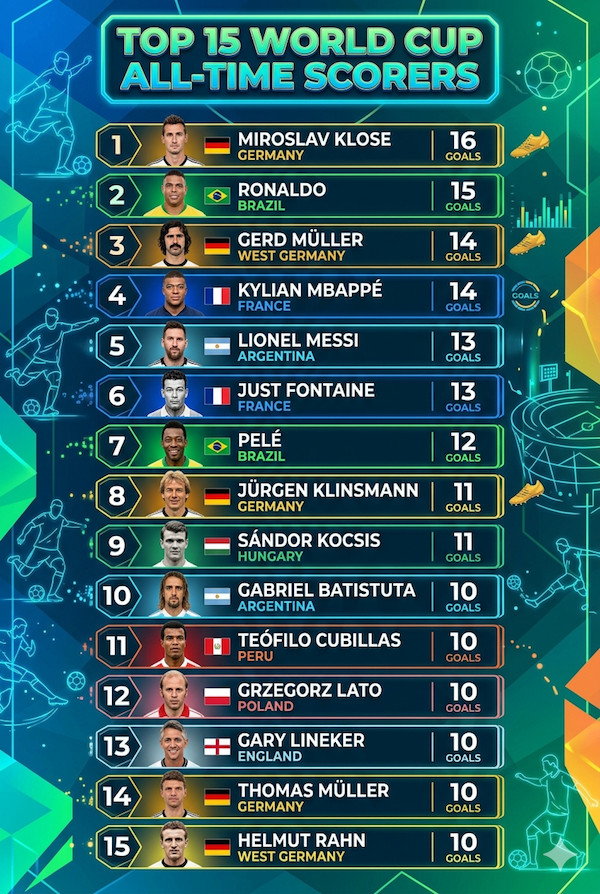
World Cup Scoring Records
Fans frequently search for individual records, especially “most World Cup goals” and “top scorers in World Cup history.”
All-Time Top Scorers (Prior to 2026 World Cup):
- Miroslav Klose (Germany) – 16 goals
- Ronaldo (Brazil) – 15 goals
- Gerd Müller (Germany) – 14 goals
- Lionel Messi (Argentina) – 13+ goals (ongoing legacy)
- Just Fontaine (France) – 13 goals in a single tournament (1958 record)
Just Fontaine’s record of 13 goals in a single World Cup remains one of the most impressive achievements in sports history, especially since it came in only six matches.
Biggest Wins and Memorable Matches
The World Cup is also famous for unexpected blowouts and legendary matches.
Largest Margin of Victory:
- Hungary 10–1 El Salvador (1982)
Other memorable high-scoring matches:
- Germany 7–1 Brazil (2014 semifinal)
- France 4–2 Croatia (2018 final)
- Argentina 3–3 France (2022 final before penalty shootout)
The 2014 Germany vs Brazil semifinal is especially notable because it occurred in Brazil and is widely regarded as one of the most shocking results in World Cup history.
World Cup Host Nations and Home Advantage
Hosting the World Cup is considered a major advantage in international soccer. Historically, several host nations have performed extremely well.
Notable Host Performances:
- Uruguay (1930) – Won the first World Cup as hosts
- England (1966) – Won their only title at home
- Germany (1974 West Germany era context varies by tournament history)
- France (1998) – Won first title at home
- Brazil (1950) – Reached final but lost in famous “Maracanazo”
- Qatar (2022) – Group stage exit, showing modern competitiveness
Home advantage typically comes from:
- Familiar climate and stadiums
- Strong crowd support
- Reduced travel fatigue
However, modern tournaments show that home advantage is no longer a guaranteed path to victory.
World Cup Upsets That Changed History
Upsets are one of the most searched and shared aspects of the tournament.
Famous Upsets:
- USA 1–0 England (1950)
- Senegal 1–0 France (2002 opening match)
- South Korea defeating Italy (2002 knockout stage)
- Saudi Arabia defeating Argentina (2022 group stage)
These results are popular because they defy expectations and highlight the unpredictable nature of tournament soccer.
Search interest spikes around phrases like:
- “biggest World Cup upsets”
- “shock results World Cup history”
How VAR Has Changed the World Cup
Video Assistant Referee (VAR) technology has become a major topic in modern World Cup discussions.
VAR is used to review:
- Goals (offsides, fouls in buildup)
- Penalty decisions
- Direct red card incidents
- Mistaken identity cases
While VAR improves accuracy, it has also created controversy due to:
- Delays in decision-making
- Subjective interpretation of fouls
- Emotional disruption of goal celebrations
Search interest for “VAR World Cup controversy” has grown significantly since its introduction in 2018.
World Cup Expansion and Why It Matters
The expansion to 48 teams is one of the most important structural changes in tournament history.
Why FIFA expanded the tournament:
- Increase global participation
- Allow more developing soccer nations to qualify
- Generate more broadcasting revenue
- Expand global fan engagement
What this means for fans:
- More group-stage matches
- More potential debut nations
- More competitive imbalance in early rounds
- Longer tournament duration
Critics argue that expansion may dilute quality in early matches, while supporters believe it strengthens global representation.
Why the World Cup Is So Popular Worldwide
The World Cup’s popularity is driven by several unique factors:
1. National Identity
Fans don’t just support clubs—they support countries.
2. Global Participation
Almost every country in the world participates in qualification.
3. Rarity
The tournament only happens every four years, increasing anticipation.
4. Drama and Knockout Format
Single-elimination matches create high emotional stakes.
5. Universal Accessibility
Even casual fans watch during the tournament, increasing global reach.
This combination makes the World Cup unique among sporting events.
Summary: How the World Cup Works in Simple Terms
At its core, the World Cup follows a clear progression:
- Nations qualify through regional tournaments
- Qualified teams are placed into groups
- Teams compete in round-robin matches
- Top teams advance to a knockout bracket
- A single winner emerges after multiple elimination rounds
It is a system designed to combine global inclusion with elite-level competition, creating one of the world’s most compelling sporting events.

By Mike O’Halloran
Founder and Editor, Sports Feel Good Stories
Mike O’Halloran founded Sports Feel Good Stories in 2009. He has authored three books on sports jokes, co-authored four trivia books, and authored three books on basketball coaching. Mike has also written a book on sports slogans and captions. He coached youth basketball for 15 seasons, taught tennis, and was a contributing writer for USA Football, the youth arm of the NFL.
Mike is the publisher of the Well-Prepared Coach line of coaches’ practice plans and editable award certificates. He is the founder of the Fantasy Football Team Names Hall of Fame. Mike is married with four children.
You are on our How the World Cup Works feature.
You might also like:
