
The celebration outside Madison Square Garden and into the choked arteries of Manhattan went long after midnight. It was a blue-and-orange delirium that transformed Seventh Avenue into a canyon of pure, unadulterated catharsis.
Car horns echoed down toward Times Square, rhythmic and relentless. Fans climbed traffic barriers, hoisted flags, and embraced total strangers on the asphalt as if they were long-lost siblings.
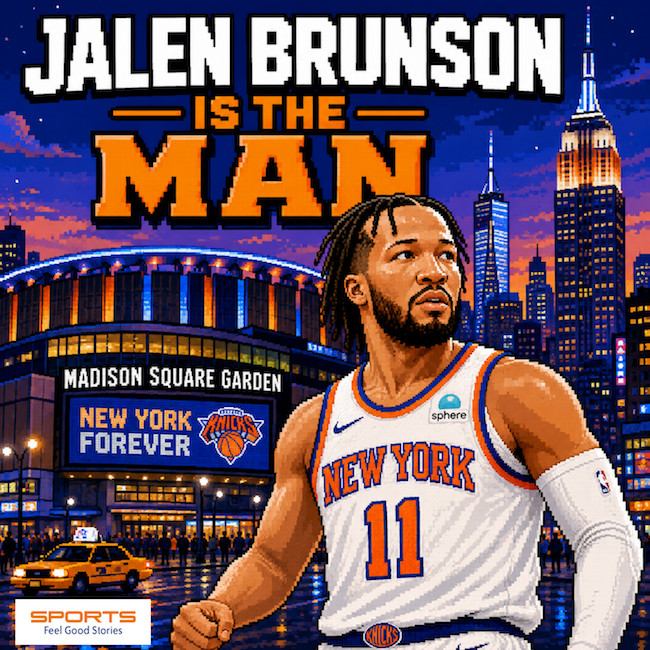
The Knicks celebrated many heroes in their championship run, but there was no question who led them to the title. Jalen Brunson.
The Knicks Long Wait
For 53 years, New York Knicks fans had waited for someone to deliver the franchise’s first NBA championship since 1973.
For more than half a century, generations of stars had arrived at Penn Station carrying enormous expectations like heavy luggage. Some came with Hall of Fame credentials already stamped on their resumes. Some arrived with the backing of massive contracts that choked the team’s salary cap for years. And some arrived with slick public relations campaigns and grand promises.
None of them delivered a parade. The history of modern Knicks basketball had become a tragicomedy of errors, an endless loop of lottery disappointments, front-office dysfunction, and expensive saviors who withered under the merciless glare of the Madison Square Garden ceiling. The city had grown cynical, convinced that the ghosts of Willis Reed, Walt Frazier, and Red Holzman had cursed the franchise to an eternity of beautiful nostalgia and ugly reality.
Then Came Brunson
He was not supposed to be the savior of basketball’s most demanding city. Jalen was not a number-one overall draft pick whose arrival was heralded by a tanking campaign. He was not a once-in-a-generation athletic marvel who could leap over defenders or sprint past them with Olympic speed.
When he entered the league as a second-round pick out of Villanova, scouts openly wondered if his lack of elite size and lateral quickness would prevent him from ever becoming a reliable starting point guard in a league dominated by athletic anomalies.
What he possessed, however, turned out to be exactly what New York had been begging for since the Nixon administration. He was tough with an old-school, black-and-blue resilience that felt native to the city’s concrete streets. He was selfless to a degree that baffled the modern sports establishment. Jalen was relentlessly, obsessively prepared for every single possession of every single game. And perhaps most importantly, he understood an ancient, forgotten truth about team sports: that true greatness requires individual sacrifice.
Discover our inspirational and fun basketball slogans.
The Covenant of Sacrifice
In July 2024, the professional sports business witnessed an unprecedented decision. Jalen Brunson signed a four-year, $156.5 million contract extension with the New York Knicks.
In the hyper-inflated economy of the modern NBA, the move represented a staggering financial sacrifice. Had Brunson chosen to wait until the summer of 2025 to sign a new deal as an unrestricted free agent, he would have been eligible for a five-year maximum contract projected at roughly $269.1 million. By choosing to lock in his long-term future early, he voluntarily left more than $113 million in guaranteed money on the table.
In an era where star players routinely maximize every available dollar of leverage under the salary cap, Brunson’s decision was an anomaly. The move provided the Knicks’ front office with critical, long-term financial flexibility under the league’s stringent new collective bargaining agreement. It allowed the organization to retain core defensive pieces, maintain bench depth, and aggressively build a highly competitive roster around him without immediately triggering crippling luxury tax penalties.
Beyond the spreadsheet, the decision established a powerful cultural foundation inside the organization. When the undisputed franchise cornerstone willingly chooses collective flexibility over maximum personal enrichment, accountability becomes the baseline. The sacrifice resonated deeply with a fan base that had spent decades watching high-priced acquisitions fail to match their paychecks with their production. Brunson devoted his peak athletic years to New York, cementing a unique bond of trust with the city.
Browse our funny basketball quotes.
The Blueprint of Rick and Sandra Brunson
The ironclad discipline defining Brunson’s career is rooted in his upbringing. His father, Rick Brunson, was a journeyman guard who fought through a grueling nine-year NBA career spanning eight different franchises. Rick understood the precarious nature of life on the fringes of professional basketball—the reality of ten-day contracts, sudden cuts, and the constant demand to earn a roster spot through sheer defensive intensity and work ethic.
From an early age, Jalen’s development was governed by an uncompromising development plan. The workouts with his father focused heavily on micro-details rather than flashy highlights. They drilled immaculate footwork, court awareness, and the psychological stamina required to embrace and absorb physical contact in the paint.
This athletic discipline was balanced by his mother, Sandra Brunson. A former standout volleyball player at Temple University, Sandra managed Jalen’s academic commitments and instilled a deep sense of personal accountability. While Rick taught him how to survive the physical and mental rigors of professional basketball, Sandra ensured he maintained a grounded perspective off the court.
The result was a player who entered the league with a remarkably mature approach to the game. When Rick joined the Knicks as an assistant coach under Tom Thibodeau, their professional partnership reached its ultimate stage. On the New York bench, their dynamic remained intensely focused, defined by direct feedback and a shared commitment to tactical precision. This strong family foundation anchored Jalen, keeping his focus entirely on execution amidst the intense media scrutiny of the New York market.
The Villanova Way
Within modern basketball circles, players emerging from Villanova University under coach Jay Wright carry a distinct reputation. The program became synonymous with specific organizational values: high basketball IQ, low turnover rates, lethal mid-range efficiency, and defensive versatility.
Brunson was the absolute pinnacle of that system. During his three years on the Main Line, he anchored two national championship teams in 2016 and 2018, culminating in a sweep of the major National Player of the Year honors, including the Naismith Trophy.
When the Knicks’ front office structured their roster, they deliberately tapped into this collegiate synergy by bringing in Brunson’s former Villanova teammates, Josh Hart and Donte DiVincenzo.
The on-court chemistry between the trio was built on years of shared development. This familiarity translated into an instinctive shorthand on the NBA hardwood. They possessed a precise understanding of each other’s spacing, defensive tendencies, and passing angles, eliminating the traditional adjustment periods required by newly assembled star rosters.
Off the court, their genuine camaraderie—frequently showcased through playful banter on media platforms and podcasts—endeared them to New York fans. Beneath the public humor lay an absolute competitive trust. This “Villanova Way” quickly became the identity of the Knicks’ locker room, establishing a baseline of unselfishness, relentless effort, and collective accountability that influenced the entire roster.
Explore our amusing basketball jokes.
The Craft of the Footwork Architect
Standing 6-foot-2, Brunson does not rely on the explosive vertical leaping ability or overwhelming lateral speed that defines many modern NBA guards. Instead, his dominance is an exercise in elite fundamental execution, spatial geometry, and physical leverage.
Operating heavily in the paint and the mid-post, Brunson utilizes his sturdy frame to shield off lengthier defenders. His game is defined by a masterclass of stop-and-start changes of pace, precise pivots, and highly effective pump fakes that routinely throw shot blockers off balance. Once he creates a calculated window of space, he utilizes an exceptionally soft touch to convert high-arcing floaters and mid-range jumpers.
This style of play requires exhaustive physical conditioning and meticulous mental preparation. Brunson’s routine involves studying defensive rotations and refining foot placement to maximize efficiency. This preparation manifests as an unshakeable composure during high-stakes moments. When opposing defenses throw aggressive blitzes or double-teams his way, Brunson maintains his preferred tempo, forcing the defense to react to his decisions rather than dictating his mistakes.
This approach defines his leadership. He is a stoic, lead-by-example point guard whose steadiness provides structural security for the entire team. By maintaining a highly consistent, calm demeanor through both winning streaks and tough stretches, he sets a reliable standard of professional composure that anchors the entire roster under pressure.
Learn how many teams make the NBA Playoffs.
The Historical Context of Winning
True basketball legacies are cemented when individual brilliance aligns directly with historic productivity on the game’s biggest stages. Throughout his career, Jalen Brunson has consistently elevated his output as the stakes have increased.
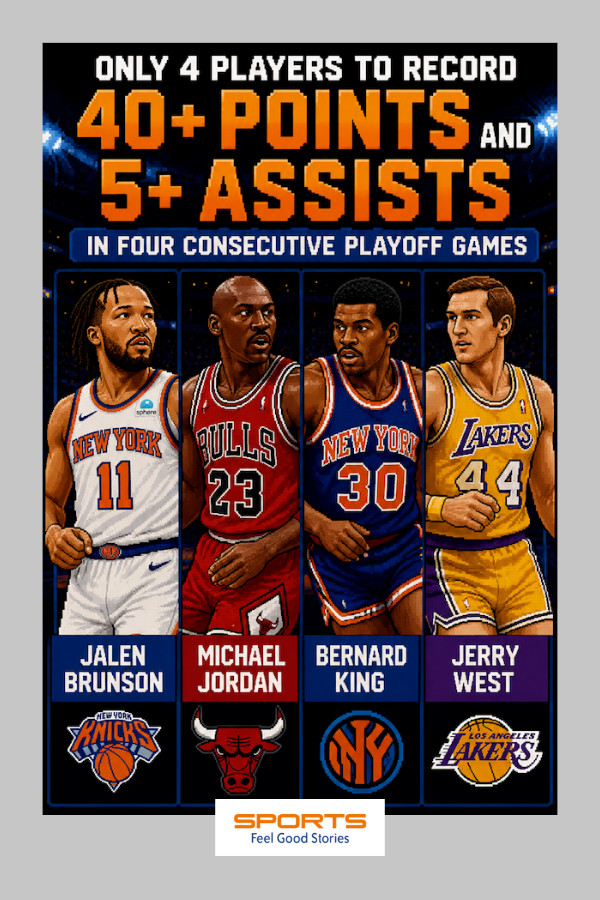
His ability to carry an immense scoring and playmaking burden has drawn historic statistical comparisons. During his remarkable postseason ascent, Brunson achieved elite consistency, recording four consecutive playoff games with at least 40 points and 5 assists.
This elite stretch placed him in an incredibly exclusive historical company alongside only three other players in NBA history to achieve that specific postseason mark: Michael Jordan, Jerry West, and Bernard King.
Furthermore, Brunson’s career trajectory places him in a rare tier of historical winners. He stands as one of the very few players in basketball history to have captured an NCAA National Championship, a Naismith College Player of the Year award, and consistently transition those championship-level habits to the professional stage as an elite, franchise-altering guard.
His historical identity is defined entirely by winning. Across different levels of competition, varying roster structures, and different coaching systems, his presence has consistently elevated teams into legitimate contenders.
The Face of a Franchise
New York sports culture holds a highly discerning standard for its stars. The fan base respects elite talent, but it reserves its deepest admiration for sustained effort, resilience, and authenticity.
Brunson earned this unique status because his approach directly mirrors the competitive traits New Yorkers value most. He plays through physical distress, avoids making excuses, and maintains a distinct humility despite entering the upper echelon of NBA stardom. He does not operate with the detachment of a celebrity; he approaches his craft with the focus of a technician.
This authenticity extends to his teammates, who value his willingness to absorb structural blame during tough stretches while consistently deflecting praise to the collective unit during victories. This complete absence of hypocrisy creates genuine locker room credibility, motivating players to buy into their respective roles.
For decades, the New York Knicks searched for an anchor capable of navigating the immense pressures of the market while establishing a sustainable culture of excellence. In Jalen Brunson, the franchise secured a leader who redefined their identity. Through financial sacrifice, elite tactical execution, a committed family foundation, and an unyielding work ethic, he became the definitive face of a proud basketball city—proving that ultimate organizational success is built one deliberate, disciplined step at a time.
Old School Work Ethic
In the end, the savior did not arrive with a thunderous dunk or a theatrical announcement. He arrived quietly, with a low center of gravity, a brilliant mind, an old-school work ethic, and an unbreakable spirit.
When future generations of basketball fans sit in the blue seats of Madison Square Garden and look up at the championship banner hanging proudly from the iconic, webbed ceiling, they will tell stories about the historic four-game scoring streak. They will talk about the unbelievable contract extension that changed the NBA landscape. They will remember the beautiful, dizzying footwork in the paint and the soft floaters that seemed to hang in the air forever.
But more than anything, they will remember how he made them feel. They will remember that Jalen Brunson brought back something New York had nearly forgotten how to experience: a profound, unshakeable belief.
He was the son who honored his father’s grueling legacy. He was the collegiate brother who brought his fraternity to the grandest stage in the world. Jalen was the champion who brought a sleeping giant back to life. And as the confetti finally settled on the streets of Manhattan, a simple, beautiful truth became written into the eternal history of the city.
Jalen Brunson wasn’t merely the Knicks’ best player.
Jalen Brunson was the man.

By Mike O’Halloran
Founder and Editor, Sports Feel Good Stories
Mike O’Halloran founded Sports Feel Good Stories in 2009. He has authored three books on sports jokes, co-authored four trivia books, and authored three books on basketball coaching. Mike has also written a book on sports slogans and captions. He coached youth basketball for 15 seasons, taught tennis, and was a contributing writer for USA Football, the youth arm of the NFL.
Mike is the publisher of the Well-Prepared Coach line of coaches’ practice plans and editable award certificates. He is the founder of the Fantasy Football Team Names Hall of Fame. Mike is married with four children.
You are on our Jalen Brunson is the Man feature.
You might also like:
